Most service pages lose buyers for one simple reason: they ask for a call before they earn enough trust. A few proof blocks before the CTA can change that. When SMEs show evidence early, they make the decision easier and the enquiry stronger.
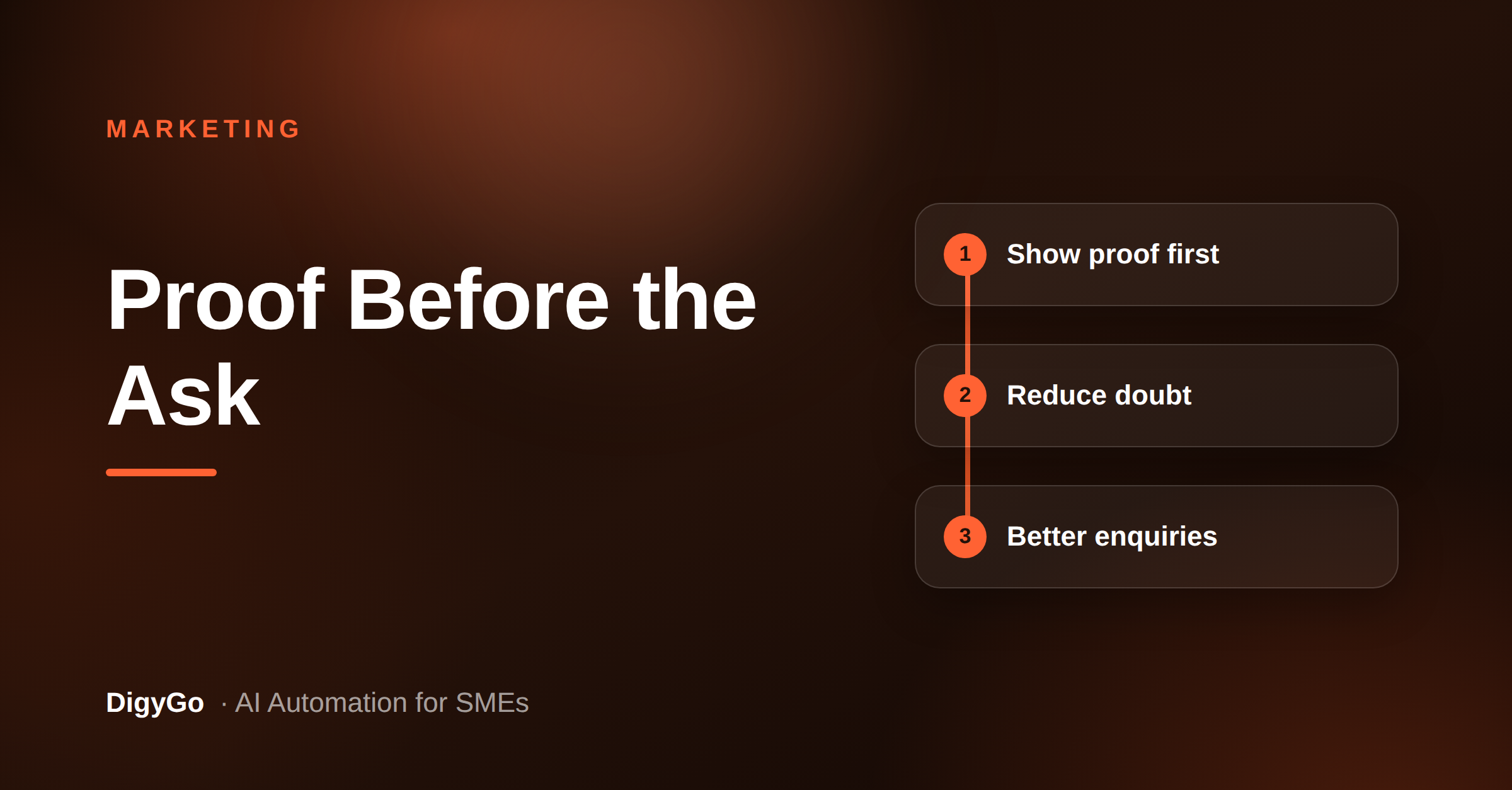
A strong service page earns trust before it asks for a call. Proof blocks help SMEs reduce doubt, improve credibility, and get better-fit enquiries.
If you want more qualified leads, the page should answer a visitor’s silent questions before the book-now button appears: Have you done this before? Do you work with businesses like mine? What results do you usually create?
In this guide
- Why proof blocks lift service-page conversions
- What proof to place before the CTA
- How to keep the page credible without clutter
- A simple service-page structure SMEs can copy
Why proof matters before the CTA
A CTA only works well when the visitor believes the offer is relevant and credible. That belief is not created by a button. It is created by the evidence around it.
For SMEs, that matters because most visitors are cautious. They are not just asking, “Can this business help me?” They are also asking, “Why should I trust them with my time or budget?”
The best proof blocks to use
You do not need a huge case study library to make a service page work. You need the right proof, placed in the right order.
1) Short outcome-led testimonial
One short testimonial that mentions a result is better than three vague compliments. A line like “They made our lead flow clearer and faster” says more than a paragraph of praise.
2) Mini case snapshot
Add a compact snapshot with the problem, the approach, and the outcome. Keep it readable in 30 seconds. Founders do not need a full case study on the service page; they need enough evidence to keep scrolling.
3) Process proof
Many buyers feel safer when they know what happens next. A simple three-step process reduces uncertainty and shows that your delivery is structured, not improvised.
Keep proof close to the CTA
Proof should sit near the decision point. If the CTA is asking for action, the evidence should be one scroll away, not hidden at the bottom.
What to avoid on service pages
Service pages often fail because they try to sound impressive instead of helpful. That creates confusion, not confidence.
- Do not bury the offer under long brand copy.
- Do not list too many services on one page.
- Do not use generic claims with no examples.
- Do not place the CTA before the trust-building content.
- Do not make the page look like a brochure instead of a sales page.
The buyer does not need more decoration. They need a clearer path to a decision.
A simple service page structure
At DigyGo, we prefer service pages that move in one direction: attention, trust, clarity, and action. That rhythm works well for SMEs because it mirrors how people actually buy.
- State the offer clearly — one service, one outcome.
- Explain who it is for — so the right visitors keep reading.
- Show proof early — testimonials, snapshots, or numbers.
- Explain the process — so the buyer knows what happens next.
- Place the CTA after trust — not before it.
When that sequence is in place, the page stops acting like a description and starts acting like a sales conversation.
“A service page should not ask for trust first. It should earn trust in small, clear steps and then make the next action feel obvious.”
— Sivaraj, Founder & CEOFAQ
How much proof is enough on a service page?
Enough to reduce doubt, not enough to overwhelm the visitor. One testimonial, one mini case snapshot, and one process block are often a strong start.
Should proof go above the CTA or below it?
Both, if possible. The strongest pages place a small amount of proof before the CTA and more support below it for people who keep reading.
What if I do not have many case studies yet?
Use process proof, founder credibility, client quotes, and simple before/after explanations. You can build stronger case studies over time.
Bottom line
If your service page is not converting, the problem may not be the CTA. It may be the missing trust layer that should come before the CTA. A few strong proof blocks can make the page clearer, safer, and more persuasive for the right buyer.
That is a small change with a real business effect: better-fit enquiries, fewer cold clicks, and more people ready to talk. Talk to DigyGo about building a service page that earns the click and the call.