Most SMEs collect customer feedback the same way they receive it: passively, in odd moments, with no plan for what happens next. A client mentions something in a WhatsApp message, someone thanks them, and the comment disappears into chat history. The problem is not a lack of feedback. The problem is that it never loops back. A customer feedback loop system changes that: collect comments at fixed moments, resolve them fast, and tell the client what you changed. That one habit turns complaints into retention, referrals, and compounding growth.
Most SMEs collect feedback passively and never act on it, so the same complaints return and clients quietly churn. Learn how a customer feedback loop system turns complaints into retention, referrals, and compounding growth.
- Feedback only compounds into growth when it loops back, meaning the client sees what changed because of their comment
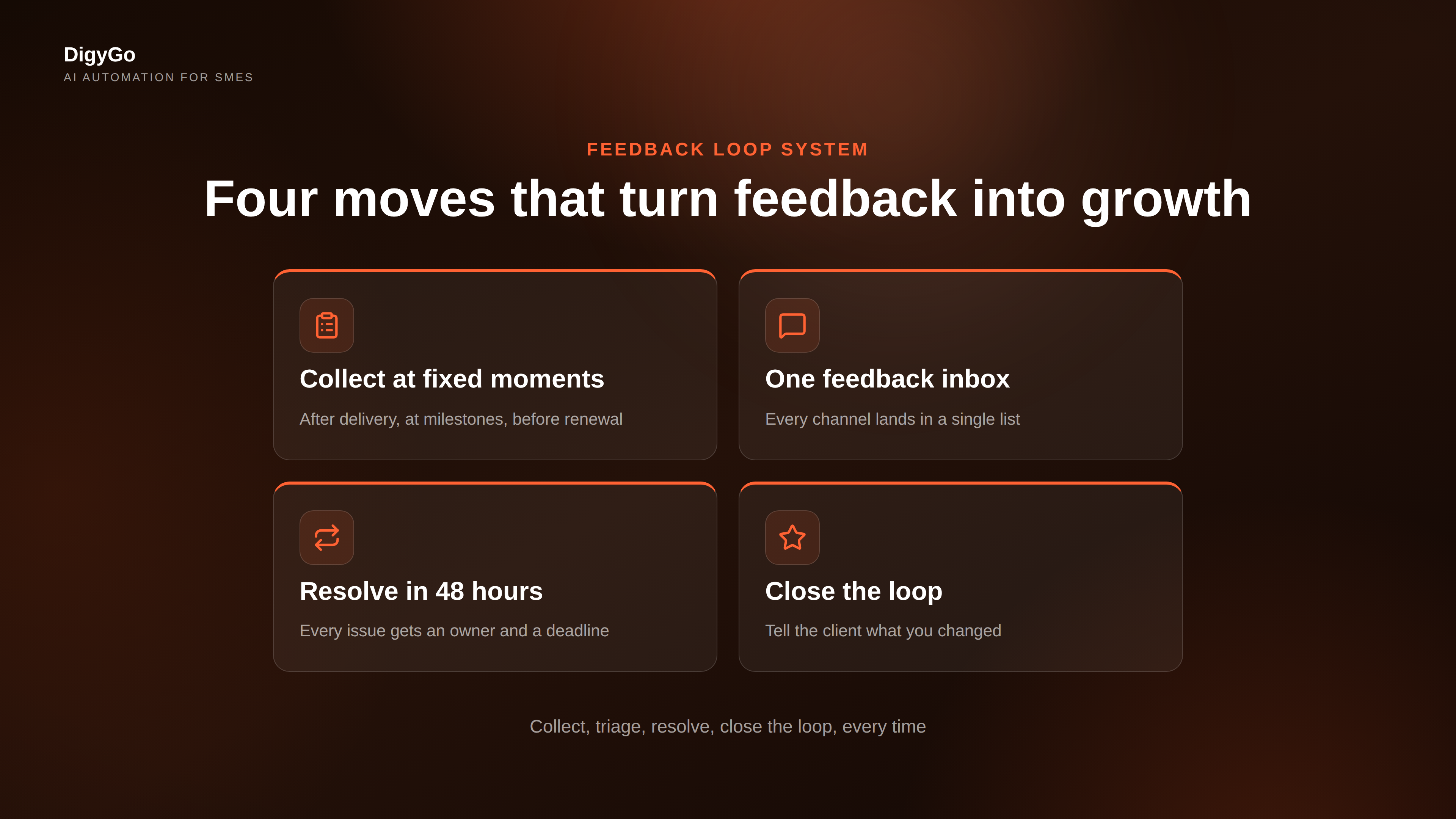
- A loop system has four parts: fixed collection moments, one feedback inbox, one-minute triage, and a 48-hour resolve-and-reply rule
- A monthly 30-minute review plus a simple sheet keeps the whole system running at 2-3 hours per month, no software purchase needed
Why feedback only compounds when it loops back
Customer feedback has three possible endings. It can die, it can be actioned privately, or it can loop. Each ending produces a completely different business outcome.
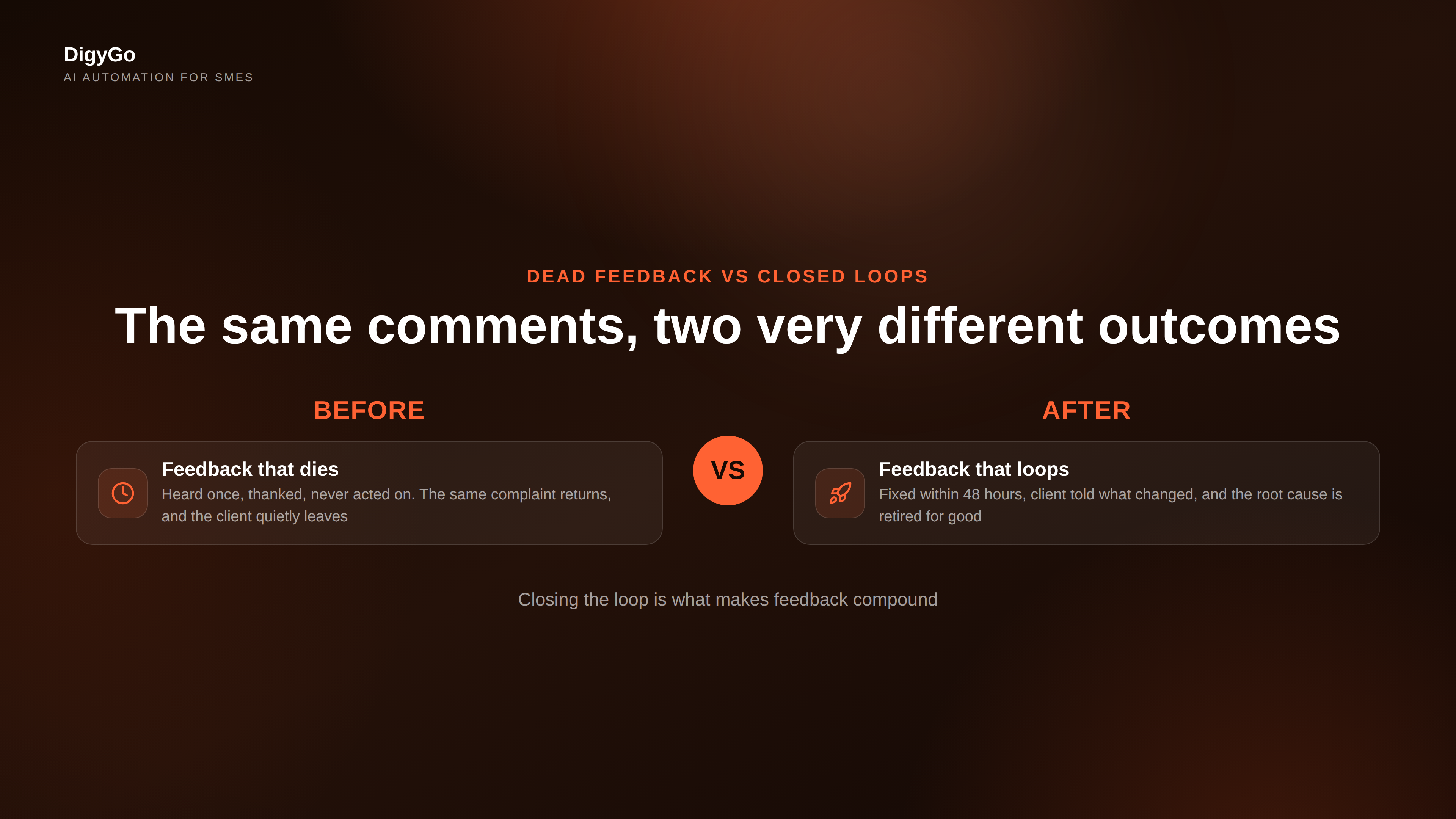
- Feedback that dies: the comment is acknowledged, then forgotten. The same complaint returns three months later, now with more frustration attached, and the client quietly churns.
- Feedback actioned privately: the team fixes the problem but never tells the client. The issue is solved, yet the client gains no trust from it, because from their side nothing visibly changed.
- Feedback that loops: the comment is logged, actioned, and answered with proof: "You said the invoice format was confusing, so we have simplified it from next week." This is the only ending that builds trust.
Only the third ending compounds. Every closed loop is a proof point that the business listens and acts, and proof points are what referrals are made of. A client who sees their comment change something does not just stay, they tell other founders about you. That is how a feedback system stops being a customer-service nicety and becomes a growth system.
The four parts of a customer feedback loop system
None of the parts below are complicated. What makes them a system is running all four, every time, without exception.
1. Collect at fixed moments
Set three or four collection moments per client per year: within 48 hours of delivery, at the 30-day milestone, before renewal, and after any complaint is resolved. Each touch asks at most three questions: What worked? What could be better? What do you need next? A short Google Form or a simple WhatsApp message is enough. Fixed moments matter because they catch quiet dissatisfaction before it becomes a cancellation.
2. A single feedback inbox
Every comment lands in one place: a spreadsheet, a CRM note section, or one dedicated email address. If feedback lives across four chat threads and two inboxes, it is already lost. One person owns this inbox and checks it twice a week. The inbox is the raw material for everything else in the system.
3. Triage with a one-minute score
Each comment gets a score from 1 to 5 and a category: quality, speed, communication, price, or delivery. A 4 or 5 becomes a reply with thanks and a gentle ask for a Google review or a referral. A 1 to 3 becomes an action item with a named owner and a 48-hour resolution deadline. Triage is a decision, not a discussion. If it takes more than a minute per comment, the scoring is too complicated.
4. Close the loop
Within 48 hours of fixing anything, tell the customer exactly what changed because of their comment. One short line is enough: "You flagged a delay in our handover, so we have added a delivery checklist for every project." This step is the entire point of the system. Without it, you have feedback collection, not a feedback loop.
What a closed loop looks like in practice
Consider two versions of the same event. A client mentions in passing that your last delivery ran a week late. In the first version, the account manager says sorry, the comment stays in WhatsApp, and nothing changes. Three months later, the same client's second project runs late again, and now it is not a passing remark, it is a formal complaint. The renewal goes quiet and the account dies without a single dramatic argument.
In the loop version, the same comment is logged into the feedback inbox, scored a 2 under the delivery category, and assigned to the project lead. Within 48 hours the cause is found: no handover checklist, so a step got skipped. The checklist is added, and the client gets a short message: "You were right, our handover missed a step. We have added a checklist so every project now ends the same way." The client does not just stay, they tell two other founders about the response when they meet at an industry event. The same comment, two completely different trajectories.
The monthly review that fixes root causes
A feedback loop system without a monthly review is just a faster way to collect complaints. Once a month, block 30 minutes and go through the inbox with the team:
- Which comments came in, and what are the top three categories?
- Which themes repeated? A repeated theme means a root cause, not a one-off mistake.
- What changed because of feedback this month, and which loops are still open?
The meeting produces two outputs: a short list of fixes for next month and a short list of open loops to close. This is where feedback becomes an operations system. The same complaint should never be logged twice. When you see a category repeat, you are seeing a process gap, and the fix belongs in the process, not in another apology.
Making the system stick without overhead
The standard objection is time. In practice, the system costs a few hours a month when you keep it light:
- Name one owner: the project manager, account manager, or the founder themselves.
- Use one sheet with five columns: date, client, score, category, status.
- Check the inbox twice a week, 15 minutes each time.
- Batch the "what changed" replies into one weekly slot instead of replying one by one.
- Use a simple form that feeds the sheet automatically, so collection takes no extra effort.
For a team of three with forty active clients, that is roughly 2-3 hours per month. One retained client or one new referral covers that cost many times over. Most SMEs already have the feedback; they are just not paying the small price of looping it back.
Three metrics to know the loop is working
Track three numbers in your monthly review:
- Resolution rate: what share of low-score comments were resolved within 48 hours?
- Loop closure rate: what share of clients were told what changed?
- Repeat theme rate: how often does the same category of complaint appear more than once?
If resolution rate climbs but repeat theme rate stays high, the system is logging problems without fixing their root causes. That is the signal to stop treating symptoms and change the process itself. When all three numbers move in the right direction, feedback has officially become a growth system: complaints turn into fixes, fixes turn into proof, and proof turns into referrals.
How is a feedback loop different from customer support?
Support is reactive: the client raises a problem and you respond. A feedback loop is proactive: you collect comments at fixed moments, you close every loop even for happy feedback, and you tell the client what changed. Support answers the question, the loop fixes the pattern behind it.
What if clients do not give feedback when we ask?
Keep the ask tiny: three questions, one message, delivered right after delivery or a milestone, when the experience is fresh. If clients still stay quiet, treat silence from a usually responsive client as a signal worth a follow-up call. In practice, most clients are happy to answer once they see that previous feedback actually changed something.
What if most of our feedback is negative?
That is the best possible position to be in, because negative feedback is specific and actionable. It tells you exactly where the process breaks. A steady stream of small complaints caught early is far cheaper than one quiet churn at renewal time. Score them, fix them in 48 hours, and watch the repeat theme rate fall.
Do we need software for this?
No. A shared spreadsheet, a simple form, and a calendar reminder are enough for the first year. The system is the rhythm: collect, triage, resolve, close. Software only becomes worth it when you have more comments than one person can triage in the weekly slot.
How long before the loop shows up in revenue?
Expect the first visible result in one quarter: fewer repeated complaints and smoother renewals. Referrals usually follow in the second or third quarter, because they depend on clients hearing about a fix and remembering it. The loop is a compound system, so the returns grow with every closed loop, not all at once.
Ready to turn customer feedback into a retention and referral engine? Talk to us about setting up your feedback loop system.