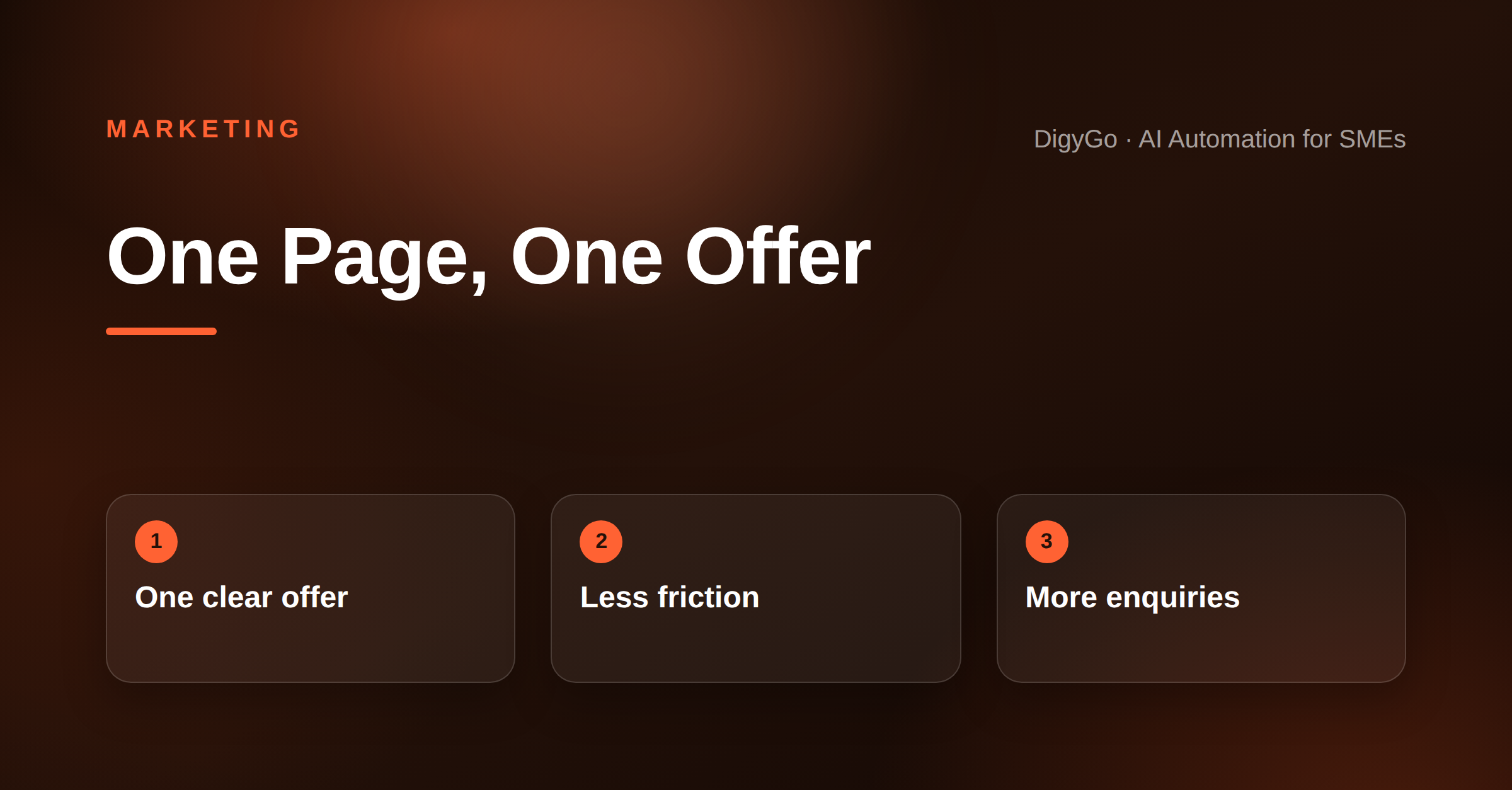
Most SME service pages try to impress everyone: every service, every feature, every industry, every outcome. The result is usually the same — visitors skim, hesitate, and leave. A service page converts better when it has one clear buyer problem, one offer, and one action.
A focused service page helps SMEs explain the offer faster, reduce friction, and turn more visitors into qualified enquiries.
Why one-offer pages convert better
When a founder lands on your service page, they are not looking for a company history lesson. They are asking a simple question: Can this team solve my problem, and is it worth a call? If the page answers that quickly, you reduce friction and earn the next step.
That is why focused service pages usually outperform broad ones. They are easier to understand, easier to trust, and easier to act on. The page does not need to say everything. It needs to say the right thing clearly.
- One page should target one primary search intent.
- One offer should solve one high-value problem.
- One CTA should tell the visitor exactly what to do next.
What to remove from a crowded service page
If your page is not converting, the problem is often not the service itself. It is the way the page tries to sell it. Most underperforming pages contain too much optional detail and too little decision support.
1. Extra services that distract
When a page lists five different offers, the visitor has to do the sorting work. Instead of moving toward a call, they start comparing, second-guessing, and bouncing between options.
2. Long feature dumps
Features matter only after the buyer understands the outcome. Service pages should lead with the result, then explain the process, then answer objections. If you start with a list of capabilities, you make the reader work too hard.
3. Weak calls to action
A generic Contact Us button does not reduce hesitation. A better CTA tells the visitor what happens next: book a discovery call, request a pricing estimate, or get a quick audit.
The structure of a service page that sells
A good service page is not complicated. It just follows the buyer’s decision journey in the right order.
| Section | What it should do | What to avoid |
|---|---|---|
| Hero | State the problem, outcome, and audience | Vague brand slogans |
| Proof | Show relevance and trust quickly | Long company biography |
| Offer | Explain what is included and what is not | Hidden scope and fuzzy deliverables |
| Process | Show how the engagement works | Too much technical detail too early |
| CTA | Tell the visitor the next step | Multiple competing buttons |
How to frame the offer for SMEs
SME founders do not buy services because they sound sophisticated. They buy because the offer feels practical, low-risk, and connected to business growth. Your page should show how the service creates one of three outcomes: more leads, better conversions, or less manual work.
For example, instead of saying we provide digital marketing support, say we build a service page that turns more qualified enquiries into booked calls. That language is sharper, easier to trust, and easier to remember.
Simple rule: if a visitor cannot explain your service back in one sentence after reading the page, the page is too broad.
A practical rewrite formula
If you want to improve a service page fast, rewrite it in this sequence:
- Start with the buyer’s problem.
- Explain the result they want.
- Describe the service in plain English.
- Add proof that reduces doubt.
- End with one clear next step.
This is not about making the page shorter for the sake of it. It is about making the page easier to decide on. When the structure is clear, the visitor spends less time interpreting and more time moving forward.
What this means for lead generation
Service pages are not just information pages. They are lead-generation assets. A focused page can improve click-to-call behaviour, increase form completion, and bring in better-fit enquiries because the offer is easier to judge.
That is especially important for service businesses selling higher-ticket work. The right visitor wants confidence, not a sales pitch. A clear page helps them say yes sooner.
FAQ
Should every service have its own page?
Yes, if the service solves a different buyer problem or needs a different sales conversation. One page per offer is usually easier to rank and easier to convert.
How much detail should a service page include?
Enough to help the buyer decide. Focus on the problem, the outcome, what is included, and the next step. Avoid over-explaining process details unless they reduce a real objection.
What is the most important part of the page?
The hero section and the CTA. If those two pieces are unclear, the rest of the page has to work too hard.
Want a service page that sells more qualified leads? Talk to DigyGo.