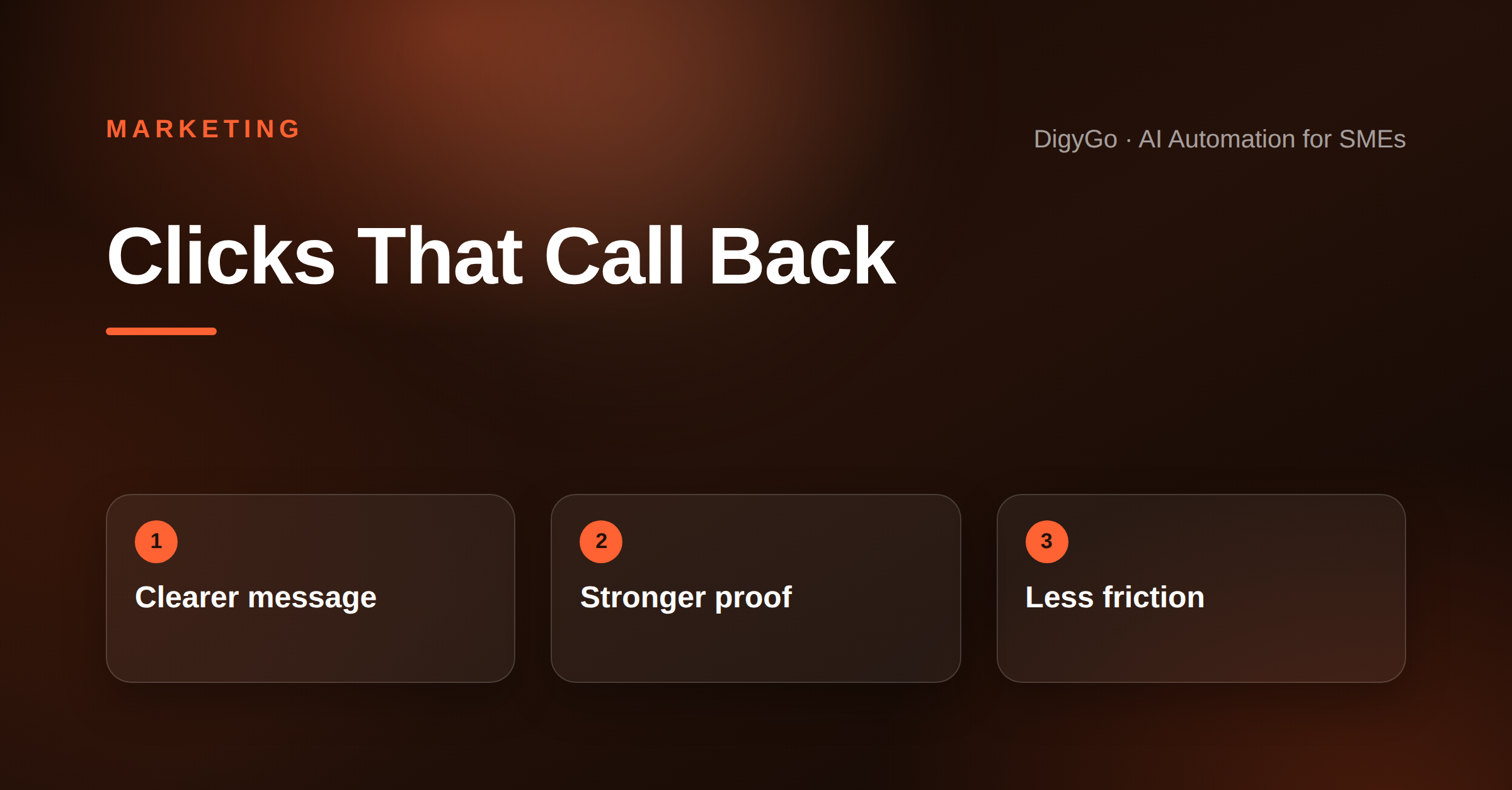
Traffic is useful only when it turns into conversations. For most SMEs, the real challenge is not getting more visitors; it is turning the right visitors into enquiries that your team can actually close.
A practical guide for SMEs on turning website visitors into qualified enquiries with clearer messaging, better proof, and less friction.
That is why the best service businesses do not chase “more traffic” as a goal on its own. They build a path from landing page to trust to action, so every click has a better chance of becoming a sales opportunity.
In this guide
- Why website traffic often fails to produce leads
- What turns anonymous visitors into qualified enquiries
- How to reduce friction without making the page dull
- What SMEs should change first for better lead flow
Why traffic does not equal enquiries
Many founders assume the traffic problem is a visibility problem. Sometimes it is, but often the deeper issue is that the page does not give the visitor enough confidence to act.
When someone lands on your site, they are asking a simple question: “Is this relevant to me, and is it safe to enquire?” If the answer is not immediate, they leave and you lose the lead before it begins.
What makes an enquiry qualified
A qualified enquiry is not just any form fill or WhatsApp ping. It is a prospect who understands your offer, fits your target customer profile, and is interested enough to start a sales conversation.
- Relevant — they match the service you actually sell.
- Informed — they understand what outcome you deliver.
- Ready — they are open to the next step, whether that is a call, quote, or demo.
When SMEs chase low-quality leads, the team wastes time on follow-up, and the sales pipeline looks busy without producing real revenue.
“Good marketing does not just create interest. It pre-qualifies the interest before the first conversation.”
— Sivaraj, Founder & CEOThe message-match layer
The fastest way to improve lead quality is to make the page match the promise that brought the visitor there. If the ad, post, or search result says one thing and the landing page says another, trust drops immediately.
Match these three things
- Audience — who the service is for.
- Outcome — what result the customer wants.
- Next step — what happens after they enquire.
This is where many SMEs leak leads. The traffic may be good, but the page is vague, so visitors have to guess whether the service fits them. Guessing kills conversion.
Proof that moves people forward
People do not enquire because you say you are good. They enquire because something on the page makes your claim feel believable.
Use proof in layers
Start with one strong trust cue near the top, then add a short example, then add deeper proof later in the page. That way the visitor keeps finding reasons to continue.
For service businesses, proof can be simple: client logos, a clear before-and-after result, a short testimonial, a short case summary, or a process diagram that shows how you work.
Remove friction before you add more ads
More traffic is expensive if the page is leaking conversions. Before increasing ad spend, improve the path the visitor already takes.
- Shorten forms — ask only for what you need first.
- Use one primary CTA — do not split attention.
- Explain the follow-up — say what happens after enquiry.
- Make contact easy — offer call, form, or WhatsApp where appropriate.
- Reduce jargon — plain language converts better than clever language.
Most SME websites do not need a redesign to get better results. They need clearer messaging, cleaner offers, and a follow-up path that feels safe.
The simple SME enquiry system
At DigyGo, the goal is not just to collect enquiries. It is to build a repeatable system that helps the right people move from curiosity to contact to conversation.
- Attract — bring in the right traffic with the right topic or ad.
- Clarify — make the offer easy to understand fast.
- Reassure — show proof and remove doubt.
- Ask — give a clear next step with low friction.
- Follow up — respond quickly so the lead does not cool down.
That sequence matters because lead generation is not a one-step event. It is a chain, and every weak link lowers conversion.
FAQ
Should I focus on more traffic or better conversion first?
For most SMEs, conversion comes first. If the current traffic is not converting, more traffic will only make the leak more expensive.
What is the fastest way to improve enquiry quality?
Make the page more specific. A specific offer attracts a more specific prospect, and that usually means better-fit enquiries.
Do I need a long landing page to convert?
Not always. You need enough content to answer objections and build trust. If the offer is simple, a shorter page can work very well.
Bottom line
If your website gets traffic but not enough enquiries, do not assume you need a bigger budget. First check whether the page makes the right promise, shows enough proof, and removes enough friction for a visitor to take the next step.
When those pieces are aligned, website traffic becomes a more reliable source of qualified leads. Talk to DigyGo about building that system.