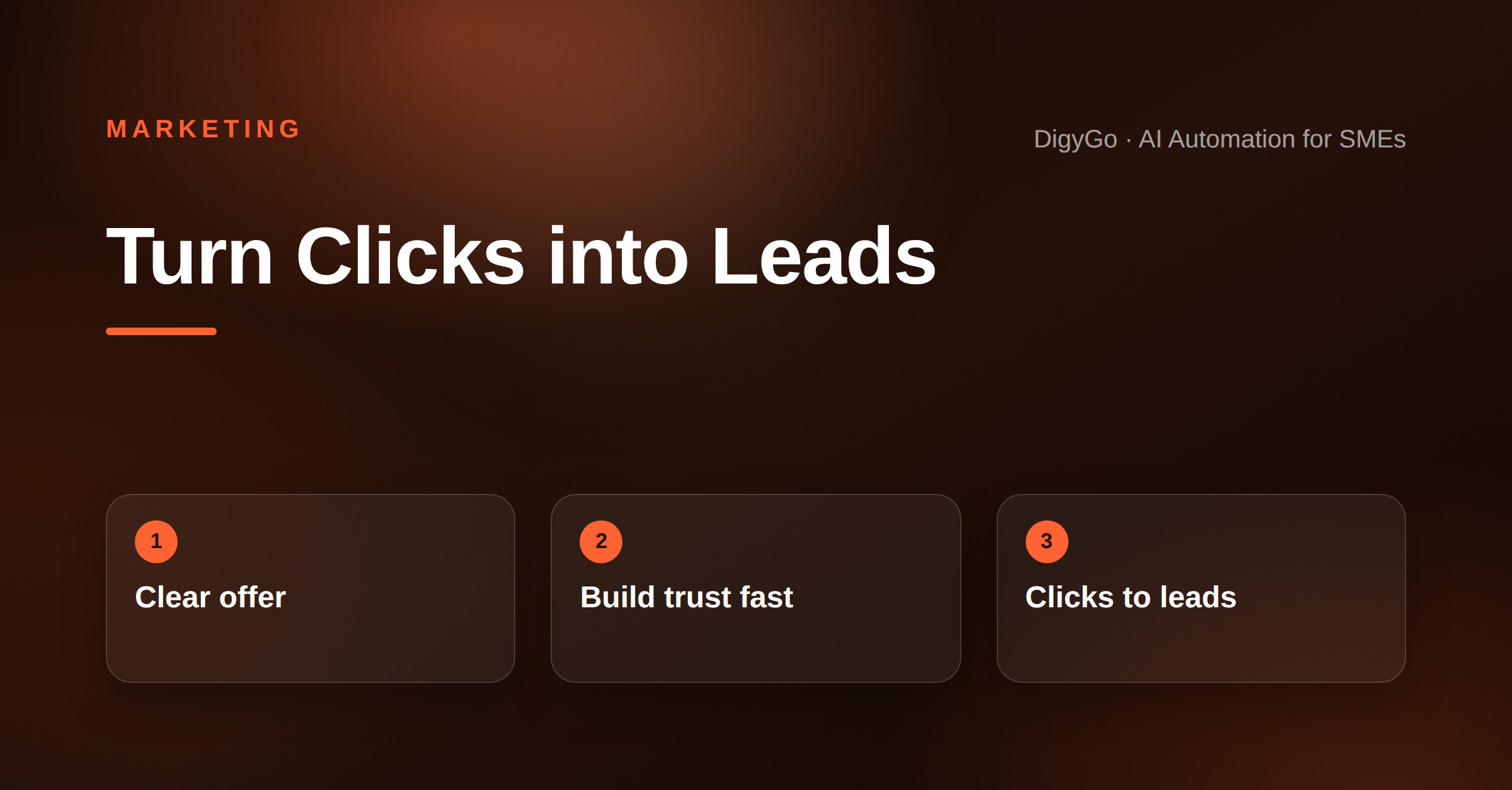
A lot of SME landing pages look busy, but they do not convert because they try to say everything to everyone. A good landing page does the opposite: it makes one promise, removes one objection at a time, and pushes the visitor toward one clear next step.
A practical guide for SMEs on building a landing page that earns trust fast, explains the offer clearly, and turns traffic into leads.
If you run a service business, your landing page is not a brochure. It is a sales conversation in webpage form. The job is to earn trust quickly, explain the offer simply, and make enquiry feel easy.
In this guide
- What a high-converting SME landing page must include
- How to structure the page for leads, not just traffic
- What founders should remove immediately
- How DigyGo approaches conversion-focused pages
What makes a landing page convert
Conversion is not about flashy design. It is about message clarity, friction control, and trust. If a visitor understands the offer and believes you can solve the problem, they will take the next step.
The strongest SME landing pages usually do three things well: they speak to one audience, solve one problem, and ask for one action.
The above-the-fold promise
The first screen should answer three questions immediately: what is this, who is it for, and why should I care now?
- Clear headline — state the outcome, not the feature.
- Supporting subheadline — explain the business result in plain language.
- Single CTA — one obvious action, not four competing buttons.
When founders over-explain on the hero section, the page becomes harder to scan. Short beats clever. Clear beats cute.
"A landing page is not where you impress people. It is where you remove hesitation."
— Sivaraj, Founder & CEOProof that lowers doubt
Visitors do not only buy the promise. They buy evidence. That evidence can come from testimonials, case studies, numbers, logos, screenshots, or a simple before-and-after explanation.
For SMEs, proof should be easy to skim. Put the best credibility signals near the top, then repeat them later in the page with more detail.
Use proof in layers
- Quick trust cue in the hero.
- One real example early in the page.
- Detailed evidence near the middle or bottom.
How to present the offer
People convert when the offer feels specific. Instead of saying you "help businesses grow," tell them what happens, how long it takes, and what they get.
A strong offer usually contains four pieces: outcome, process, timeframe, and next step. When those are obvious, the page feels grounded and credible.
Service businesses should show the path
Explain what happens after enquiry. If the visitor knows there is a call, audit, proposal, or demo, the next step feels safer.
Common mistakes that kill conversions
- Too many CTAs — the visitor does not know where to click.
- Generic copy — it sounds like every other agency or consultant.
- No proof — the page asks for trust without earning it.
- Long forms — every extra field lowers completion rate.
- Weak offer framing — the value is hidden behind jargon.
Most of these problems are not design problems. They are message problems. Fix the message first, then refine the layout.
Founder checklist before you publish
- Can a visitor understand the offer in five seconds?
- Is there one action you want them to take?
- Do you show proof before asking for commitment?
- Does the page explain what happens after enquiry?
- Does every section help the page sell, not just fill space?
If you cannot answer yes to most of those, the page still needs work.
FAQ
How long should an SME landing page be?
Long enough to answer the main objections, but short enough to stay focused. For many service businesses, clarity matters more than word count.
Should I use one landing page for everything?
No. One page should support one audience and one offer. Separate pages convert better because they can speak directly to the visitor's need.
What should I improve first: design or copy?
Copy first. If the message is weak, no visual polish can rescue the page. Once the message is sharp, improve layout and spacing.
Bottom line
A landing page that converts is not complicated. It is focused, credible, and easy to act on. For SMEs, that usually means one offer, one audience, one CTA, and enough proof to make enquiry feel safe.
If you want help building a page that turns traffic into leads, book a free call with DigyGo and we’ll map the message and structure with you.