Most small-business owners I meet are running the same marketing playbook: posting on Instagram three times a week, running a Facebook ad on the side, sending an occasional WhatsApp broadcast, keeping a Google Business Profile listing, and wondering why none of it adds up to consistent enquiries. The problem isn't effort — it's that the effort is spread across too many channels, and none of them gets enough attention to actually work.
Most SME marketing fails because the budget is spread too thin across too many channels. This post offers a practical 4-step process to pick the right channel, test it, and scale what works.
The instinct to be "everywhere" is understandable. When every platform promises reach and every consultant tells you to build a presence on the latest channel, it feels risky to leave any stone unturned. But for an SME with a limited marketing budget and a small team, being everywhere usually means being invisible everywhere.
This post walks through a practical framework for choosing the right marketing channels — not the ones with the biggest user base, but the ones where your specific customers are actually paying attention and where you can show up consistently enough to be noticed.
The Trap of Spreading Too Thin
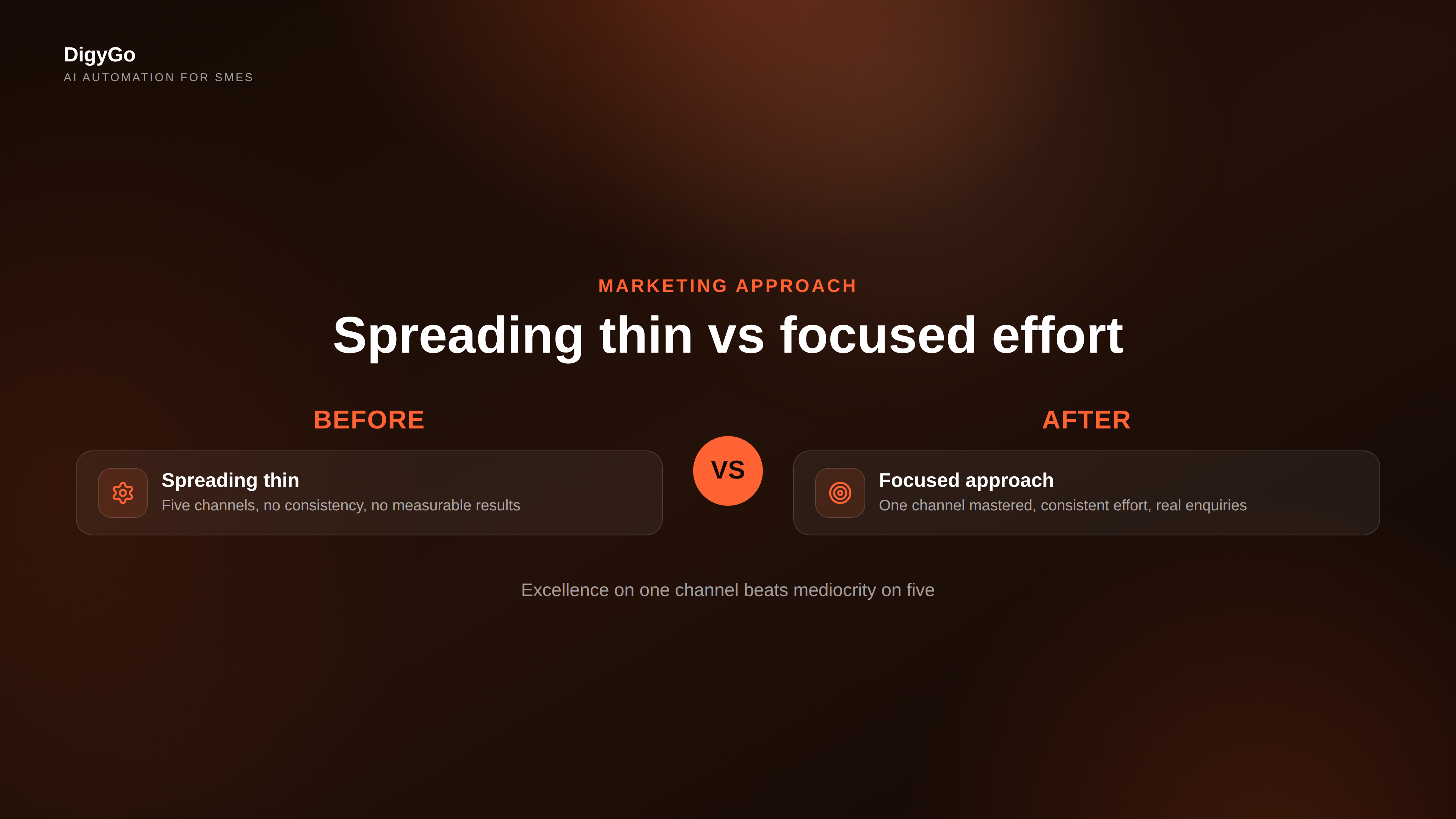
Here is what happens when an SME tries to maintain a presence on five channels with a team of one or two people. Each channel gets a fraction of the attention it needs to produce results. The Instagram posts are rushed. The Facebook ads run without proper targeting. The WhatsApp broadcasts feel spammy. The Google Business Profile has old photos and unanswered reviews. The email newsletter — if it exists — goes out once a quarter.
No single channel ever gets enough consistent effort to build momentum. And because no channel delivers measurable results, the business owner cannot tell which one is worth more investment. So they keep spreading the same thin budget across everything, hoping that one of them will eventually click.
This is not a strategy. It is a defence mechanism against the fear of missing out. And it is the single biggest reason SME marketing budgets fail to produce reliable enquiries.
What Channel Selection Actually Depends On
Choosing the right marketing channel is not about which platform has the most users. It is about three things that are specific to your business:
- Where your best customers already spend time. Not "everyone" — your best customers. The ones who pay on time, refer others, and come back. If they are on WhatsApp groups and rarely open Instagram, that tells you something.
- Where you can show up consistently. A channel you can post on three times a week for six months will always outperform a channel where you post brilliantly once and then go silent for a month. Consistency beats polish for SMEs.
- Where the buying intent matches your offer. Some channels are built for discovery (search, Google Maps). Others are built for engagement (Instagram, YouTube). Others are built for direct response (WhatsApp, email). Pick the channel whose natural strength matches your sales motion.
These three filters will narrow your options from "every platform that exists" to one or two channels that are genuinely worth your time.
A Simple Channel Selection Process
Here is a four-step process that has helped several DigyGo clients stop wasting marketing budget and start seeing consistent enquiries from fewer channels.
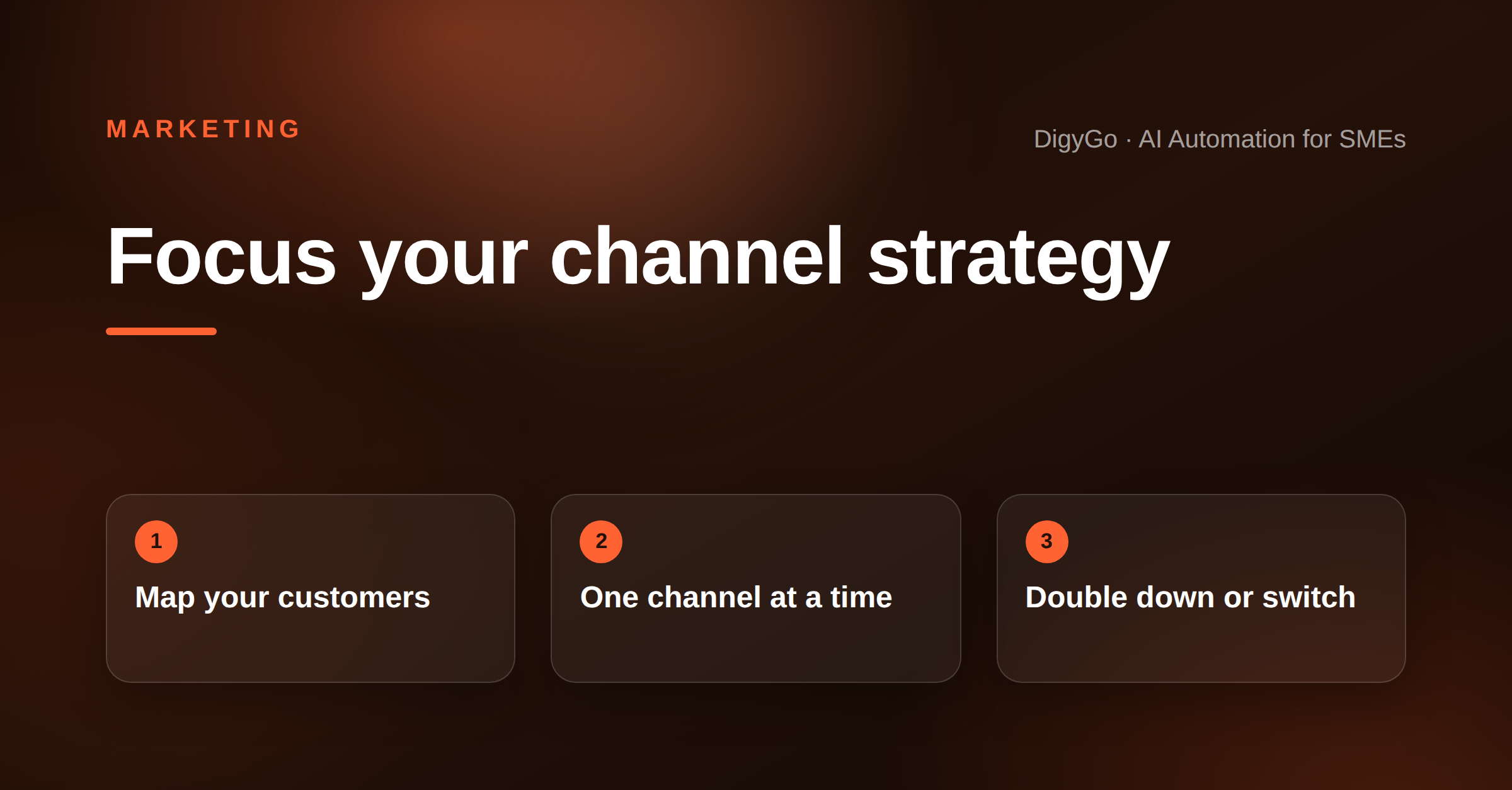
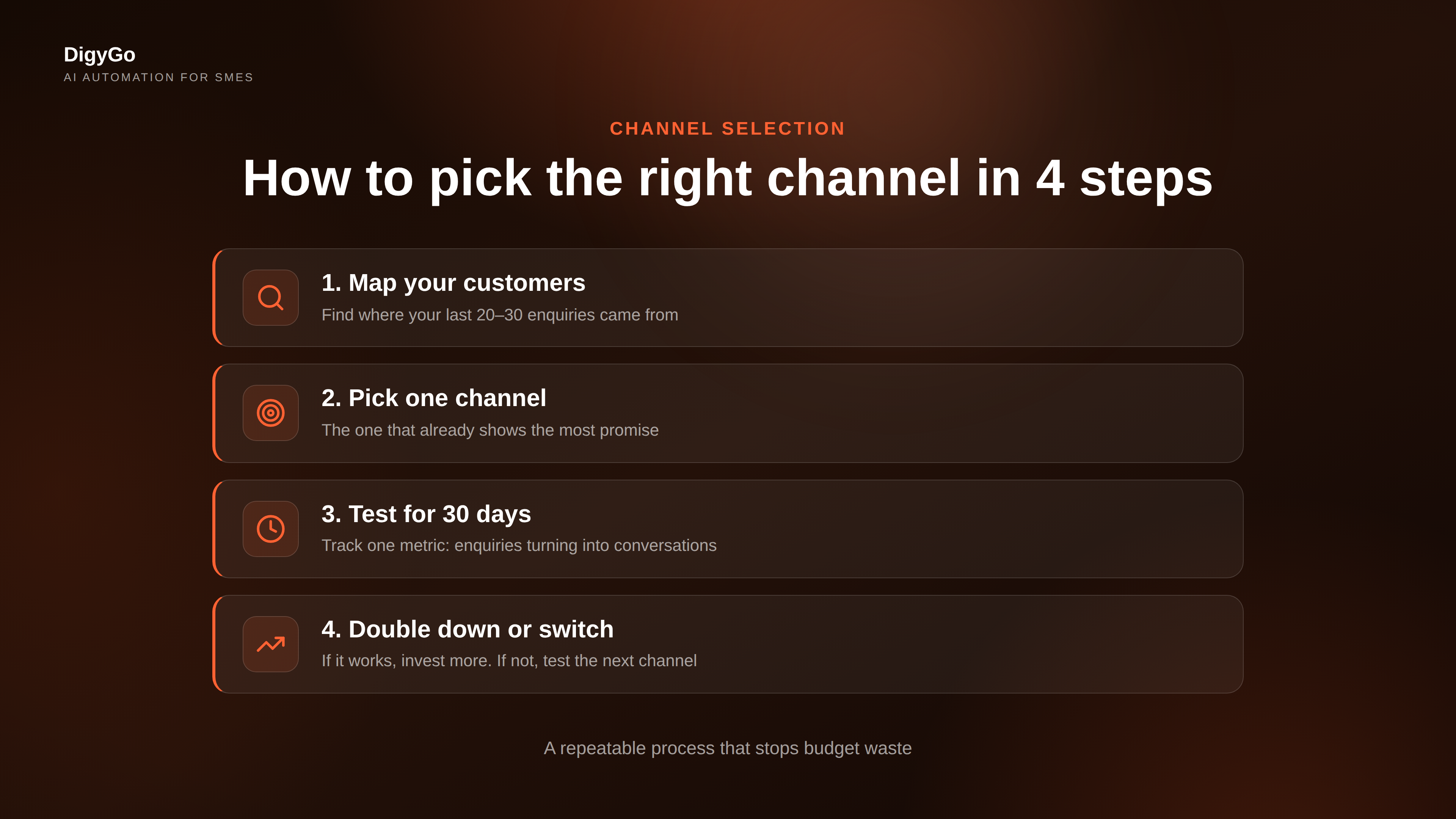
Step 1: Map Where Your Current Customers Came From
Go back through your last 20–30 customers. For each one, write down how they first heard about you. Was it a Google search? A referral? A WhatsApp group? An Instagram post? A walk-in after seeing your board outside?
Be honest. If most of your business comes from referrals and Google searches, there is no point spending your budget on Instagram Reels just because every brand is doing Reels. The data from your own business is the most reliable marketing research you will ever get.
Step 2: Pick One Primary Channel
Based on the map from step one, pick the single channel that already shows the most promise. If Google Search sent you five customers last year and Instagram sent you one, your primary channel is Google Search — even if Instagram has more users in your area.
Your primary channel gets 70% of your marketing time and budget. It is the channel you will show up on consistently, optimise, and track. Everything else gets at most 30% — and only if you have the energy to maintain it after the primary channel is working.
Step 3: Set a 30-Day Test With One Metric
Most SMEs measure the wrong thing — likes, views, followers — instead of the metric that matters: enquiries that turn into conversations. For your primary channel, define one clear metric: calls from Google Business Profile, DM enquiries from Instagram, form submissions from a landing page, or replies to a WhatsApp broadcast.
Run the channel consistently for 30 days. Track that single metric. At the end of 30 days, you will know whether the channel is worth more investment or whether the next channel in your list deserves the primary slot.
Step 4: Double Down or Switch
If your primary channel delivered enquiries at a cost you can afford (even if the volume is still small), double down. Invest in better content, better targeting, or a small paid boost. Do not add a second channel until the first one is producing consistent, predictable enquiries.
If the primary channel did not deliver after 30 days of consistent effort, switch to the next channel on your list. No hard feelings. The test was small and inexpensive — you learned what does not work for your business, which is just as valuable as learning what does.
Why "One Channel at a Time" Feels Wrong (and Why It Works)
The objection I hear most often is: "But what if I am missing customers on other channels?" It is a fair question. The fear of missing out is real, and it is compounded by the fact that every platform's algorithm is designed to make you feel like you are leaving money on the table by not posting there.
Here is the counter-intuitive truth: when you focus on one channel and do it well, your presence on that channel becomes strong enough that customers on other channels start noticing you too. A strong Google Business Profile with recent reviews and consistent posts ranks higher in search, which means people who never even opened Google Maps will find you. A strong WhatsApp broadcast list with useful content gets shared into other groups, reaching people who never joined your list.
Excellence on one channel leaks into other channels. Mediocrity on five channels leaks nothing.
How to Know When You Are Ready for a Second Channel
Adding a second channel is not a sin — it is a natural progression. But the timing matters. You are ready for a second channel when:
- Your primary channel delivers enquiries consistently without daily attention — it has become a system rather than a task.
- You have documented what works on the primary channel well enough that someone else (or an AI tool) could maintain it.
- You have a clear hypothesis for the second channel — not "it would be nice to be there" but "our customers spend time there and we know what kind of content would reach them."
When you hit these three conditions, add the second channel with the same 30-day test approach. Give it 70% of whatever spare marketing time you have left. Keep the primary channel running on maintenance mode.
The Channels That Work Best for Tamil Nadu SMEs
While every business is different, there are patterns worth noting. Based on what we have seen across DigyGo clients:
- Google Business Profile + Google Search is the most reliable enquiry source for local-service SMEs — home services, electricians, plumbers, beauty salons, clinics, and auto dealers. If you are not showing up in local search results, you are invisible to most of your potential customers.
- WhatsApp is the most underutilised high-intent channel for SMEs in Tamil Nadu. Your customers are already on WhatsApp. A well-managed broadcast list with useful, non-spammy updates can generate more enquiries than any social media platform.
- Instagram works well for visually driven businesses — restaurants, salons, boutiques, home decor — but requires consistent high-quality posting. If you cannot commit to three posts a week minimum, Instagram will not move.
- YouTube is excellent for businesses that can demonstrate their work — contractors, mechanics, fitness trainers, cooks. A single "how we work" video can generate enquiries for months.
The key is not to pick the channel that sounds most impressive. Pick the channel where your specific customers are already paying attention, and where you can show up consistently for the next six months.
Frequently Asked Questions
How do I know which channel my customers use if I have not tracked it?
Start asking every new customer: "How did you hear about us?" Record the answers in a simple spreadsheet. Within 20–30 responses, a clear pattern will emerge. If the answers are all over the place, pick the channel that appears most frequently and start there.
What if my competitors are everywhere and I am only on one channel?
Your competitors being "everywhere" does not mean they are succeeding everywhere. Most SMEs with multi-channel presence are mediocre on each channel. One strong, credible channel beats five weak ones. Customers notice the difference between a business that genuinely owns a channel and one that just has an account there.
How much budget should I allocate to my primary channel?
Start small. If you are spending ₹10,000 a month on marketing, put ₹7,000 on your primary channel and ₹3,000 on a secondary experiment. If the primary channel delivers, shift more budget into it. The goal is not to spend less — it is to spend where the return is highest.
Can I use AI to manage multiple channels at once?
AI tools can help you repurpose content across channels, schedule posts, and track responses — but they cannot replace the strategic decision of which channels to prioritise. Use AI for execution, not for strategy. The channel selection itself needs a human who understands the business and its customers.
How long should I stick with a channel before deciding it does not work?
Give it 60–90 days of consistent effort. Some channels take time to build momentum — particularly Google organic search, which can take 3–6 months to show meaningful results. But if after 90 days you are seeing zero enquiries from a channel you have been consistently active on, it is probably not the right channel for your business.
Stop Trying to Be Everywhere. Start Being Great Where It Matters.
The single most important marketing decision you will make this year is not which platform to post on — it is which platforms not to post on. Every channel you say no to frees up time, money, and attention for the one or two channels that will actually drive enquiries for your business.
At DigyGo, we help SMEs build marketing systems that work with their actual capacity — not the capacity they wish they had. If you are tired of spreading your budget thin and want a channel strategy that fits your business, we would love to help.
Talk to DigyGo about building a focused marketing channel strategy for your SME →