Most SME founders know that referrals are their best source of new business. Referred clients trust you before the first call, they buy faster, and they tend to stay longer. Yet fewer than one in five businesses have a real system for earning referrals — they wait for them to happen instead of making them happen. A structured referral program changes that. Here is how to build one that fits the way your SME already works.
A practical guide for SME founders on building a customer referral program that generates consistent enquiries — with the right timing, a simple process, and a genuine thank-you that turns happy customers into a reliable demand channel.
Why Referral Marketing Works So Well for SMEs
A referral arrives with built-in trust. The person on the other end already knows what to expect because someone they trust told them. That changes the entire sales conversation from "who are you and why should I care?" to "tell me more, I think I need this."
For an SME, that shift is enormous. You do not need a long nurture sequence or a brand-awareness campaign for a referred lead. The social proof has already done the hardest part of the sale. The cost of acquiring a referred customer is typically much lower than a paid-ad lead, and the lifetime value is often higher because the fit is better from the start.
But referrals do not happen by accident. They come from a system — one that makes it easy for happy customers to send business your way at the right moment.
The Three Pillars of an SME Referral System
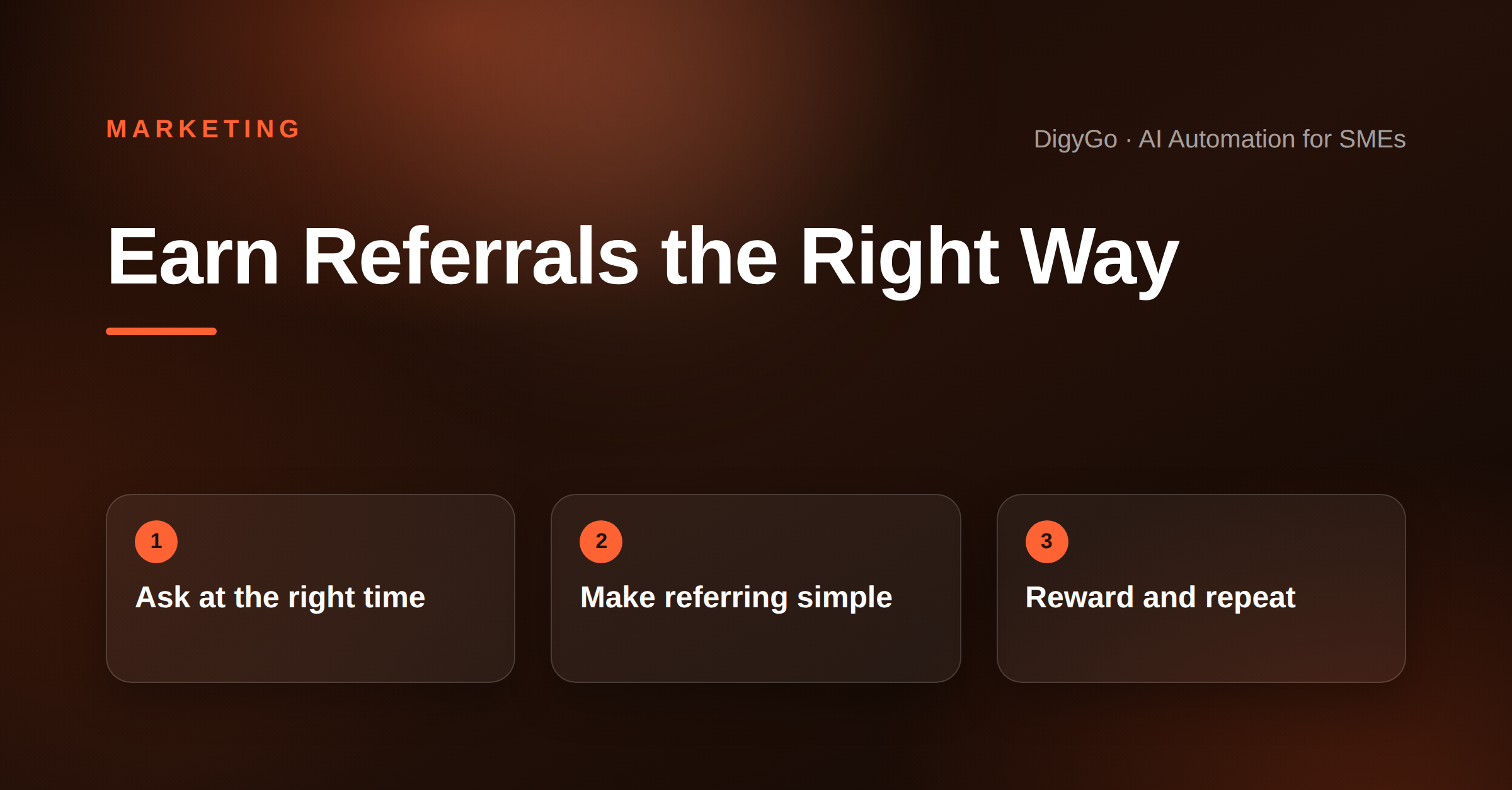
A working referral program stands on three legs. Miss one, and the system leaks. Get all three right, and referrals become a predictable channel instead of an occasional surprise.
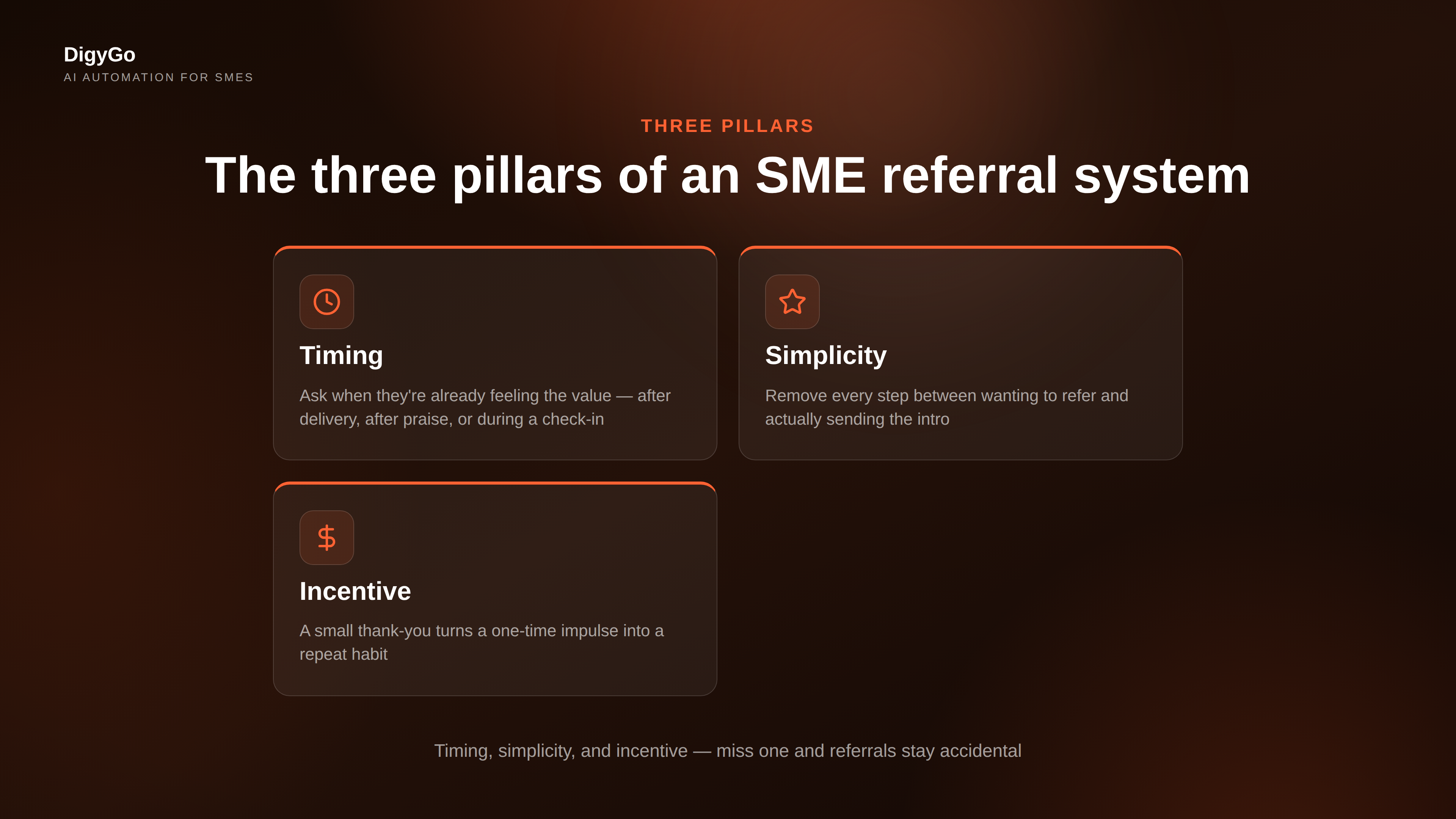
Timing. The best time to ask for a referral is when your customer is already feeling the value — not when you need pipeline. If you ask during a routine check-in or right after a successful delivery, the request lands naturally. If you ask out of the blue, it feels transactional.
Simplicity. The easier you make it to refer, the more referrals you get. A customer who has to write a paragraph, find your link, and compose a message is less likely to follow through than one who can forward a pre-written note or tap a share button. Remove every step between thinking "I know someone who needs this" and actually sending the introduction.
Incentive. People refer because they want to help a friend and they want to help you. But a small, genuine thank-you — a discount on their next service, a gift, or a service credit — turns a one-time happy impulse into a repeat behaviour. The incentive does not have to be large. It just has to exist.
The Three Best Times to Ask for a Referral
Timing is the most overlooked part of referral marketing. You can have the best offer in the world, but if you ask at the wrong moment, the request feels awkward and gets ignored. Here are the three windows that work best for service-based SMEs.
1. Right after delivery
The moment a project, service, or product is delivered and the customer is happy is the single best referral window. The result is fresh in their mind. They are grateful. They are already thinking about how much better things are now. A simple "if you know anyone else who could use this, I would love an introduction" lands perfectly here.
2. After unsolicited praise
When a customer sends a thank-you message, leaves a positive review, or tells you "this is the best service I have had in years" — that is a second golden window. They have already volunteered that they value you. All you need to do is ask them to share that value with someone they know.
3. During a check-in call or review
A scheduled check-in or quarterly review is a natural place to ask. The conversation is already about their results and satisfaction. When you have just walked them through the impact of your work, you have earned the right to say "if you know a business that could use similar results, I would welcome the introduction."
How to Make Referring Easy: A Four-Step System
Even a happy customer will not refer if the process feels like work. Design a system that removes every bit of friction from the referring side. Here is how to build one.
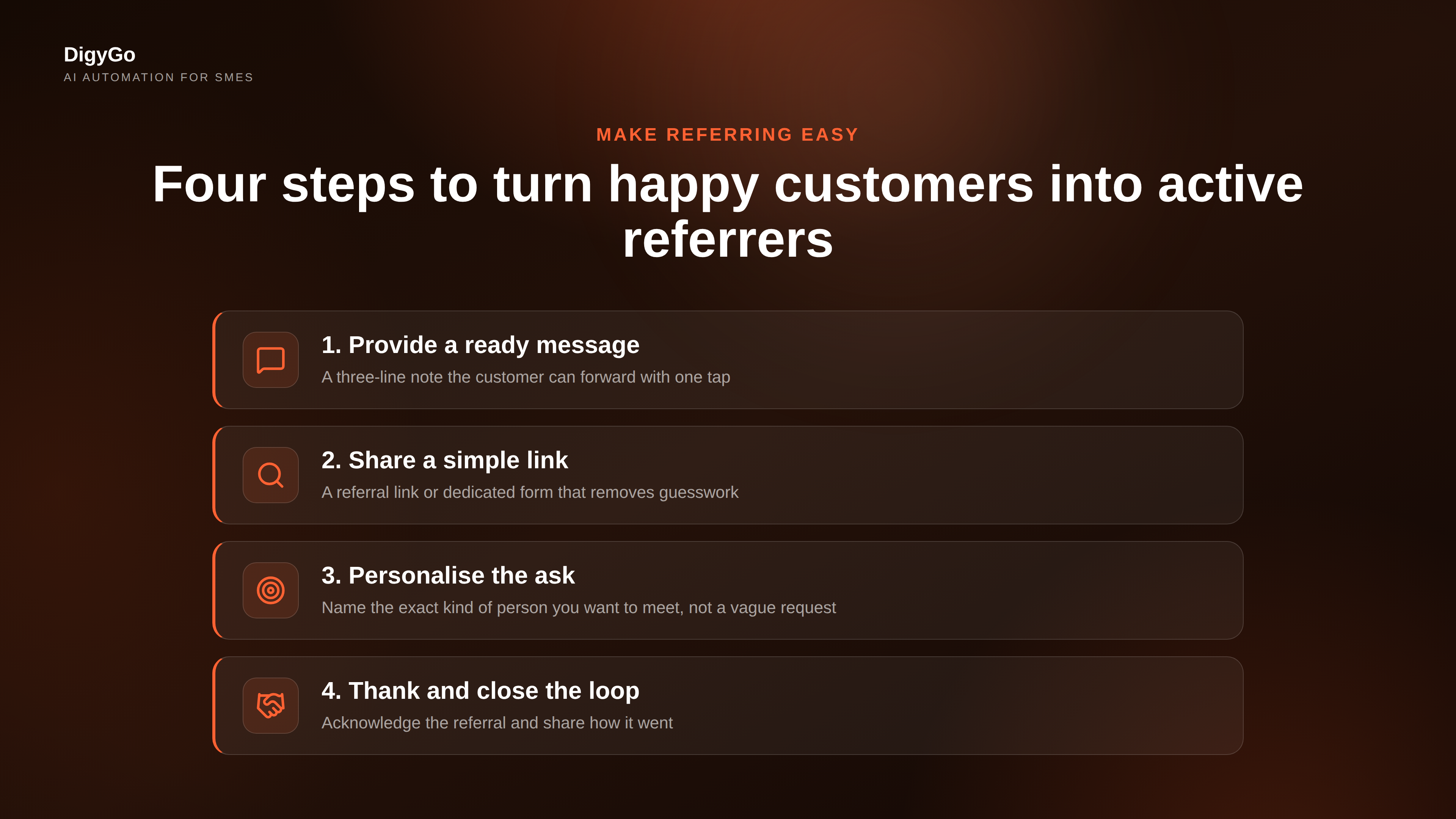
1. Provide a ready-to-forward message. Write a short note your customer can send to a friend with one tap. Something like: "Hey, I have been working with [your business] and they have been great. If you ever need [what you do], talk to them — here is their number." Keep it under three lines with a clear next step.
2. Give them a simple shareable link. A referral link or a dedicated contact form for referrals removes the guesswork. The customer does not have to remember your number or type your email. They just forward a link.
3. Personalise the ask. Generic referral requests get ignored. "If you know anyone who needs our services" is forgettable. "If you know any other real estate agents who struggle with client follow-up, I would love an intro" is specific and actionable because it names the exact kind of person you want to meet.
4. Follow up with gratitude. When a referral comes in, acknowledge it immediately. Thank the person who sent it, and keep them posted on how it went. That recognition makes them more likely to refer again.
Build a Monthly Referral Rhythm
A referral system only works if you actually use it. Add a referral check to your existing monthly or quarterly review. Look at three numbers: how many referrals came in, how many converted, and how many customers you asked. The gap between the last number and the first two is where the opportunity lives.
For most SMEs, the fix is not a better incentive or a fancier landing page. It is simply asking more often and making it easier to say yes. A monthly referral rhythm — one day a month when you check in, send your ask to the right customers, and review the results — turns an occasional trickle into a reliable channel.
- Ask at the right time — right after delivery, after praise, or during a check-in
- Make it simple — pre-written message, a shareable link, personalised to the recipient
- Offer a genuine thank-you — a small reward that turns one-time referrals into a habit
- Track and repeat — one monthly check to see what is working and ask more people
Frequently Asked Questions
Should I offer a discount or a gift as a referral reward?
Either works, but a service credit or a small upgrade to their existing service tends to feel more natural than a cash discount. The key is that it feels like a thank-you, not a commission.
What if my customers are not comfortable referring?
Some customers will never refer, and that is fine. Focus on the ones who actively tell you they are happy. If a customer has sent unsolicited praise or posted a review, they are already halfway to making a referral — you are just giving them a structure to do it.
How often should I ask existing customers for referrals?
Once per quarter per customer is a safe rhythm for most SMEs. Asking more often than that can feel pushy. But if a customer has just had a big win with your service, asking right then — even if it has only been a month — is perfectly natural.
Do I need a formal referral program with software and tracking?
Not at first. A simple spreadsheet with three columns — customer name, date asked, referral outcome — is enough to get started. Add a shared link and a pre-written message template. That is 90 per cent of the system. You can add software later when referrals become a major channel.
How do I track which referrals converted?
Ask every new lead how they heard about you, and keep a column in your CRM or spreadsheet for the referral source. Over a few months, this gives you the data to see which customers refer the most and which referral sources convert best.
"A referral system does not need to be complicated. It needs to be intentional. Ask at the right time, make it easy, say thank you, and do it again next month."
Ready to build a referral system that brings consistent enquiries? Talk to the DigyGo team about setting up a referral workflow that fits your business.