Most service pages wait until the contact form to talk about price. That feels safe to the business, but it often creates doubt in the buyer's mind. The visitor has one quiet question from the start: is this service in my budget, or am I about to waste time?
A practical guide for SMEs on using price context to qualify better leads, reduce sales friction, and improve the quality of inbound enquiries.
For SMEs, the service page is not just a list of features. It is a decision page. If you answer the price question early, you qualify better leads, reduce back-and-forth, and make the sales call more productive.
In this guide
- Why price transparency improves lead quality
- What to say when you cannot publish a fixed rate
- How to frame price without discounting your value
- Simple service-page sections that reduce sales friction
Why price matters earlier than you think
A lot of founders treat price like a secret. In reality, buyers use price as a shortcut for fit. They are not always asking for a discount. Often they are just trying to understand whether they should keep reading.
When a service page hides all pricing context, it forces the visitor to make a guess. That guess creates friction. Some buyers leave. Some buyers enquire too early. Either way, your sales team spends more time filtering than closing.
How price clarity improves lead quality
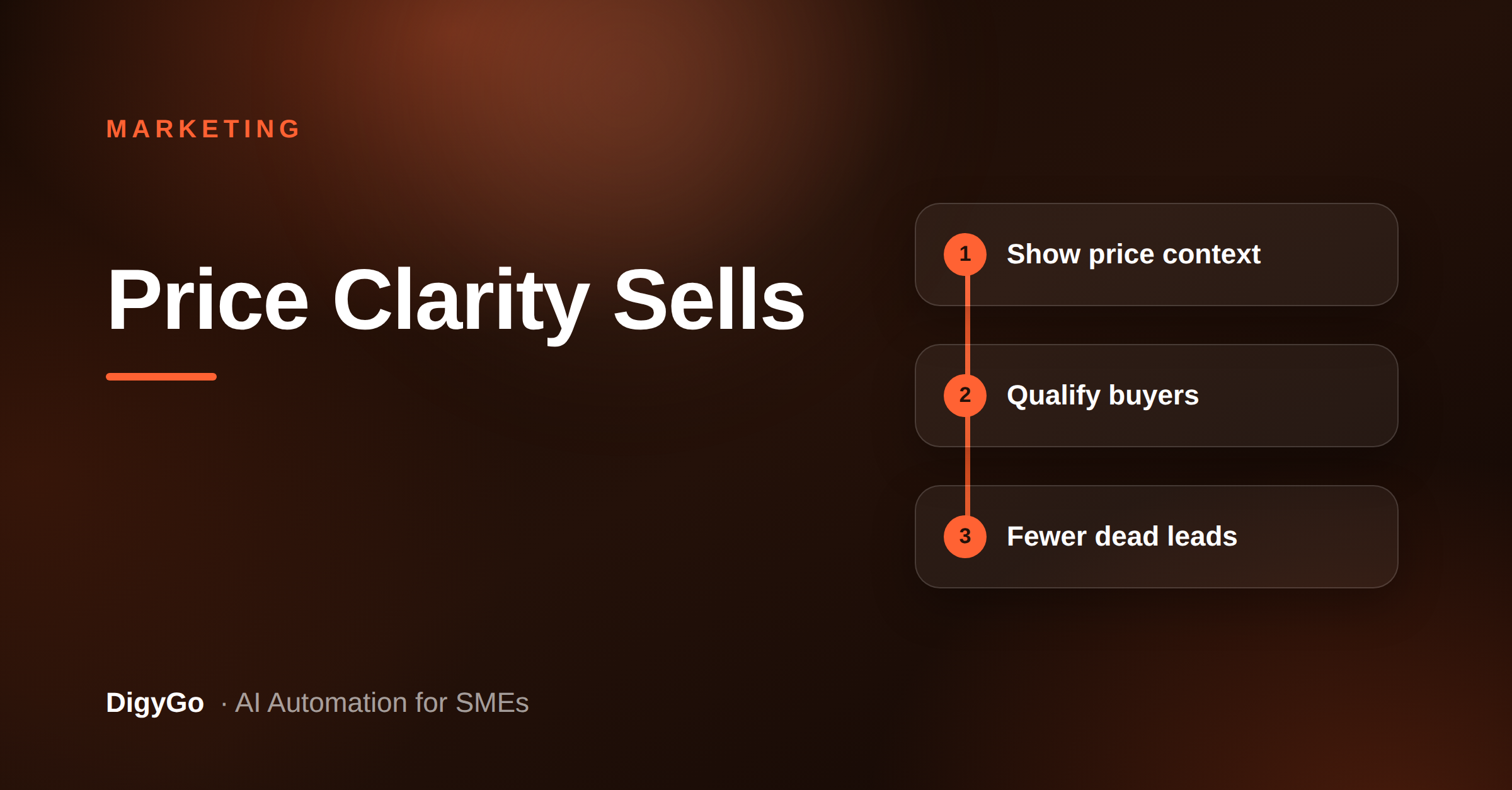
Price clarity does not scare away the right buyer. It removes the wrong buyer sooner. That matters because bad-fit leads consume time in three places: the enquiry form, the sales call, and the follow-up loop.
When you add price cues to the page, the people who enquire are usually more serious. They already understand the ballpark, the process, and the value. That makes the conversation more commercial and less exploratory.
"Good service pages do not attract everyone. They attract the right someone."
— Sivaraj, Founder & CEOThree signals that qualify better leads
- A starting range, package tier, or project band.
- A simple explanation of what influences the final cost.
- A clear statement of who the service is and is not for.
What to publish if you do not want to list a flat fee
Not every service needs a single price tag. Custom projects, retainers, and larger consulting offers can still give the buyer enough context to self-qualify.
If you cannot publish a fixed rate, publish one of these instead:
- Starting from — useful when project scope can vary.
- Typical range — helps the buyer understand budget fit.
- Package tiers — ideal when you have clear service levels.
- What's included — if outcomes matter more than raw price.
The goal is not to trap yourself into a number. The goal is to reduce ambiguity. If the page helps a visitor understand the likely investment, it does its job.
A service-page structure that sells
The strongest pages answer the buyer's questions in the order they ask them mentally: what is this, who is it for, what does it cost, what do I get, and what happens next?
| Section | What it should do | Why it helps |
|---|---|---|
| Hero | State the service outcome and the right-fit customer. | Stops unqualified traffic from bouncing immediately. |
| Price context | Show a starting point, range, or tier. | Qualifies budget early and lowers hesitation. |
| Proof | Use results, testimonials, or mini case studies. | Shows why the price is justified. |
| Process | Explain what happens after enquiry. | Makes the next step feel safer. |
Good service pages sell the process, not just the promise
People are rarely buying a vague service. They are buying a result delivered through a process. If you explain how the work happens, the price feels less arbitrary.
For example, a founder looking for lead generation help wants to know whether they are buying strategy, execution, reporting, and support — or only a one-time setup. When the process is visible, the investment makes more sense.
Common mistakes founders make
- Hiding every number — this creates uncertainty instead of interest.
- Only saying "contact us" — it shifts the burden to the buyer.
- Listing features without outcomes — the price then feels disconnected from value.
- Talking only to dream buyers — you need a page that also filters out poor-fit enquiries.
- Making pricing sound apologetic — confidence helps the page convert.
If your service page feels vague, the issue is usually not the price itself. It is the lack of context around the price.
FAQ
Will showing price reduce enquiries?
It may reduce total enquiries, but often improves lead quality. That usually means fewer wasted calls and a better close rate.
What if my service is fully custom?
Show a range, a starting point, or a set of package examples. You only need enough context for the buyer to self-assess fit.
Should every service page include pricing?
Yes, if the goal is lead generation. The format can change, but the page should still give the buyer a sense of investment.
How do I talk about price without sounding cheap?
Lead with outcomes, then explain scope, process, and support. Price becomes stronger when the value is visible.
Bottom line
A service page that answers price earlier does not weaken your sales process. It strengthens it. The right buyers feel more confident, the wrong buyers self-select out, and your sales conversations start from a better place.
If you want service pages that bring in better-fit leads, book a free call with DigyGo and we will help you shape the message, price context, and enquiry flow.