If your sales team wastes time on the wrong calls, the problem usually starts before the call happens. A simple lead qualification form can save hours, raise lead quality, and help SMEs speak only to prospects who are more likely to buy.
A practical guide for SME founders on using a simple qualification form to improve lead quality, protect sales time, and speed up follow-up.
For founders, the goal is not just to collect enquiries. It is to collect the right details early enough to separate serious buyers from casual clicks, price-shoppers, and low-fit leads.
In this guide
- Why qualification forms improve lead quality
- What questions to ask without killing conversion
- How to connect the form to faster follow-up
- A simple SME lead system you can copy
Why a form improves sales calls
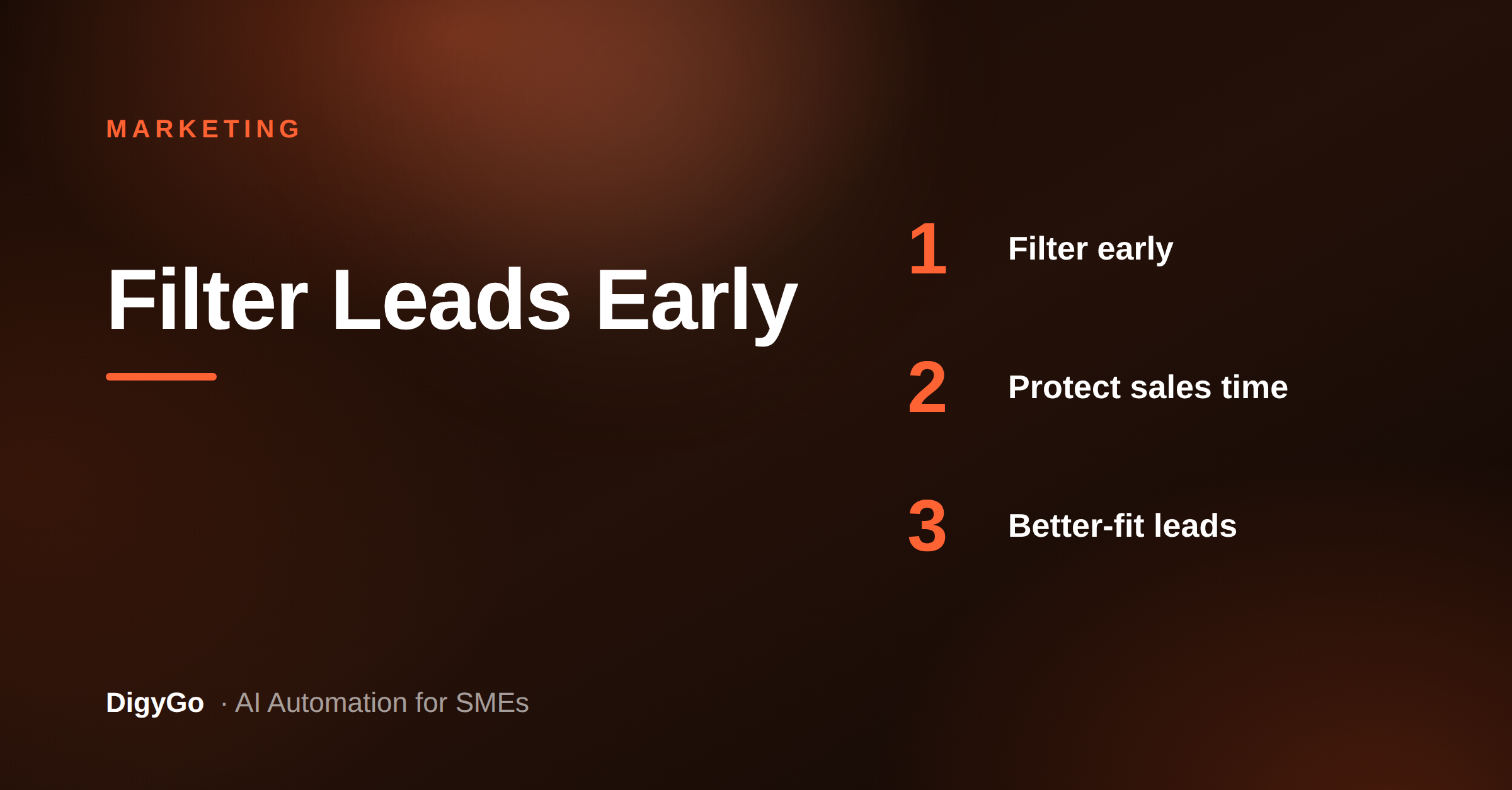
A good lead qualification form does one job very well: it reduces uncertainty before your team spends time on a call. Instead of hoping every enquiry is a fit, you collect enough context to judge intent, budget, and need.
That matters because many SME sales teams are small. Every unqualified call takes attention away from the leads that are actually ready to buy.
What to ask in the form
Do not make the form long. Make it useful. The best forms ask only what helps you decide the next step.
Start with these fields
- Name and contact — so you can follow up quickly.
- Business name — so you know who you are dealing with.
- What do you need help with? — so the prospect states the problem in their own words.
- Timeline — so you know whether this is urgent or early-stage.
- Budget range — so your team can avoid mismatched calls.
Keep the wording simple
Ask in plain language. The more natural the question feels, the more likely people are to complete it honestly.
What not to ask
Too many form fields create drop-off. Too much pressure creates distrust. If you ask for too much too soon, you may lose the lead before the first conversation.
- Do not ask for 10 fields when 5 will do.
- Do not ask technical questions the buyer cannot answer.
- Do not force a lead to write a long essay just to contact you.
- Do not hide the next step after submission.
The form should qualify, not interrogate. That is an important difference for SMEs that rely on trust and speed.
How to use the answers
The form only works if the answers change what happens next. If every lead gets the same response, the qualification step is wasted.
- High intent — route to a call or fast callback.
- Medium intent — send more information and a follow-up sequence.
- Low fit — reply politely and keep the lead in nurture.
At DigyGo, we think of this as a filter before the sales call, not after it. The earlier you identify fit, the cleaner your pipeline becomes.
The simple SME lead system
A practical lead system has four parts: capture, qualify, route, and respond. Most teams only focus on capture. That is why their inbox fills up but revenue does not move.
- Capture — use one clear offer and one clear CTA.
- Qualify — ask the minimum questions that reveal intent.
- Route — send the right lead to the right person.
- Respond — follow up fast while interest is fresh.
When these steps work together, the business stops treating every enquiry like a maybe. It starts treating the pipeline like a system.
“A strong lead form does not create friction. It removes the wrong friction and leaves only the leads worth your team’s time.”
— Sivaraj, Founder & CEOFAQ
Will a qualification form reduce total enquiries?
It may reduce low-quality enquiries, but that is usually a good thing. The aim is better sales conversations, not just a bigger count.
How many questions should the form have?
Start with 4 to 6 important fields. If you need more, test carefully and watch where drop-off happens.
Should I use a form or WhatsApp first?
Use the channel that fits the buying process. For many SMEs, a form plus WhatsApp follow-up works well because it balances structure and speed.
Bottom line
If your team is spending time on weak leads, a lead qualification form is one of the easiest fixes. It helps the business collect better context, protect sales time, and respond to the right people faster.
That is how SMEs build a cleaner pipeline: fewer random calls, better-fit prospects, and a clearer path from enquiry to conversation. Talk to DigyGo about building that system.