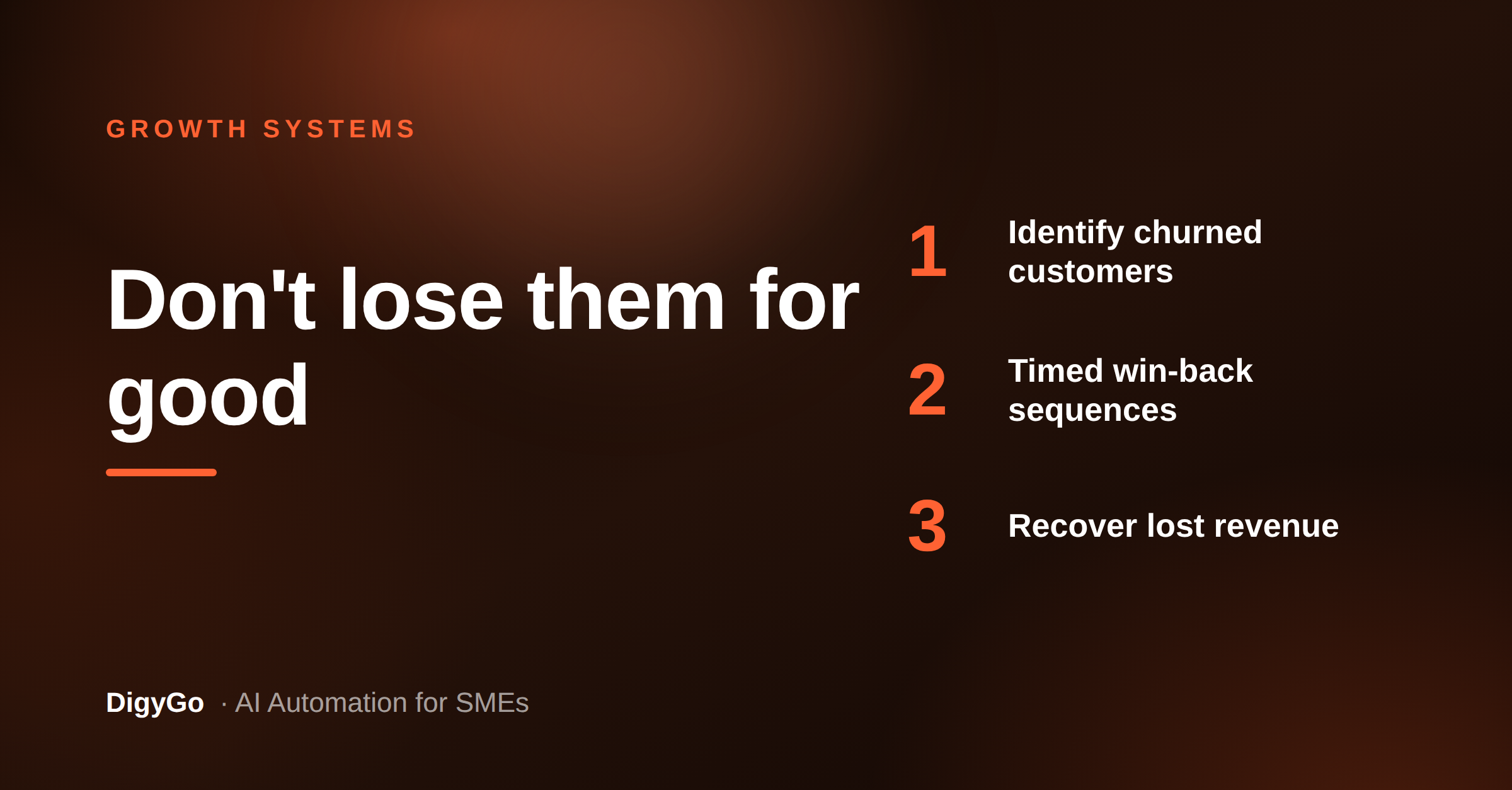
Every SME loses customers. The question is whether those customers ever come back — and most don't, because there is no system designed to win them back. A customer win-back system changes that by turning lost revenue into recoverable revenue through a repeatable, time-tested process.
A practical guide for SMEs on building a repeatable customer win-back system that identifies churned customers, runs timed re-engagement sequences, and recovers lost revenue without a dedicated retention team.
SMEs spend heavily on acquiring new customers — ads, referrals, sales calls — yet few invest a fraction of that effort into winning back the ones who already bought, already trusted them, and already left. The gap is not in motivation but in process. A formal win-back system gives your business a structured way to re-engage churned customers, recover recurring revenue, and plug the biggest leak in your growth bucket.
Why Churned Customers Are Your Cheapest Growth Opportunity
A customer who already bought from you knows your product, trusts your brand, and needs minimal onboarding. Winning one back costs a fraction of acquiring a new lead, yet the return is often higher because returning buyers tend to spend more per transaction and refer others at a higher rate.
Studies consistently show that increasing customer retention by even 5 percent can lift profits by 25 to 95 percent. Win-back sits at the intersection of retention and re-acquisition — keeping a former customer from being permanently lost is the most efficient growth move most SMEs never make.
The Four Pillars of a Win-Back System
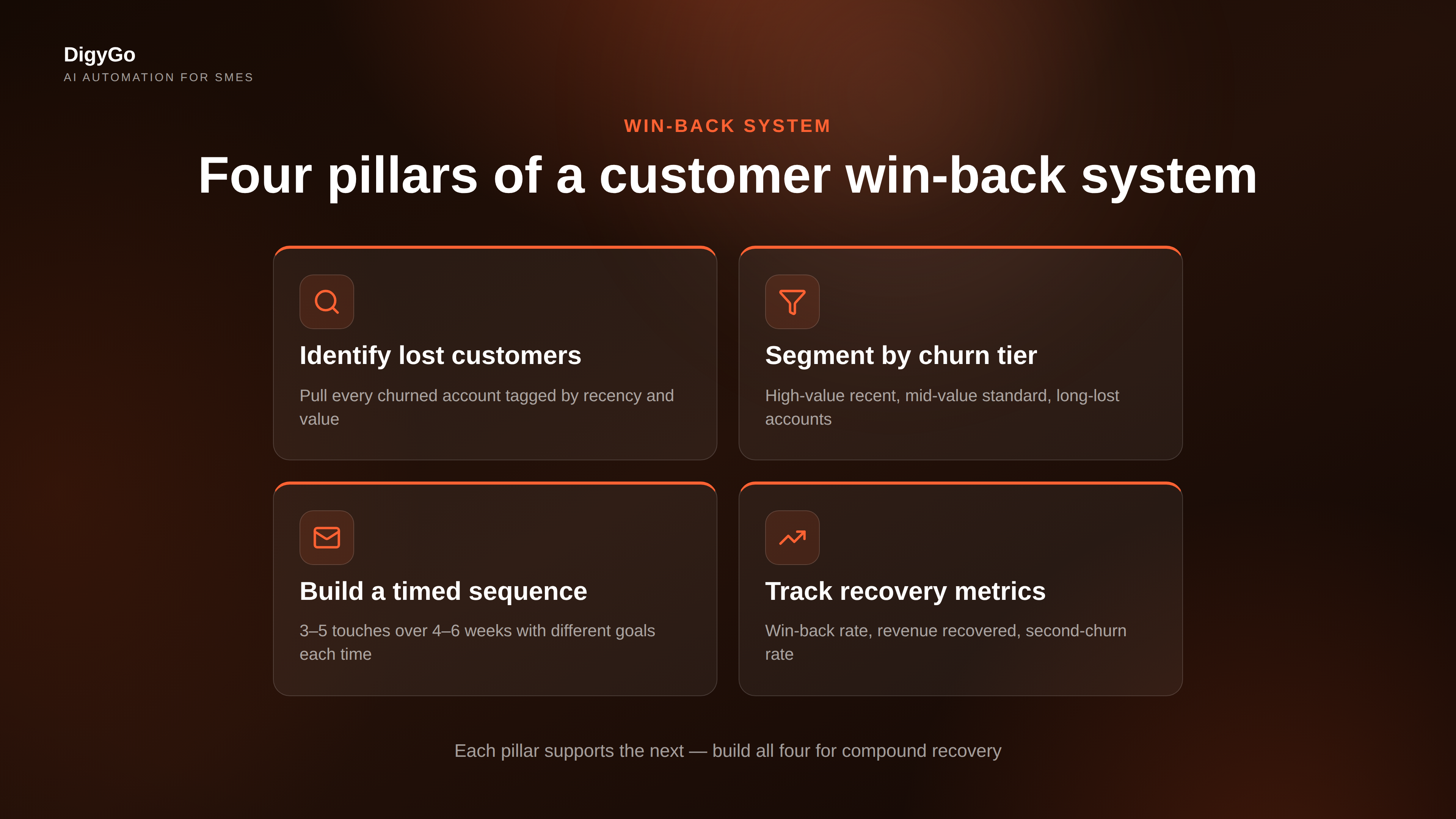
The Four-Step Win-Back System
Building a win-back system does not require expensive software or a dedicated retention team. It requires a clear process, a few automated touches, and a commitment to measuring what comes back. Here is the four-step system that works for SMEs.
Step 1: Identify and Tag Every Lost Customer
You cannot win back a customer you have not identified. The first step is to pull a list of every customer who stopped buying — filtered by how long it has been since their last purchase, what they bought, and why they left (if that data is available). Tag them as churned in your CRM or spreadsheet, and note the recency and value of their last transaction.
Segment these lost customers into tiers:
- High-value recent churn — customers who spent the most and left within the last 90 days. These are your fastest recovery candidates.
- Mid-value standard churn — customers who bought regularly but stopped 3 to 12 months ago. A targeted offer can often bring them back.
- Long-lost accounts — customers inactive for over a year. A lighter, brand-recall touch is usually better here before a direct sell.
Step 2: Build a Timed Win-Back Sequence
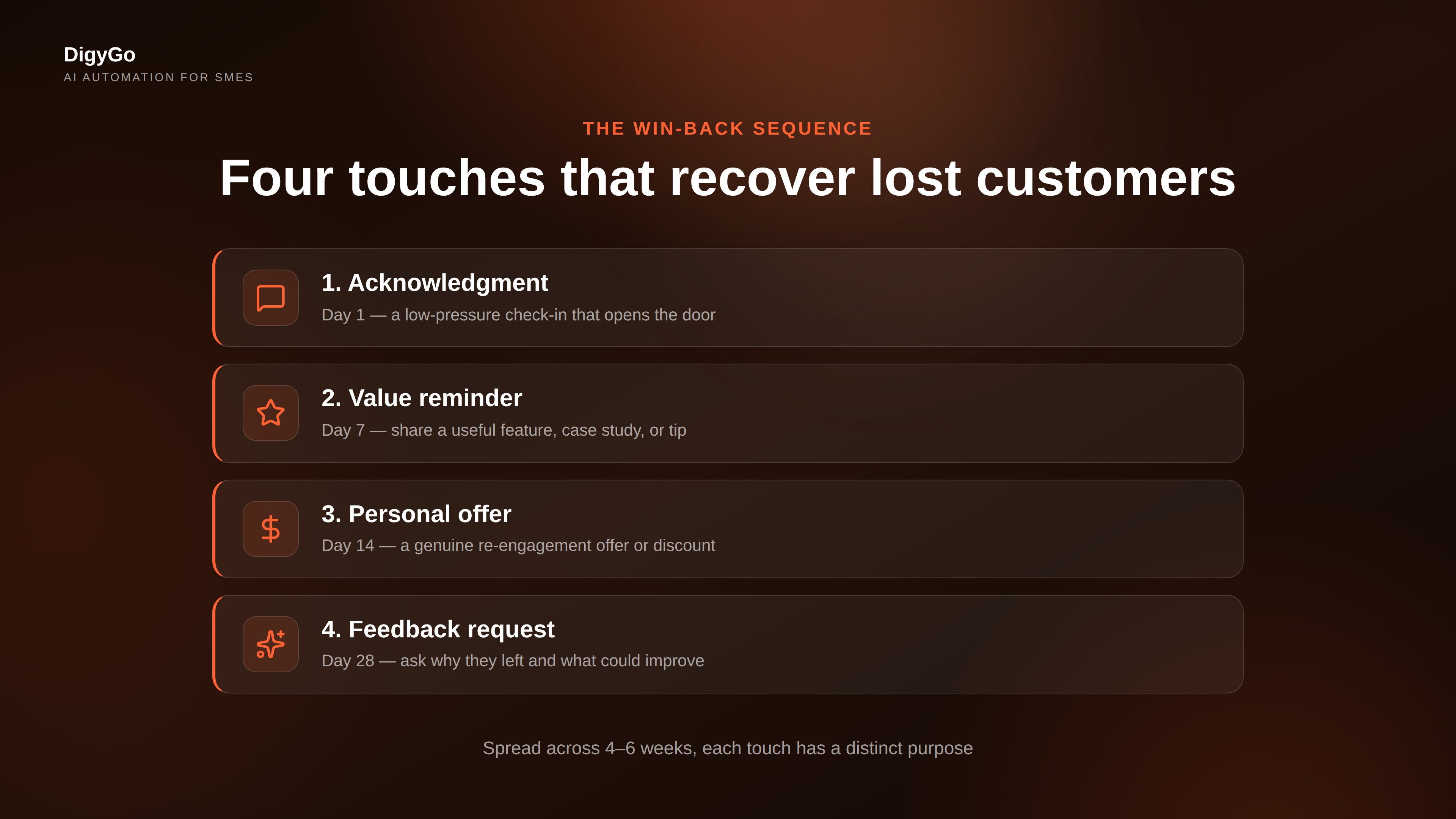
A single email or call rarely works. The most effective win-back sequences follow a timed cadence of three to five touches spread over two to six weeks, each with a different goal:
- Touch 1 — Acknowledgment (Day 1): Acknowledge the gap without selling. Something like "We noticed it has been a while — how are things on your end?" keeps the door open without pressure.
- Touch 2 — Value reminder (Day 7): Share something useful — a new feature, a relevant case study, or a tip related to what they bought before. Remind them why they chose you in the first place.
- Touch 3 — Personal offer (Day 14): Extend a genuine re-engagement offer. A discount, a free consultation, or an upgrade can tip the balance for a hesitant returner.
- Touch 4 — Feedback request (Day 28): If they have not re-engaged, ask for honest feedback. This signals that you value their opinion and may uncover why they left in the first place.
Step 3: Personalize the Re-Engagement Offer
Generic win-back offers — "Come back and save 10 percent" — perform poorly because they do not address why the customer left. A personalized offer ties the incentive to the customer's history:
- If they bought a specific service package, offer a free add-on or upgrade to a newer version.
- If they stopped after a poor experience, acknowledge the issue and offer a make-good discount with a clear promise of improvement.
- If they simply stopped buying (no complaint), a gentle "We miss you" with a small loyalty credit is often enough.
Automation makes personalization scalable. A CRM or simple workflow tool can apply rules based on churn tier, last purchase category, and churn reason to send the right offer to the right person without manual sorting.
The Win-Back Sequence Flow
Step 4: Track Recovery Metrics and Iterate
A win-back system without measurement is a hope. Track these metrics to know whether your system is working:
- Win-back rate — the percentage of contacted churned customers who make a purchase within 60 days. Aim for 10 to 15 percent as a starting benchmark.
- Revenue recovered — total revenue from won-back customers minus the cost of the win-back campaign. This is your net recovery value.
- Time to re-engagement — how many days it takes from the first win-back touch to the first repurchase. Shorter times mean your sequence is working.
- Second-churn rate — how many won-back customers churn again within 90 days. If this number is high, the offer or service experience needs fixing, not the sequence.
Review these metrics monthly and adjust your sequence based on what the data tells you. A low win-back rate may mean your offer is too weak. A high second-churn rate may mean you are winning back customers who were never a good fit in the first place.
When a Win-Back System Delivers Compound Returns
Think of a win-back system not as a one-time campaign but as a machine that runs continuously. Every month, it identifies newly churned customers, runs them through the sequence, and feeds recovered revenue back into your growth engine. Over a year, that recovered revenue compounds into a meaningful number — often enough to fund your next acquisition channel or hire.
The businesses that get this right treat win-back as an always-on function, not a quarterly fix. And the ones that ignore it are leaving their cheapest growth dollars on the table, month after month.
Frequently Asked Questions
How long should a win-back sequence run?
Most effective sequences last 4 to 6 weeks with 3 to 5 touches. Beyond that, the cost of continued outreach usually outweighs the return. If a customer does not re-engage within 6 weeks, move them to a long-lost nurture track with monthly or quarterly brand-touch emails only.
Should I call churned customers or just email them?
For high-value churned customers, a personal phone call can outperform email significantly. For mid-value and low-value segments, email and SMS automation provide better cost-to-return ratios. The key is to match the channel to the customer's value tier.
What is a realistic win-back rate for an SME?
Across industries, a 10 to 15 percent win-back rate is a solid benchmark for a well-executed sequence. Service-based SMEs with strong relationships often see higher rates (15 to 30 percent), while e-commerce SMEs typically land closer to 5 to 10 percent.
How do I know why a customer left?
If your business does not collect exit feedback, start with an exit survey built into your cancellation or non-renewal process. Over time, this data becomes the guide for your win-back offers. Without it, use purchase history and engagement patterns as a proxy.
Can a small team run a win-back system?
Yes. A well-designed win-back system is built to run with minimal manual work. Use a CRM with automation rules, email templates, and a simple segmentation approach. A single team member can manage the system in a few hours per week once it is set up.
Turn lost customers into recovered revenue. DigyGo helps SMEs build automated win-back sequences that identify churned customers, send personalized re-engagement messages, and track recovery metrics — without a dedicated retention team. Talk to us about setting up your win-back system →