"Let me think about it." "I'll discuss with my partner and get back." "Send me the details, I'll review." Every SME founder has heard these lines dozens of times — and most of them never hear back. The honest truth is that most stalling is not a no. It is uncertainty dressed up as a deferral. The salesperson who can tell the difference between genuine consideration and polite avoidance — and who knows exactly what to say in each case — closes far more deals without ever having to drop the price.
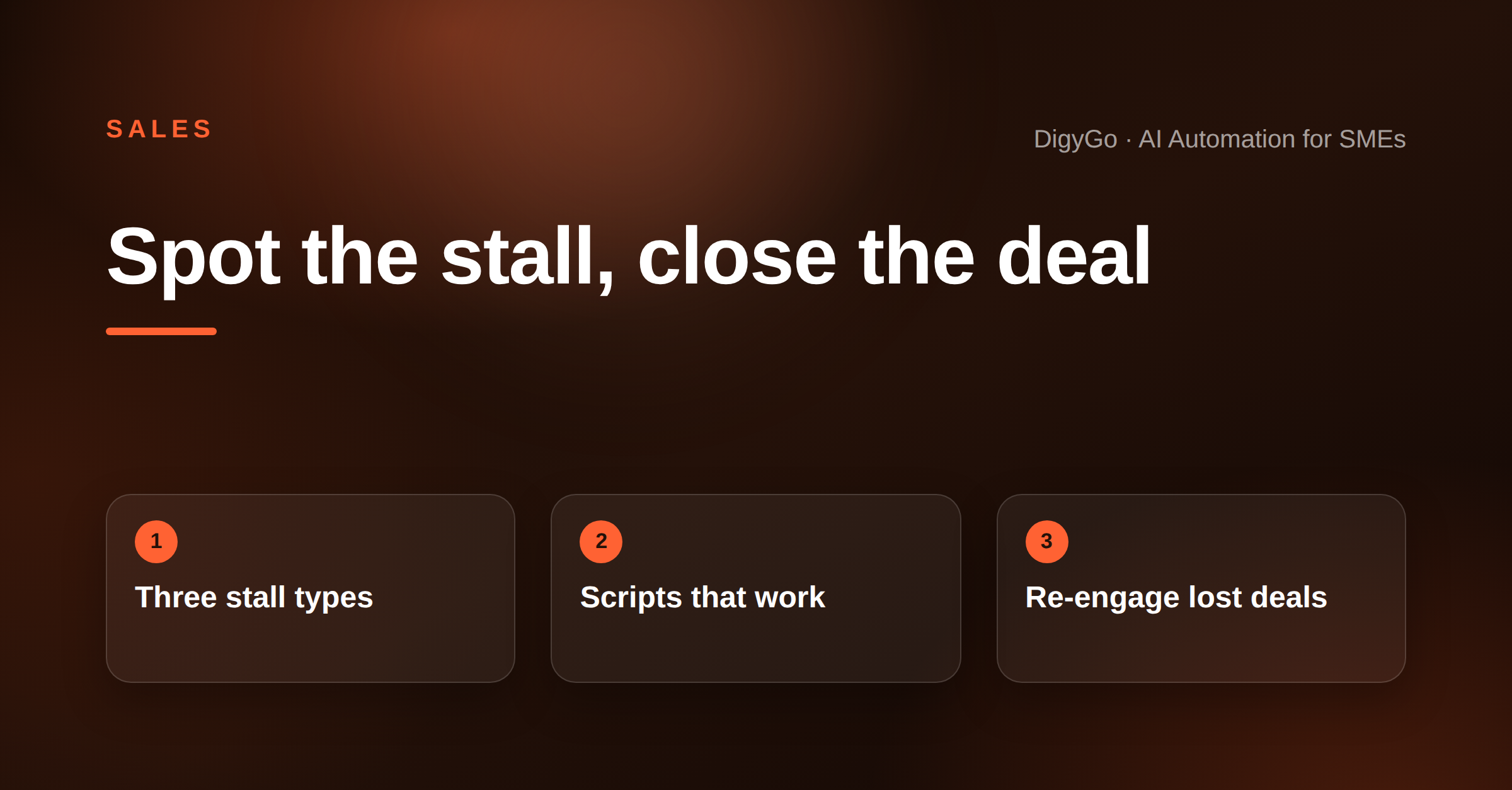
Most SME buyers who stall are not rejecting you — they are stuck on a hidden concern. Here is how to spot which type of stall you are facing and exactly what to say to move the deal forward without discounting.
- Why SME buyers stall — the real reasons behind the hesitation
- The 3 most common stall signals and how to read each one
- Specific scripts and questions to unblock each stall type
- How to test whether a stall is genuine before you invest more time
- A simple follow-up system that re-engages stalled deals without pressure
Stalling Is Not Rejection — It's a Signal
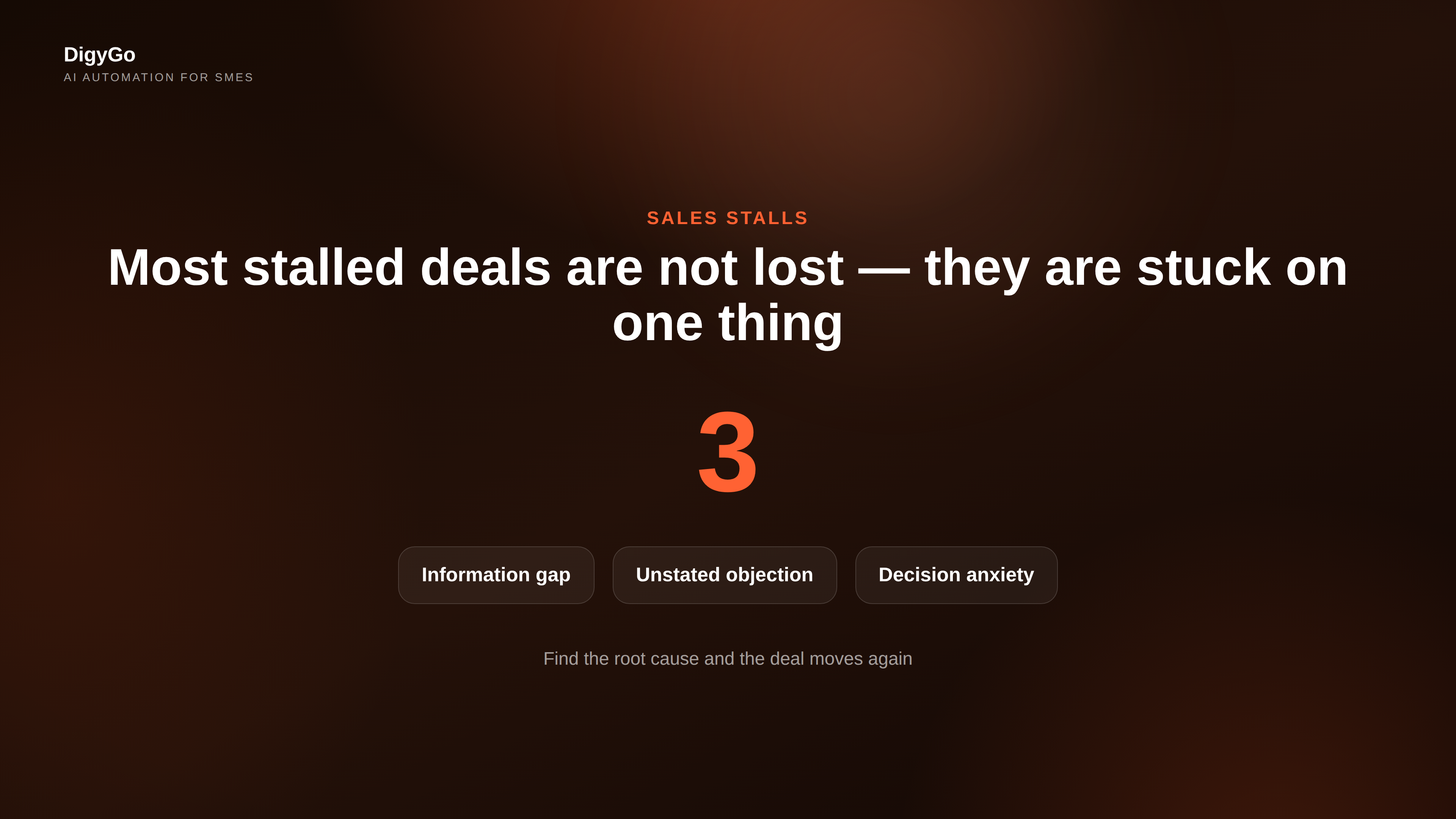
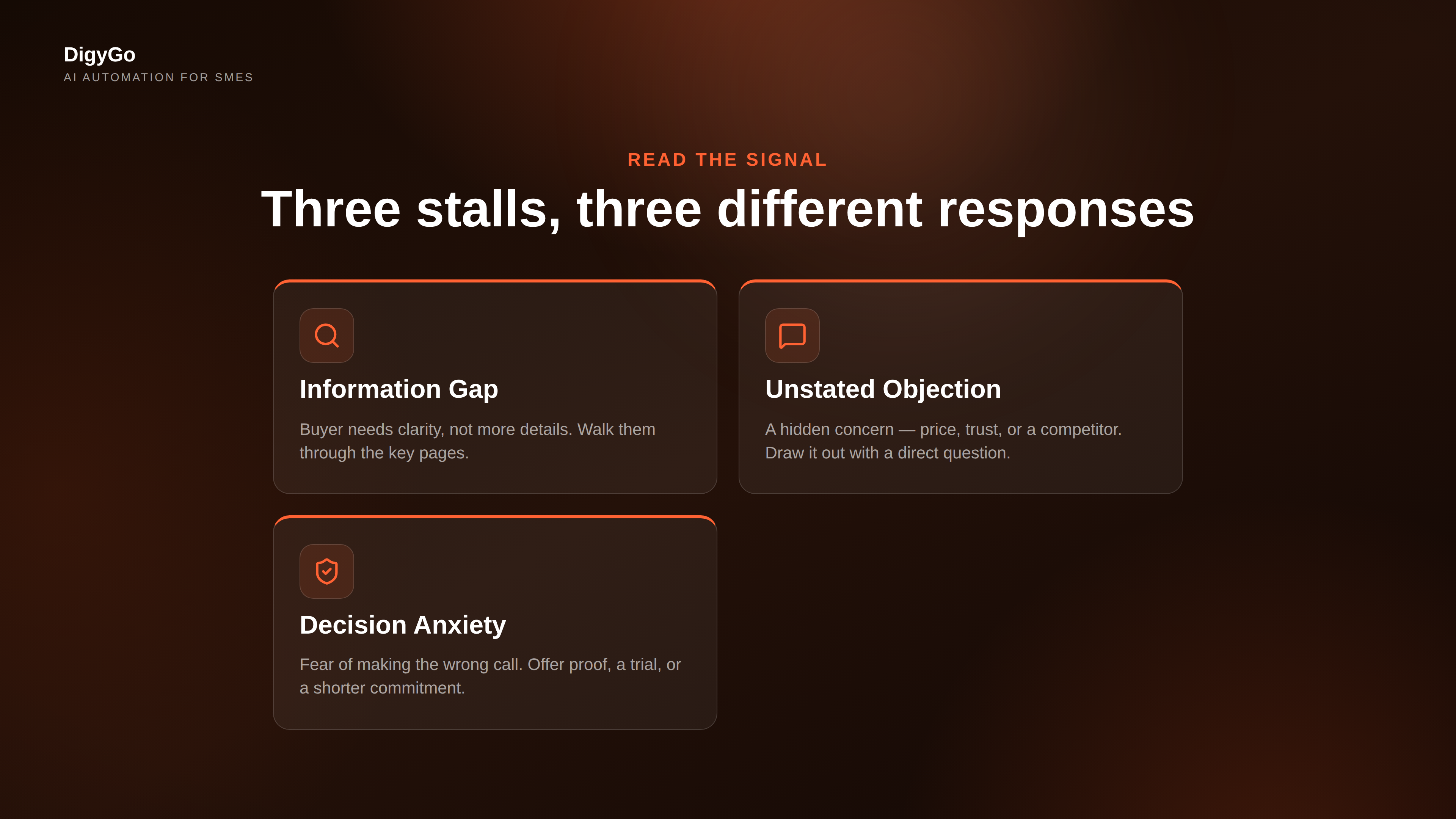
When a prospect says "I need to think about it," most salespeople hear a soft no. But in SME sales, stalling usually signals one of three things:
- Missing information. The buyer does not have enough clarity to make a confident decision.
- Unstated objection. The buyer has a concern they have not voiced — price, timing, trust, or a competitor in the background.
- Decision anxiety. The buyer is worried about making the wrong choice, especially when the decision affects their business directly.
Each of these requires a different response. Sending another email with the same proposal will not help. What helps is diagnosing which type of stall you are facing and addressing the root cause — not the symptom.
The Three Types of Stall and How to Handle Each
1. The Information Stall: "Let me review the details"
This sounds reasonable, and sometimes it is. But the problem is that reviews happen in isolation. Without you in the room — physically or virtually — the buyer reads your proposal like a document, not a conversation. They focus on price, miss the value, and set it aside.
What to say instead:
"I understand you want to go through it carefully. Let me walk you through the two most important pages in five minutes — I can answer any questions that come up right away, and then you will have the full picture before you sit down to decide."
This buys you a short call without pressure. On that call, your job is not to pitch again — it is to listen for the real concern and clear it.
2. The Approval Stall: "I need to check with my partner"
In many Tamil Nadu SMEs, business decisions involve family — a spouse, a sibling, a co-founder. This stall is usually genuine. The trick is making sure you are not left out of that conversation.
What to say instead:
"That makes total sense. What are the two or three things your partner is most likely to ask about? If I send you a one-page summary that addresses those, it makes your conversation much easier. And if it helps, I am happy to jump on a quick call with both of you — no pressure, just questions."
Offering a joint call signals confidence. Buyers who are truly interested take you up on it. Buyers who are hiding behind the approval excuse tend to decline — and that tells you something useful too.
3. The Anxiety Stall: "Let me think about it"
This is the most common and the hardest to read. The buyer likes what you offer but is afraid to commit. They worry about wasting money, picking the wrong vendor, or being locked into something they do not fully understand.
What to say instead:
"A lot of our customers felt the same way before they started. Can I ask — what is the one thing that makes you most hesitant right now? Is it the investment, the timing, or something about how it works?"
This question does two things. It names the hesitation without judgment, and it gives the buyer permission to say the real concern out loud. Once the concern is spoken, it can be addressed. Until it is spoken, you are negotiating with a ghost.
The Speed-to-Lead Stall Test
Here is a practical way to test whether a stall is genuine: give the buyer a small, easy next step and see if they take it.
The test:
"Totally fair. Here is what I will do — I will send you a short video (two minutes) that covers the three things our customers tell us they wish they had known before starting. Watch it when you get a chance, and if it still makes sense, we can pick it up from there."
A genuinely interested buyer watches the video and comes back. A staller does not — and that saves you weeks of chasing a deal that was never going to close.
Creating Urgency Without Pressure
Urgency is not about fake deadlines or expiring discounts. For SMEs, genuine urgency comes from the cost of delay. Your job is to help the buyer see that cost clearly — not to manufacture a reason to hurry.
Use this frame:
"I am not saying you need to decide today. But let me ask — if you put this off by three months, what changes in your business during that time? How many leads slip through? How much time do your team spend on manual work that this would handle?"
When the buyer answers those questions themselves, urgency becomes internal — not something you imposed. And internal urgency closes deals without resistance.
The Follow-Up That Re-Engages a Stalled Deal
Even after your best effort, some deals go quiet. The buyer does not say no — they just stop responding. Most salespeople send a "just checking in" email and get silence. Here is a better approach:
- Touch 1 (day 3): Share a relevant insight — "Saw this article about how [industry] businesses are handling [problem]. Thought of you." No ask, no pressure.
- Touch 2 (day 7): Offer a clean exit — "Not sure if this is still a priority for you. If the timing is off, just say the word — no hard feelings, and I will check back in a few months."
- Touch 3 (day 14): One last value — "I put together a one-page summary of what we discussed. Even if the timing is not right now, this might be useful later."
Touch 2 is the most important. When you give the buyer a guilt-free exit, one of two things happens: they either take the exit (and you stop wasting time), or they re-engage because you removed the pressure. Both outcomes are better than silence.
Frequently Asked Questions
How long should I wait before following up on a stalled deal?
Three days is a good rhythm for the first follow-up. Waiting a full week gives the impression you are not that interested. Following up the next day feels desperate. Day 3 strikes the right balance — attentive but not pushy.
What if the buyer says "I need to think about it" but never responds to any follow-up?
That is almost always a soft no. Use the exit offer in Touch 2 above. If they do not take it either, move on. Some buyers cannot bring themselves to say no directly, but their silence is the answer. Spend that energy on better-qualified opportunities.
Should I offer a discount to break the stall?
Rarely. Discounting to break a stall usually teaches the buyer that hesitation earns them a lower price. The next time they buy — or tell a friend — they will stall again, expecting the same result. Instead, offer scope flexibility, better payment terms, or a shorter commitment period. Those protect your price while addressing the real hesitation.
Can I prevent stalling before it happens?
Yes. The best prevention is a strong discovery process. When a buyer has clearly articulated their problem, understands the cost of inaction, and sees how your solution maps to their specific situation, the stall is far less likely. Stalling thrives on ambiguity. Clarity is the antidote.
Is stalling more common with SME buyers than enterprise buyers?
Different, not more. Enterprise buyers stall because of process — committees, approvals, procurement cycles. SME buyers stall because of personal decision anxiety — the money comes from their pocket, and the risk feels closer. The approach for each is different, but the solution is the same: address the root cause, not the surface behaviour.