Every SME owner has felt it. A potential customer comes in, asks the price, compares you with three other businesses, and picks the cheapest. No loyalty, no differentiation, no margin. You end up competing on price because there is nothing else anchoring the decision.
A practical guide for SME founders on building a brand position that attracts the right customers, reduces price sensitivity, and turns every touchpoint into a competitive advantage without spending more on advertising.
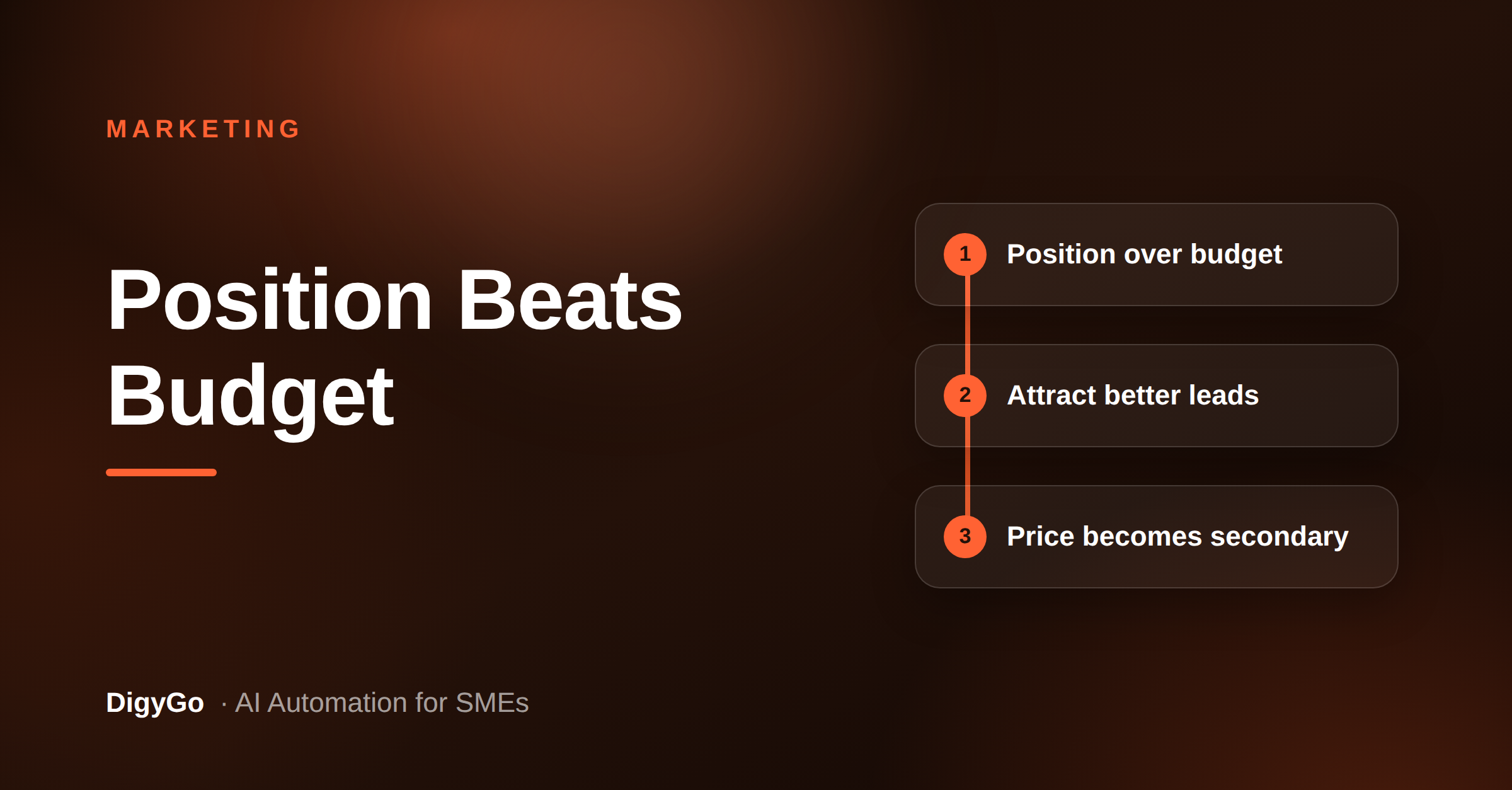
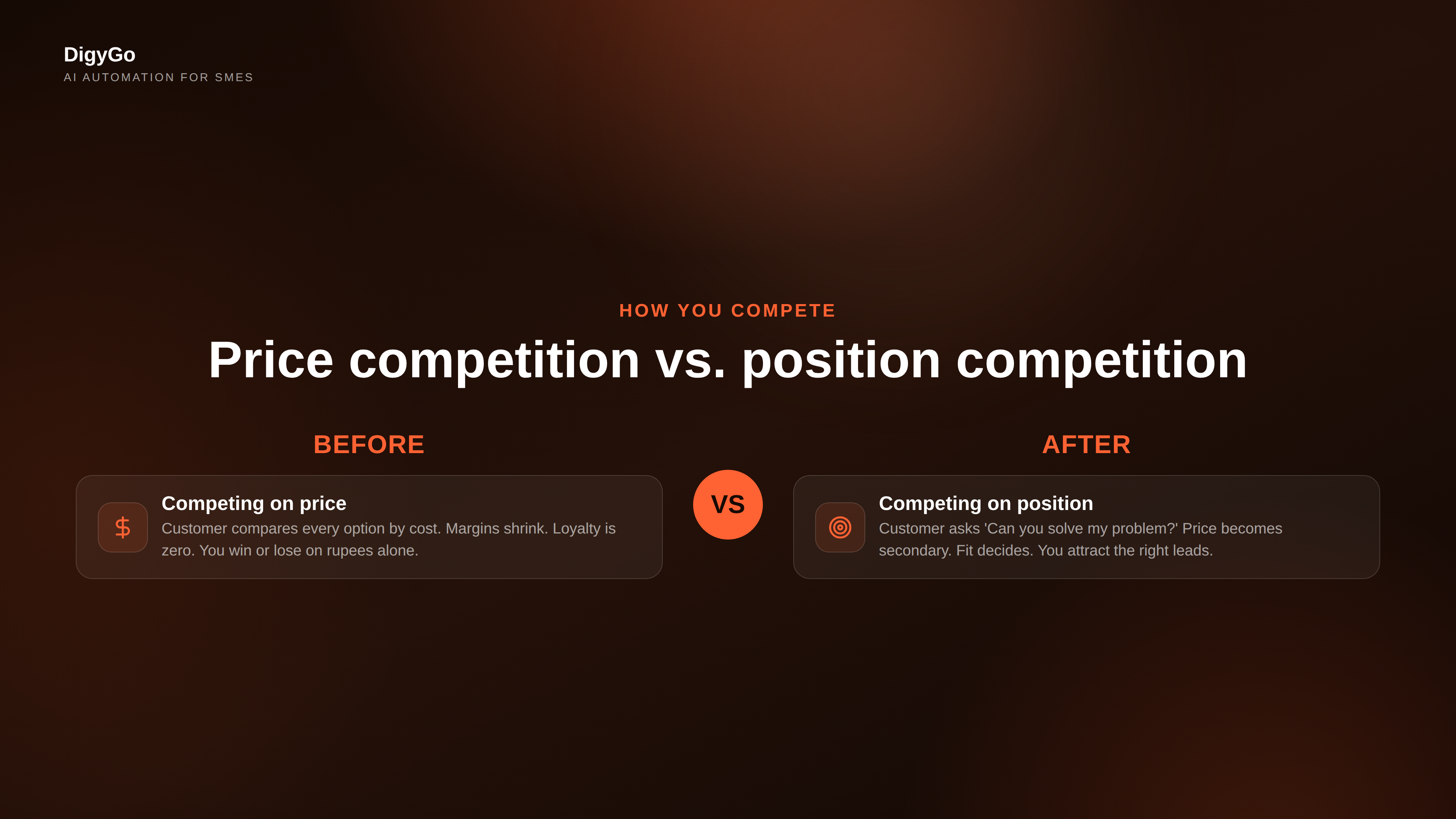
That is not a sales problem. It is a positioning problem. When a business has a clear brand position, the conversation changes. Instead of "How much?" the customer asks "Can you help us?" The price becomes secondary to the fit. And that shift happens before the sales call, inside the customer's head, shaped by what they have seen, heard, and associated with your business.
For SMEs with limited marketing budgets, positioning is the most underused lever. It costs nothing to define but changes everything about who walks through the door and what they are willing to pay.
- Why brand positioning matters more for SMEs than for big companies
- The three elements that make a position work
- A practical process to find your position without a consultant
- How to test and reinforce your position with everyday content
Why Positioning Matters More for SMEs
Large brands spend crores on television and billboards to own a space in the customer's mind. SMEs cannot do that. But the good news is they do not have to. In a local or niche market, the bar for differentiation is lower. A clear position cuts through noise faster than a bigger budget.
Think about the last time you chose a service provider. You probably did not evaluate every option equally. You picked the one that felt most relevant to your specific situation. That feeling is positioning at work. The business that owned a specific slot in your mental map got the call first.
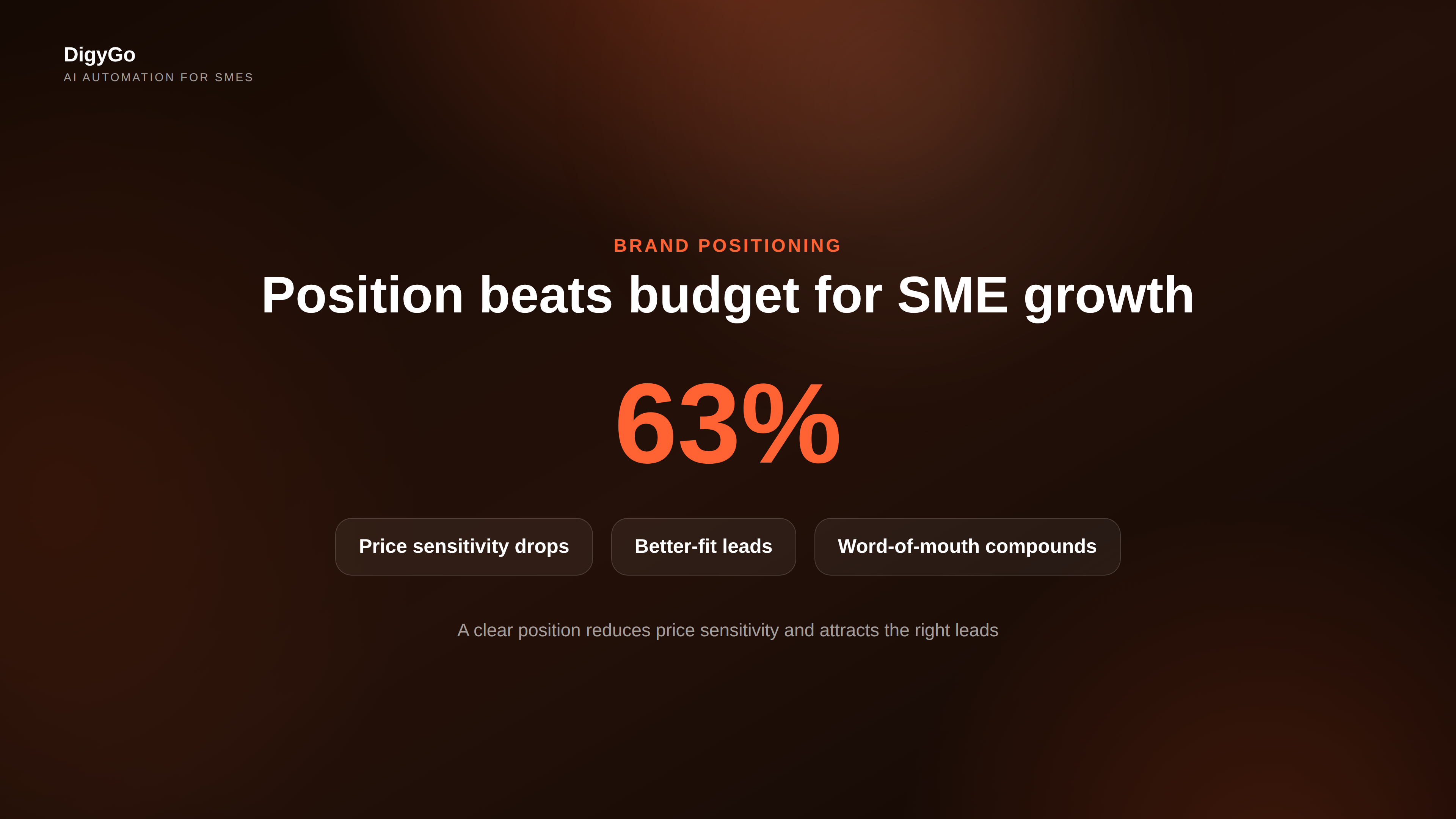
For an SME, a well-defined position does three things that paid ads cannot: it reduces price sensitivity, it attracts better-fit leads, and it makes word-of-mouth referrals more predictable. When someone says "Use that agency, they are good with manufacturing companies," that is a position doing the marketing for you.
The Three Elements of a Working Brand Position
A brand position is not a tagline. It is not a logo colour. It is the intersection of three things that together tell a customer whether you are right for them.
1. Who you serve specifically
Every SME wants to serve everyone. The instinct is understandable — more customers means more revenue. But "everyone" is an invisible position. When you say you serve everyone, the customer has to figure out whether you fit them. Most of them will not do that work. They will move to the business that says "We work with dental clinics" or "We specialise in Coimbatore-based manufacturers."
The specificity signals competence. A business that knows its customer deeply is assumed to solve their problems better. And in most cases, that assumption is correct because the focus allows them to build better processes, better examples, and better outcomes for that segment.
2. The specific outcome you deliver
Competing on process (our CRM, our methodology) is hard because the customer cannot evaluate process quality before buying. Competing on outcome is easier. If you can say "We get wedding photographers booked within 48 hours of enquiry" instead of "We provide enquiry management solutions," the customer immediately knows whether that outcome matters to them.
Outcome-based positioning turns your service into a promise. The customer does not need to understand how you do it. They only need to want what you promise.
3. The proof that backs it up
A position without proof is just words. The proof can be small — a case study, a testimonial, a repeat customer logo, a data point. For an SME, even one strong example is enough to make the position credible. A tile company that says "We supply to 40% of the hotels in Ooty" has a position backed by a specific claim. That is far more powerful than "Quality tiles supplier."
Proof does not need to be expensive to collect. A short Google review, a WhatsApp screenshot of a happy customer, a photo of a completed project — each is a piece of evidence that reinforces the position and makes it feel real to the next prospect.
How to Find Your Position Without a Consultant
You do not need a brand workshop or a fancy agency to find your position. You need honest answers to four questions.
- Who do you serve best? Look at your last 20 customers. Is there a pattern? A specific industry, location, business size, or problem that shows up repeatedly? That is your natural segment.
- What do they thank you for? Read your reviews, messages, and feedback. The thing customers consistently mention as the reason they chose you is your strongest position claim.
- What do you not want to be? Defining what you are not is as important as defining what you are. If you do not want to be the cheapest, say so in your positioning.
- What would change if you disappeared? If your business vanished tomorrow, which customers would struggle most? That dependency reveals your true niche.
Write the answers down. Then try to express your position in one sentence: "We help [specific customer] achieve [specific outcome] by [your unique approach]." If that sentence sounds like every other business, refine until it does not.
Reinforcing Your Position Through Everyday Content
Once you have a clear position, the goal is not to announce it once on the website. The goal is to make every touchpoint reinforce it. Every social media post, every reply to a customer enquiry, every conversation with a prospect is an opportunity to strengthen the position.
Content that reinforces position does not need to be elaborate. A short LinkedIn post about a specific problem your customers face, a WhatsApp broadcast sharing a customer success story, a website testimonial section focused on one customer type — each of these quietly tells the market who you are for and what you deliver.
The most powerful positioning content is the kind that helps the customer make a decision. When a prospect reads your post and thinks "That is exactly my situation," the position is working. They are not comparing you on price anymore. They are comparing everyone else to you on fit.
Common Positioning Traps for SMEs
- Positioning by features. Listing your tools, certifications, or years of experience does not differentiate you unless those features directly produce a different outcome for the customer.
- Copying a competitor's position. If your competitor owns "fast service," trying to compete on the same axis makes you a secondary choice. Find a different axis — reliable service, transparent pricing, niche expertise.
- Changing position too often. A position needs consistency to register. Chopping and changing confuses the market and makes you look generic.
- Ignoring the existing position you already have. Your customers already have a perception of you. If that perception is different from the position you want, bridge the gap with proof rather than ignoring it.
Frequently Asked Questions
Is brand positioning only for big companies with marketing teams?
No. In fact, positioning is more valuable for SMEs because you cannot outspend competitors. A clear position is a free advantage that compounds every time someone mentions your business.
How long does it take to establish a brand position?
You can define a position in a few hours. Getting the market to recognise it takes consistent reinforcement over weeks and months. Start small: update your website headline, your social bio, and how you introduce your business in conversations.
Can an SME change its position later?
Yes, but changes cost recognition. If you shift from "Wedding photographers" to "Corporate event photographers," you essentially start over. Choose a position you can own for at least 12-18 months before you consider changing.
Does positioning matter for service businesses more than product businesses?
It matters for both. Service businesses benefit more because the customer buys trust before they buy the service. A strong position builds that trust faster than any sales pitch.
What if my business serves multiple customer types?
Position for your most profitable or most defensible segment first. Once that position is established, you can add secondary segments without confusing the core message. Trying to position for everyone at once results in a position for no one.
Your Position Is Your Cheapest Marketing Asset
A clear brand position does not require a bigger ad budget, a new website, or a marketing hire. It requires clarity about who you serve, what you deliver, and why it matters. Every conversation, every post, every customer interaction can reinforce that clarity — or dilute it.
The businesses that grow faster are not the ones that spend more. They are the ones that make it easier for the right customers to find them and choose them. And that starts with a position that only you can own.
If you are an SME founder thinking about how to sharpen your brand position and turn it into a lead capture system, talk to us at DigyGo. We help Tamil Nadu SMEs build systems that attract the right customers and follow up consistently.