You send a proposal. The client says "looks good, let me review it." Then silence. A week passes, you follow up, they say "still reviewing." Another week. By the time they come back, the urgency is gone, the budget has moved, or they've gone with someone who made it easier to say yes. The problem is rarely your product or your price. It's the proposal itself.
A practical guide for SME founders and sales teams on writing proposals that help buyers decide — with outcome-led structure, ROI math, social proof, and a clear path to yes.
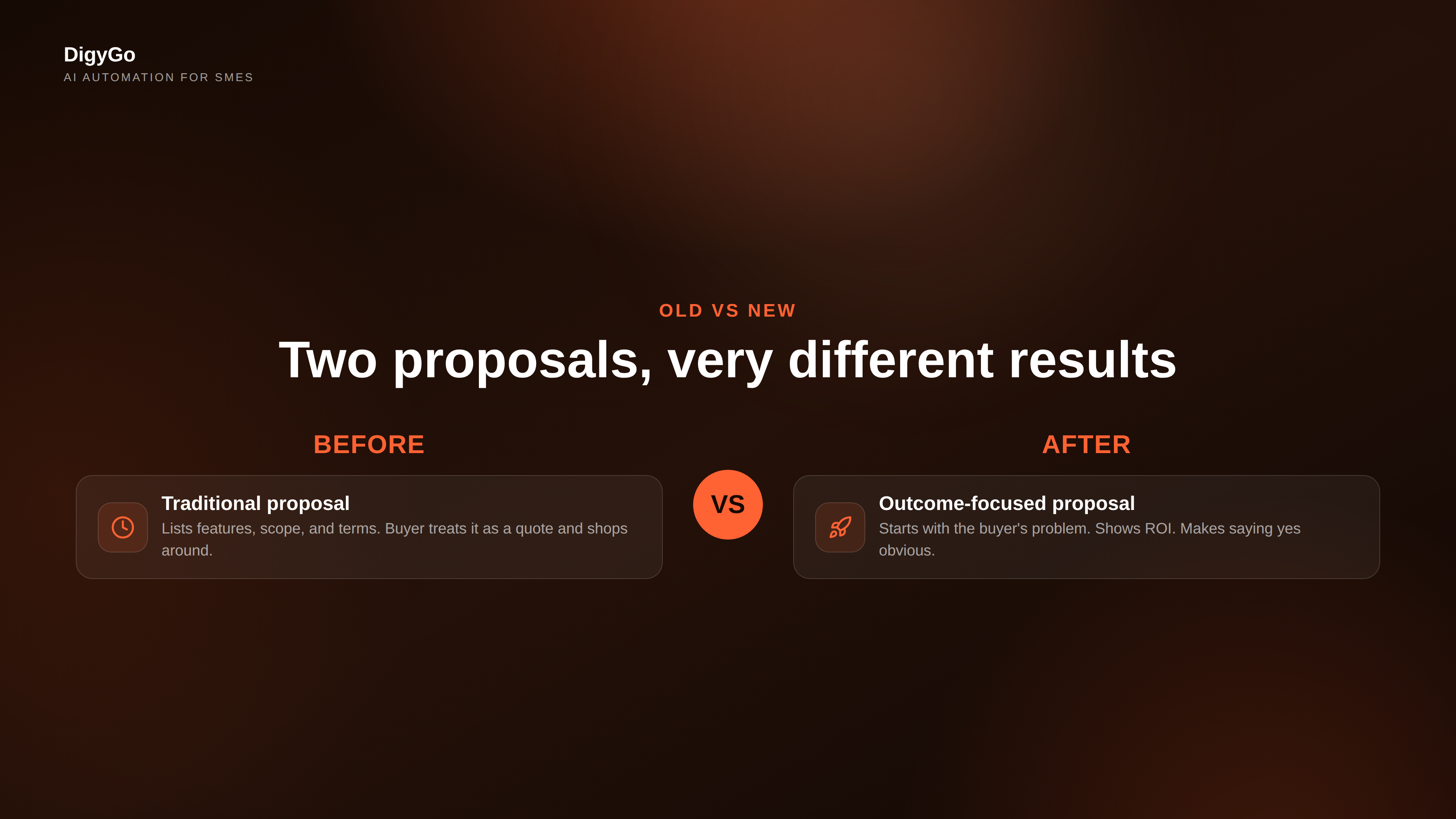
Most SME proposals are written to describe what the seller offers — features, scope, terms. They read like a spec sheet. The proposals that close, on the other hand, are written to help the buyer decide. They lay out a clear problem, a concrete outcome, and a path to get there. They make saying yes feel like the obvious thing to do.
Why most proposals fail before they're read
A proposal lands in the buyer's inbox. They open it, scan the first few lines, see a list of features or a broad scope description, and close it. They planned to read it later. Later doesn't come.
The real failure isn't the follow-up — it's that the proposal never gave the buyer a reason to prioritise it. When a proposal reads like a quotation, it gets treated like one: compared on price, shopped around, delayed until needed. When it reads like a solution to a pressing problem, it gets treated differently. It becomes part of the buyer's decision process, not part of their procurement queue.
The shift is subtle but decisive. You stop describing what you do and start describing what changes for them. That one change transforms how the proposal is received, how quickly it moves through internal approval, and how often it closes without discounting.
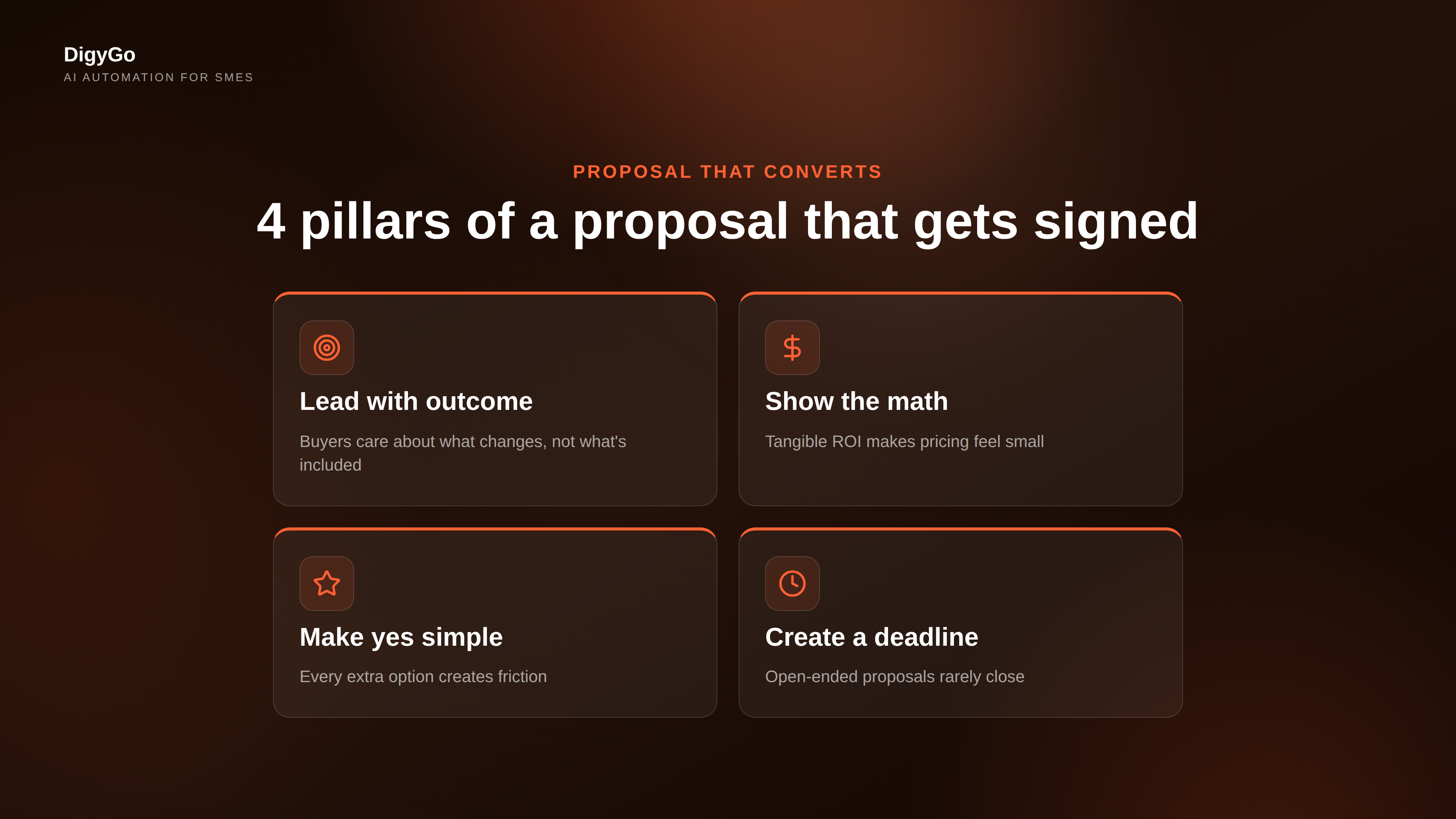
1. Start with the buyer's outcome, not your offer
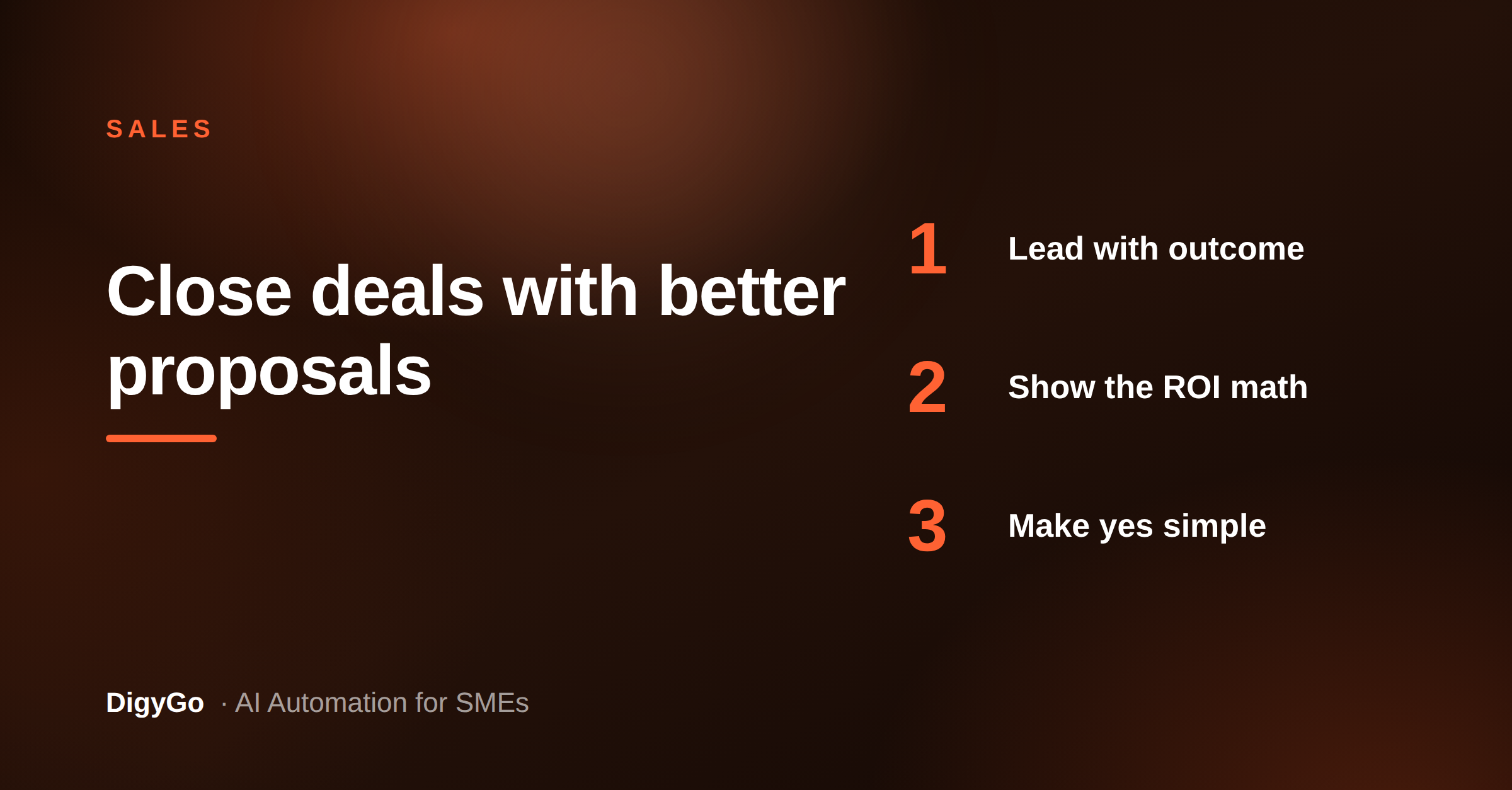
The first page of your proposal should answer one question: what problem are we solving together, and what does success look like? Not what the project includes, not how many hours, not your methodology. The outcome.
A metal fabrication workshop in Coimbatore doesn't buy a CRM because they need a database. They buy it because too many follow-ups get missed and jobs slip through the cracks. If your proposal opens with "includes 5 user seats, mobile access, and pipeline tracking," you've already lost them. Open with "Every enquiry gets a reply within 2 minutes. Every job gets scheduled. No lead falls through." That's the outcome. The features are just how you deliver it.
Write a short paragraph at the top called What this means for you. Summarise the before-and-after in their language. If they can see themselves in the "after," they're already halfway to yes.
2. Show the math — ROI makes price irrelevant
Pricing is only a problem when value is unclear. If your proposal shows exactly what the buyer gains — in money saved, time recovered, or revenue added — the price looks like a small investment by comparison.
This doesn't require complex financial models. A simple line works: "Currently you spend X hours per week on Y. At your billing rate, that's ₹Z per month. Our solution reduces that to A hours. Your saving: ₹B per month." When the saving exceeds the investment, the conversation shifts from "can we afford this" to "can we afford not to."
If you can't quantify the outcome directly, use a benchmark or a comparable case: "A similar workshop in Trichy cut their response time from 4 hours to 3 minutes and recovered ₹18,000 per month in lost opportunities." Buyers don't need perfect precision. They need to see the direction of the math.
3. Make it easy to say yes — remove the friction
Every unnecessary option, condition, or variable in your proposal makes it harder for the buyer to decide. Three pricing tiers, two implementation models, optional add-ons — each one forces the buyer to evaluate more, compare more, and delay more. The easiest proposal to close has exactly one recommendation, one price, and one clear path forward.
If you must offer options, keep them to two: a recommended plan and a stripped-down version. Frame the recommendation as the sensible choice and the alternative as "if budget is tight right now." That way, the buyer picks between moving forward and compromising — not between three unknowns.
Also simplify the logistics. Include a short checklist of what you need from them to start: signed proposal, a brief kick-off call, their logo files. The less they have to figure out, the faster they decide.
4. Use the buyer's own language — not your internal jargon
Proposals that close sound like the buyer, not the seller. Read your proposal aloud. Would your client use the words you've written? Or would they say "we want to fix our enquiry follow-up" while you've written "implement a lead management protocol with automated touchpoint sequencing"?
The gap between your language and theirs creates distance. The buyer has to translate your proposal into their own context before they can decide. Most don't bother. They put it aside and tell themselves they'll come back to it.
Quote their own words back to them. If they said "we keep losing follow-ups because there's no system," use that exact phrase in the proposal. "You said follow-ups get lost because there's no system. Here's how we fix that." When a buyer reads their own problem described in their own words, trust accelerates. The proposal stops feeling like a generic quote and starts feeling like a custom solution.
5. Add social proof that matches their situation
A case study or testimonial in a proposal does more than any feature list. But it has to match. A testimonial from a textile company in Tirupur means more to a textile buyer in Erode than one from a restaurant chain. Same industry, similar geography, comparable problem.
Keep a short bank of 3–4 client stories that cover your most common deal profiles. When you send a proposal, pick the one that most closely mirrors the buyer's situation and include it — either as a one-paragraph summary or a one-page case study attachment. The buyer reads it and thinks, "if it worked for them, it can work for me." That's the closest thing to a shortcut to a close.
6. End with a clear next step and a deadline
A proposal without a next step is a document. A proposal with a next step is a process. Include a specific, low-friction action: "I'll call you on Thursday at 11 AM to walk through this. If you'd like to move ahead sooner, just reply to this email with 'yes' and I'll send the onboarding form."
Equally important: give the proposal an expiry. An open-ended proposal signals that the offer isn't time-sensitive, which means the buyer deprioritises it. A 7-day validity creates a gentle but real nudge. It forces a decision while the conversation is still fresh, the problem still hurts, and the budget is still allocated. You can extend it if needed, but don't remove it entirely — the deadline does real work in shortening the close cycle.
7. Format for scanning, not reading
Most buyers won't read your proposal word to word. They'll scan the headings, check the price, glance at the timeline, and decide. If the key information is buried in a paragraph, they'll miss it. Structure the proposal so the decision-relevant content is immediately visible:
- The outcome — first thing they see (1–2 lines at the top)
- The price — clear, not hidden in terms and conditions
- The timeline — how fast they can expect results
- The next step — what happens when they say yes
Use short sections, bold headings, and plenty of white space. If the proposal can be understood from its headings alone, it's structured right. If someone has to read paragraphs to find the price or the timeline, restructure it.
The proposal that closes
A proposal is not a quote. It's a decision-making tool. When you lead with the buyer's outcome, show the math, simplify the choice, speak their language, include relevant proof, and create a clear deadline, you're not selling harder — you're making it easier to buy. That distinction is what separates proposals that get read from proposals that get signed.
"The easiest proposal to close has exactly one recommendation, one price, and one clear path forward."
Frequently asked questions
Should I include pricing before the proposal meeting?
No. Send the proposal in a meeting or call where you can walk through it together. Pricing shown without context gets compared, not understood. Walk through the value first, then reveal the investment.
How long should a proposal be?
Short enough to scan in 2 minutes. Long enough to answer every question they'd have. For most SME deals, 4–6 pages is enough. If it's longer, use a 1-page executive summary at the front.
What if the buyer asks for a proposal before we've discussed it?
Resist. A proposal without a discovery conversation is a quote request, not a sales process. Schedule the call first, even if it's 15 minutes. The proposal will close at a much higher rate.
Should I use a proposal software or a PDF?
Use whatever format the buyer is most comfortable with. PDF is universally accessible and looks professional. Link-based proposals offer analytics, but many SME buyers prefer something they can download and forward to stakeholders. When in doubt, send a well-formatted PDF.
How do I handle proposals with multiple decision-makers?
Include a section addressed to each stakeholder's concern. The founder cares about ROI. The operations head cares about implementation. The finance team cares about payment terms. Address all three briefly in the same proposal so nobody feels their question is unanswered.
Your next step
The fastest way to improve your close rate isn't more follow-ups or bigger discounts. It's a proposal that helps the buyer decide. Start with the outcome, show the math, simplify the choice. Then watch how many more of them say yes.
Talk to DigyGo about building proposals that close →