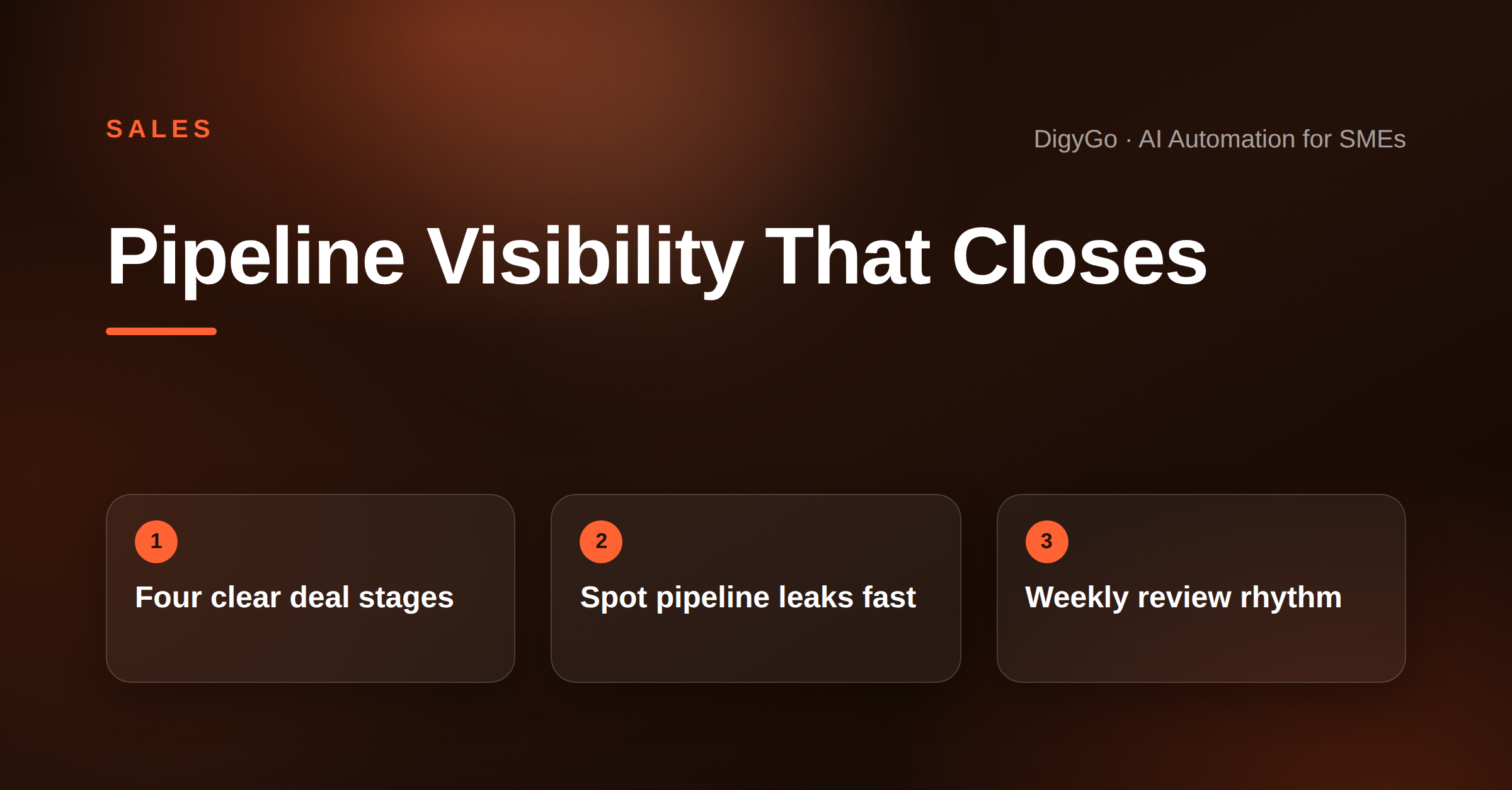
If you track your deals in your head, in a notebook, or across a dozen WhatsApp chats, you have a busy memory — not a sales pipeline. And busy memories leak. Deals that should have closed go cold, stalled conversations stay stalled for weeks, and you cannot tell whether the problem is too few leads, weak qualification, or poor closing. A visual sales pipeline changes that. It shows you, at a glance, exactly where each deal stands and — more importantly — which stage is costing you the most revenue.
A practical guide for SME founders on building a visual sales pipeline that tracks deals through defined stages, surfaces bottlenecks, and makes weekly revenue forecasting more predictable.
- Know how to build a simple pipeline with clear stages
- Spot the three most common leaks before they cost a deal
- Have a weekly review model that keeps deals moving forward
What a sales pipeline gives you that a spreadsheet does not
A spreadsheet stores data. A pipeline creates visibility. When every deal lives at a defined stage with an owner and a next action, you stop guessing and start managing. A visual pipeline — whether on a whiteboard, in a CRM, or inside a dedicated tool — answers three questions that a list of names never can: How many active deals do we have? How far through the process is each one? Where are deals consistently stalling?
For an SME founder, those three answers alone can shift a month-end panic into a predictable outcome. You know before the last week of the month whether you have enough near-close deals to hit your number, or whether you need to generate more pipeline at the top.
Define your deal stages — and what must happen at each one
The most common mistake SME teams make is having too few stages. "Contacted" and "Closed" is not a pipeline — it is a guessing game. You need a small number of clearly defined stages, each with an exit criterion that must be met before the deal advances.
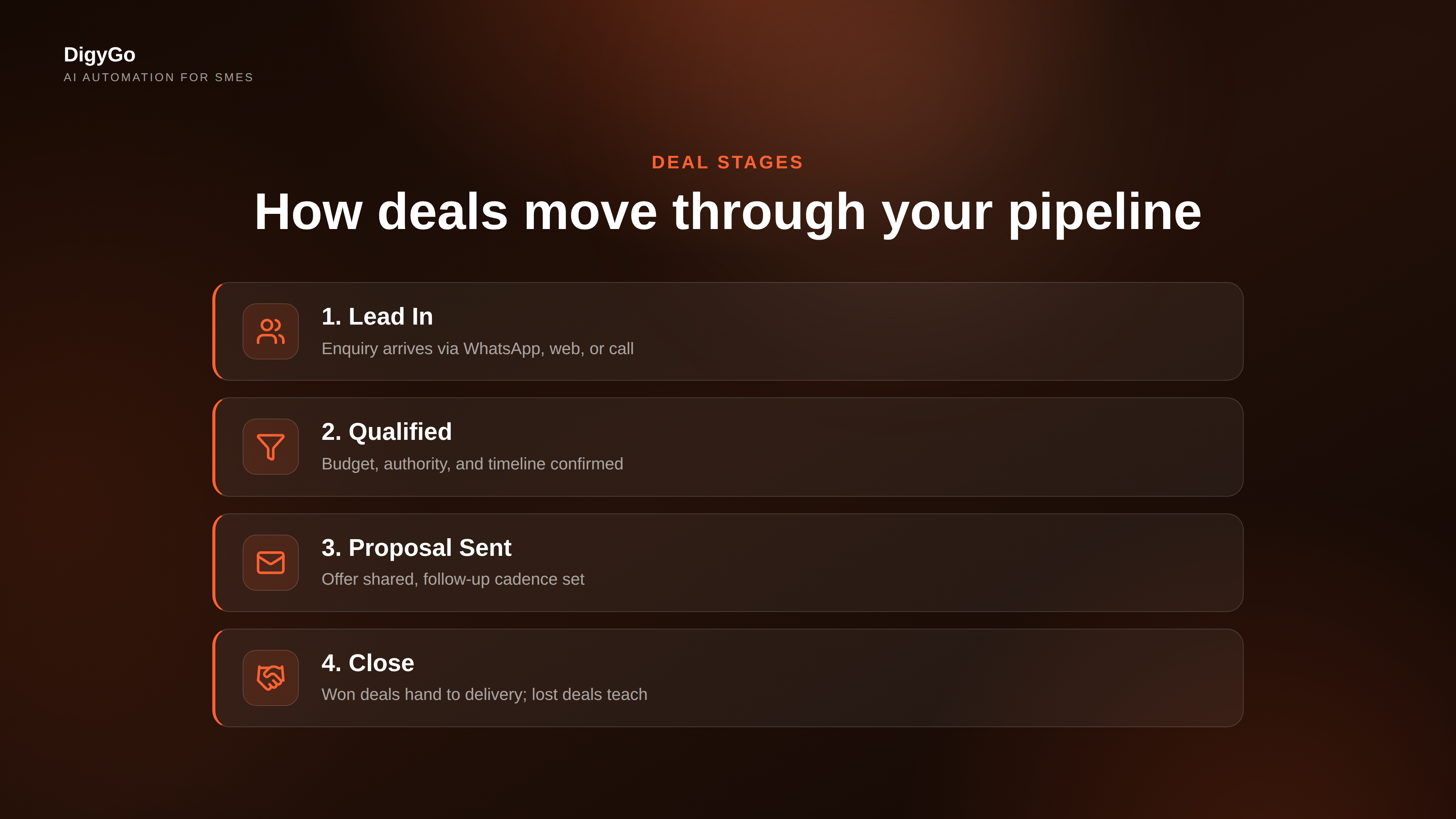
Here is a simple four-stage model that works for most service businesses:
Stage 1: Lead In
The enquiry arrives — via WhatsApp, web form, call, or referral. At this stage you capture who they are, what they need, and where they found you. The exit criterion: the basic need is clear enough to pursue.
Stage 2: Qualified
You have had an initial conversation. You know their budget range, timeline, and decision process. A qualified deal has enough information to decide whether to invest in a proposal. The exit criterion: budget, authority, need, and timeline are confirmed or reasonably assumed.
Stage 3: Proposal Sent
A formal offer has been shared. The deal is in the prospect's hands. Your only job here is follow-up cadence — do not let a sent proposal sit for more than five business days without a check-in. The exit criterion: the prospect has given a clear answer — yes, no, or not now.
Stage 4: Close
The deal is won or lost. Won deals move to delivery. Lost deals should carry a note on why — that data becomes your best qualification tool for future conversations.
Three pipeline leaks every SME should watch for
Once your stages are defined, the pipeline becomes a diagnostic tool. Here are the three most common leaks and what to do about each:
Leak 1: Too many deals stuck in "Proposal Sent"
If deals enter Proposal Sent and never leave, the problem is not follow-up — it is that the proposal was sent to an unqualified lead. The fix: tighten your Stage 2 qualification. Do not send a proposal until you have confirmed budget and decision authority. A lead with only a phone number does not deserve a full proposal.
Leak 2: Deals skip qualification and go straight to proposal
Founders who are eager to close often jump from a first call straight to a proposal. This creates a pipeline full of deals that look healthy but never convert. The fix: enforce Stage 2 exit criteria before moving to Stage 3. If the prospect will not discuss budget, the deal stays in Qualification until they do.
Leak 3: Old deals sit in the pipeline with no action
A deal that has been in one stage for more than two weeks without a touchpoint is not active — it is a zombie. Zombie deals create false optimism and waste review time. The fix: set an automatic aging rule. If a deal has no activity for 14 days, move it back to the top of the pipeline or mark it cold. Review your pipeline knowing what is real and what is noise.
Three metrics to review every week
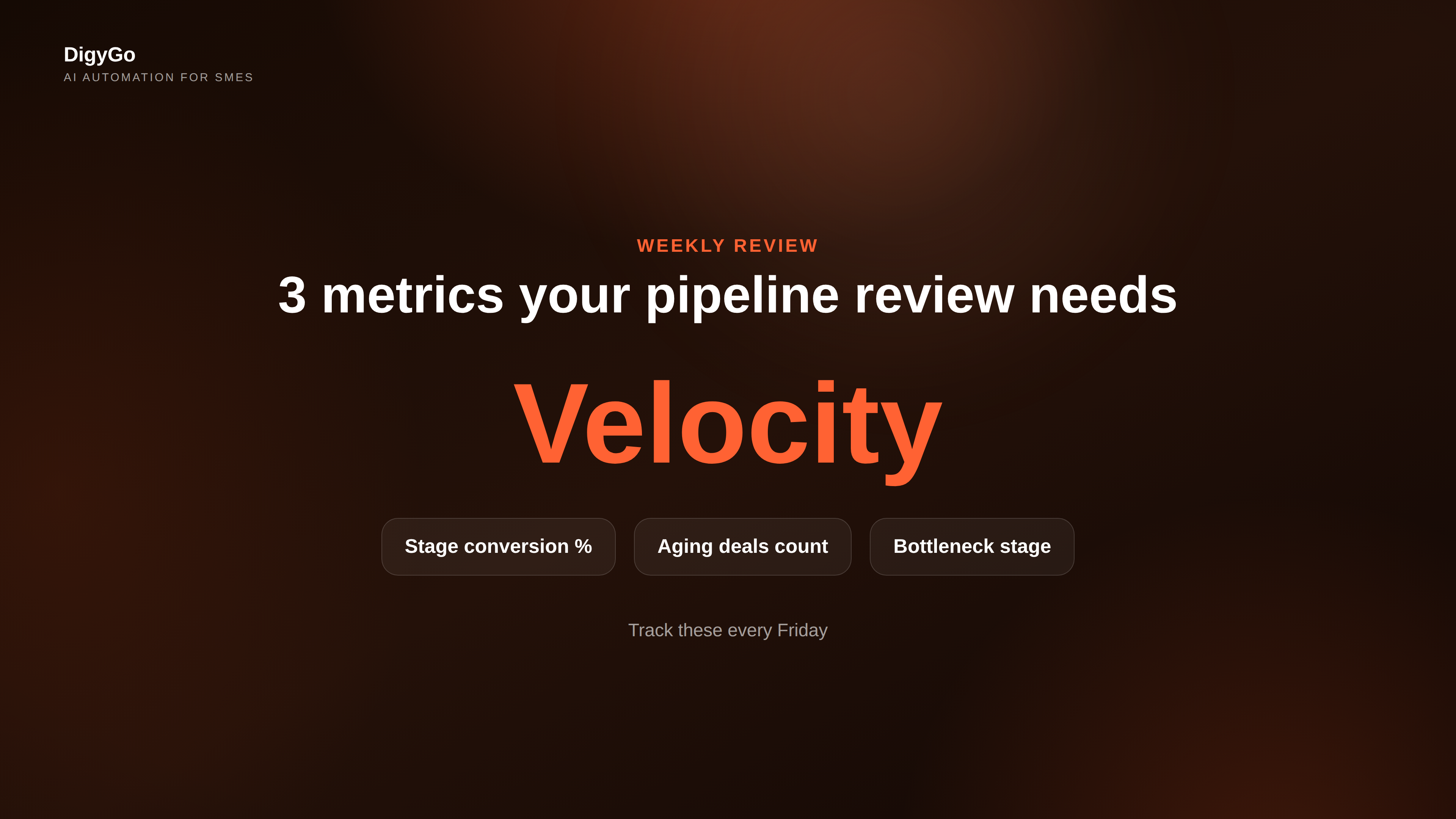
A pipeline is only useful if you look at it regularly. A standing 30-minute weekly review — same time, every week — keeps deals moving and surfaces problems early. During that review, focus on three numbers:
1. Pipeline velocity
How long does the average deal take from Lead In to Close? If your velocity is consistent, you can forecast with reasonable accuracy. If it varies wildly — some deals close in a week, others in three months — you have a qualification inconsistency. Leads that cannot decide should be filtered earlier.
2. Stage conversion rate
What percentage of Lead In deals become Qualified? What percentage of Qualified deals receive a proposal? A low conversion between any two stages identifies the specific bottleneck. If only 30% of qualified leads get a proposal, the bottleneck is not lead volume — it is proposal production or a qualification gap.
3. Aging deals count
How many deals have been sitting in a stage for more than 14 days? If your aging count grows week over week, your pipeline is filling faster than you are advancing. That is a capacity or a process problem, not a lead quality problem.
How to set up a simple pipeline this week
If you have never run a visual pipeline before, here is a way to start without overcomplicating it:
- Draw four columns on a whiteboard or in a shared document and label them Lead In, Qualified, Proposal Sent, Close.
- Move every active deal into one column. If you cannot tell which stage a deal belongs in, it goes in Lead In.
- Review every Friday for 30 minutes. Which deals advanced? Which stayed in place? For every stalled deal, decide one action and one owner.
- Archive or demote deals that have not moved in three weeks. A lean pipeline is more honest than a fat one, and an honest pipeline helps you forecast better.
After four weeks of this rhythm, you will have the data to answer the most important question in sales: "What happens between first contact and close for our business?" Once you know that, you can improve it.
Frequently Asked Questions
How many stages should my pipeline have?
Three to five is ideal for most SMEs. Fewer than three does not give you useful visibility; more than five creates administrative overhead and most deals do not need that many steps. Start with four stages and adjust as you learn which hand-offs actually create friction.
What is the biggest mistake SMEs make with pipelines?
The biggest mistake is having a pipeline that nobody looks at. A perfect board with six stages and custom deal fields is useless if the team only opens it once a month. A simple pipeline reviewed weekly will outperform a sophisticated one that no one maintains.
Do I need a CRM to run a sales pipeline?
Not at first. A whiteboard, a Google Sheet, or even sticky notes on a wall work for the first 20–30 active deals. When your pipeline grows beyond what a simple visual can hold, or when multiple team members need to update deals from different locations, a lightweight CRM becomes useful — but a CRM will not create pipeline discipline by itself. Build the habit first, then add the tool.
How do I handle deals that go cold and then wake up again?
Move them back to Lead In with a new entry reflecting the current need. Do not keep hot and cold deals in the same stage — a deal that resurfaced after three months is effectively a new lead with history. The history is useful for qualification, but the stage should reflect where the deal actually is today.