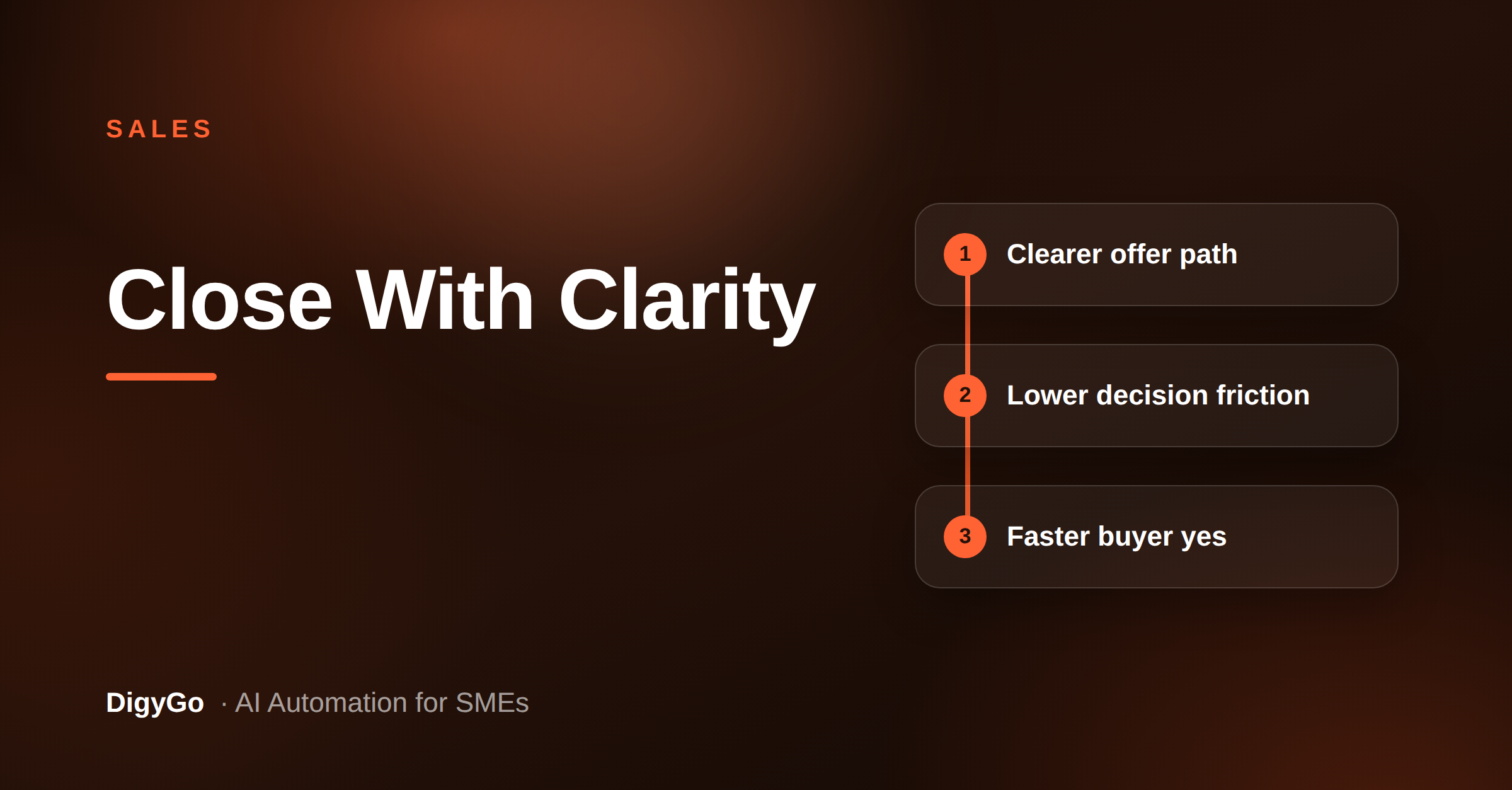
Most sales teams do not lose because the product is weak. They lose because the offer is unclear, the next step is fuzzy, or the buyer cannot see why moving now is the safer decision. When the offer is built to reduce friction, closing becomes simpler.
A practical sales guide for SMEs on shaping an offer, proposal, and next step that reduces friction and helps the right buyers decide faster.
What buyers need before they say yes
SME buyers usually do not need more persuasion. They need clarity. They want to know what they are getting, what happens next, how much effort it takes from their team, and what outcome is likely if they say yes today.
A stronger close often starts before the proposal. It starts when the offer removes uncertainty instead of adding to it.
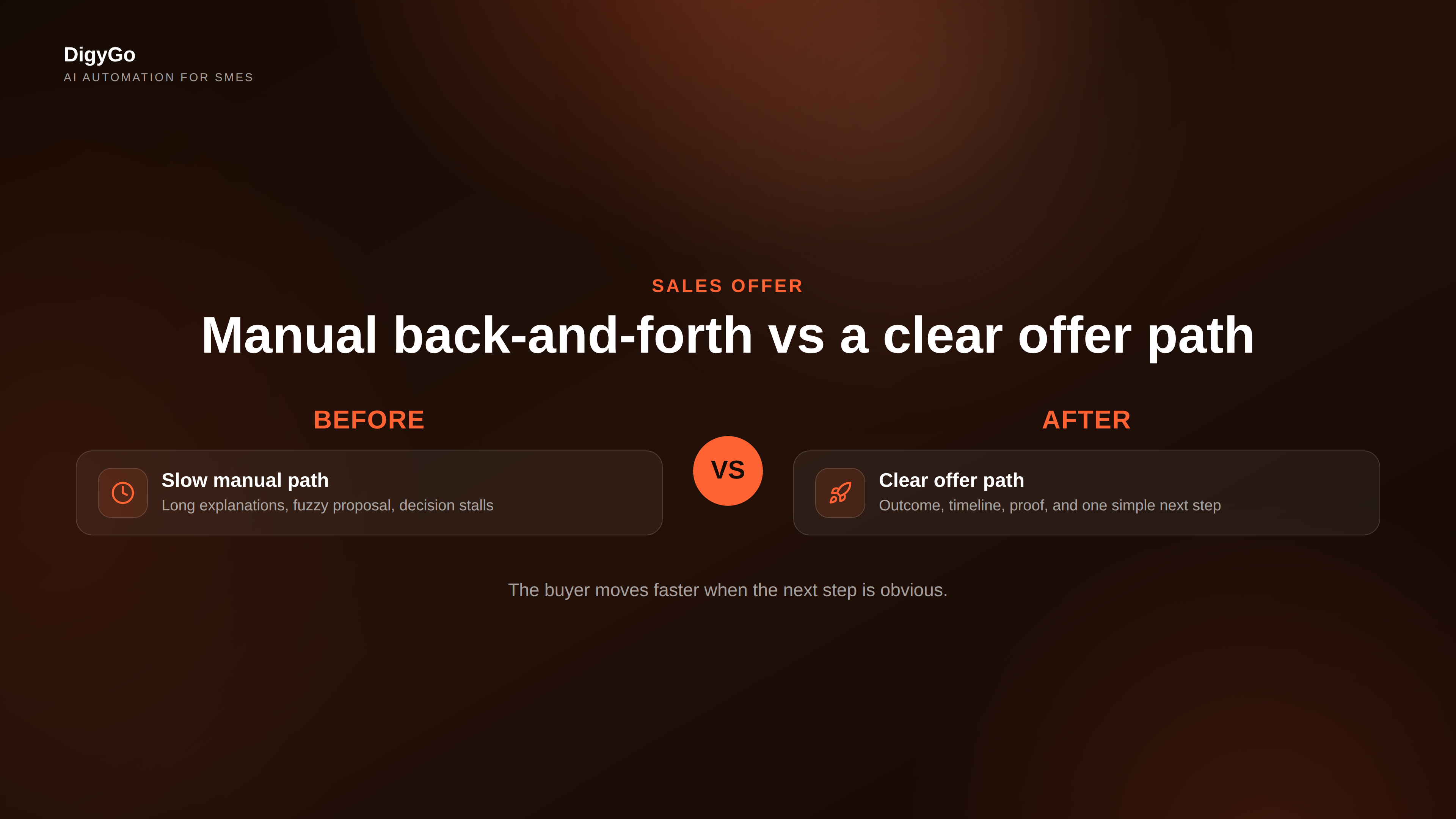
The offer stack that speeds up closing
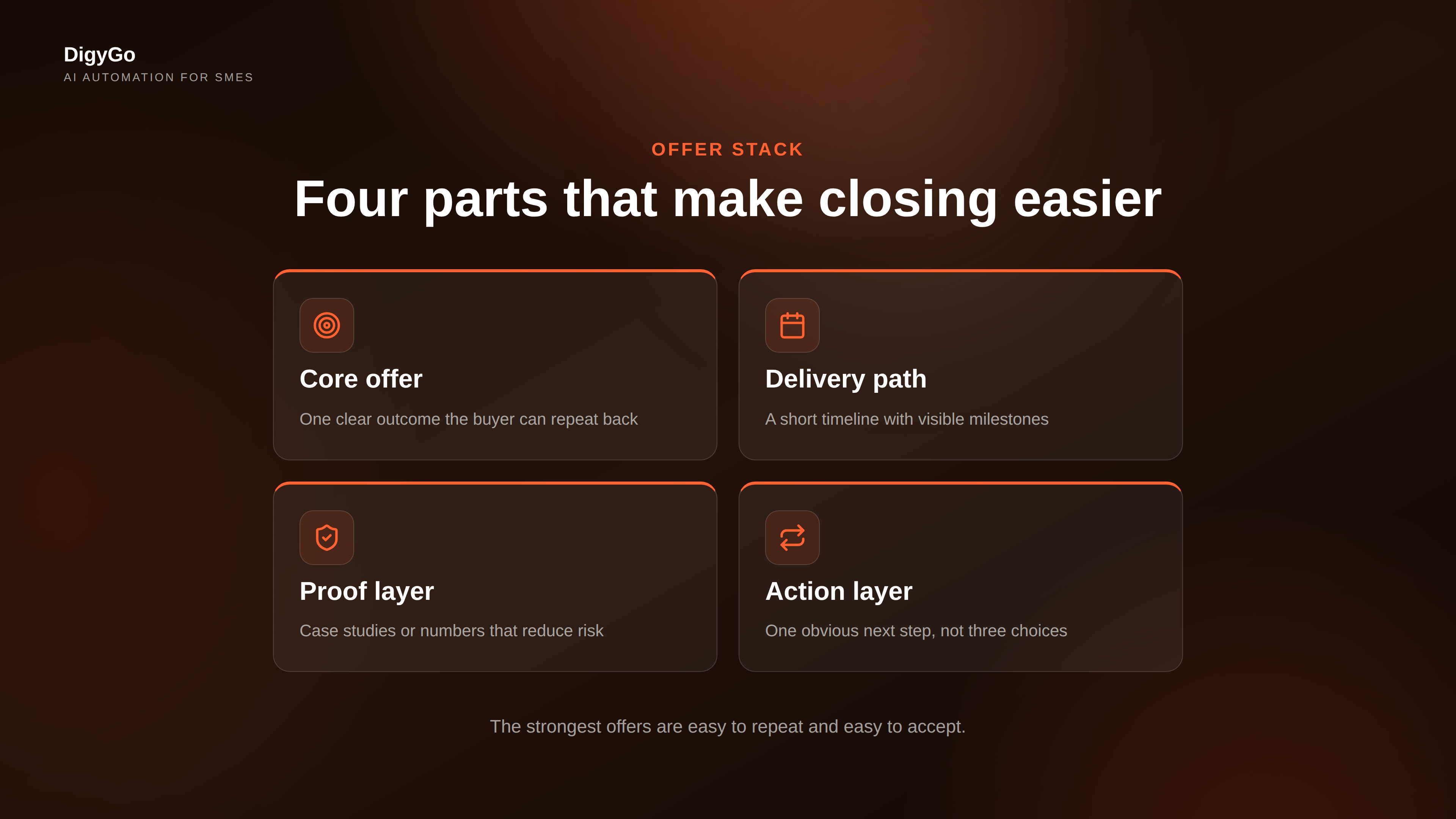
The easiest offers to close usually combine four parts: a clear core deliverable, a simple timeline, proof that reduces risk, and a next step that is easy to accept. If any one of those is vague, buyers stall.
Think of the offer stack as a decision support system. It is not only about price. It is about helping the buyer justify the decision internally.
- Core offer: one clear outcome the buyer can repeat back.
- Delivery path: a short timeline with visible milestones.
- Proof layer: case studies, numbers, or relevant examples.
- Action layer: one obvious next step, not three competing choices.
Make the offer easier to repeat
Sales teams close faster when the offer can be explained in one sentence. If the buyer has to interpret it, the conversation slows down. Keep the language plain, keep the promise specific, and avoid adding extra modules that do not help the decision.
In practice, that means replacing broad language like “full-service support” with a sharper promise like “we set up the workflow, train the team, and monitor the first 30 days.”
How to use the offer in a proposal sequence
Once the buyer has shown intent, your proposal sequence should do one thing at a time. First confirm the problem. Then show the preferred path. Then show proof. Then ask for the decision.
- Restate the buyer’s main pain in their own words.
- Show the recommended outcome, not a list of every possible option.
- Use proof that matches the buyer’s size and situation.
- Give one clean acceptance path.
When the sequence is tight, objections shrink because the buyer is not trying to solve the logic alone.
Common sales mistakes to avoid
The most common mistake is over-explaining. A long proposal can feel thorough, but it often creates more questions than it answers. Another mistake is leading with features before the buyer has agreed on the outcome.
Also avoid burying the next step. If the buyer has to hunt for the action, the momentum weakens. Make the decision path visible and simple.
- Do not overload the offer with too many options.
- Do not hide proof in the middle of long paragraphs.
- Do not ask for a decision before the buyer sees the fit.
FAQ
What is a sales offer stack?
It is the combination of outcome, timeline, proof, and next step that helps a buyer decide faster.
Why do strong offers close better?
Because they reduce uncertainty. Buyers can see what they get, how it works, and why it is worth saying yes now.
Should I give every prospect the same proposal?
No. The structure can stay consistent, but the proof, timeline, and emphasis should match the buyer’s situation.
Talk to DigyGo about building a sales offer that closes more of the right deals.