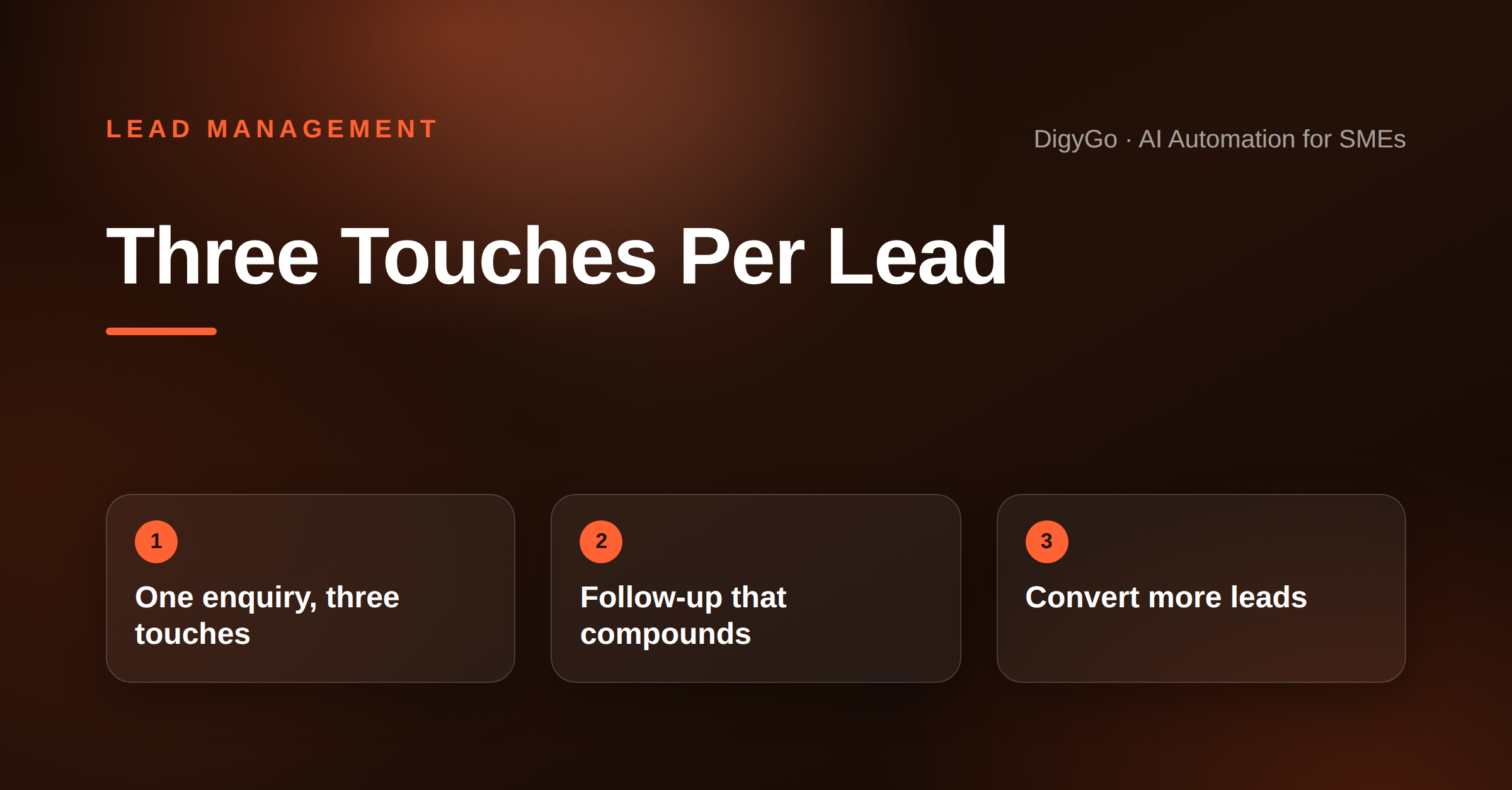
A single lead enquiry — a WhatsApp message, a missed call, a form fill — is usually treated as one moment. You reply, you wait, you forget. But every enquiry actually contains three distinct follow-up opportunities. Miss them and you leave money on the table. Use them and you turn one casual contact into a booked conversation, without chasing harder.
Every lead enquiry contains three distinct follow-up opportunities — the immediate reply, a value-add touch 24 hours later, and a booking prompt at 72 hours. This practical guide for SMEs shows how to build a three-touch system that turns one enquiry into more booked conversations without sounding pushy.
Most SMEs reply once. If the lead does not answer, the thread goes cold. The smarter approach is not to send more messages — it is to recognise that one enquiry can fuel three separate touches, each with a different job: acknowledge fast, add value after a pause, then ask for the booking. That is the difference between follow-up that feels like spam and follow-up that feels like service.
Why one enquiry gives you three chances
When a lead reaches out, they expect a reply. What they do not expect is how you follow up after that reply. The gap between a lead's first message and their next action is where most SMEs lose them — not because the lead lost interest, but because the business stopped following up after sending one answer.
- Intent — they need something now or soon
- Context — their message tells you what, where, and how urgent
- Permission — they started the conversation, so follow-up is welcome
Each of these is a reason to stay in touch, and each deserves its own touchpoint with a clear purpose — not a repeated "just checking in."
Touch 1 — the immediate reply (within 5 minutes)
Speed-to-lead is well documented: respond within five minutes and you are dramatically more likely to convert the enquiry. The first touch is not just about being fast — it is about being useful fast. Your reply should do three things:
- Thank and acknowledge — confirm you received their message and understand what they need
- Add a specific question — one clarifying question that moves the conversation forward (budget, timeline, job type, location)
- Set the next step — "I will check availability and get back to you today" or "Here is a link to pick a time"
This touch captures the lead when intent is highest. It does not need a long pitch — just a fast, specific reply that shows you are listening. The goal is not to close here; it is to earn the right to a second touch.
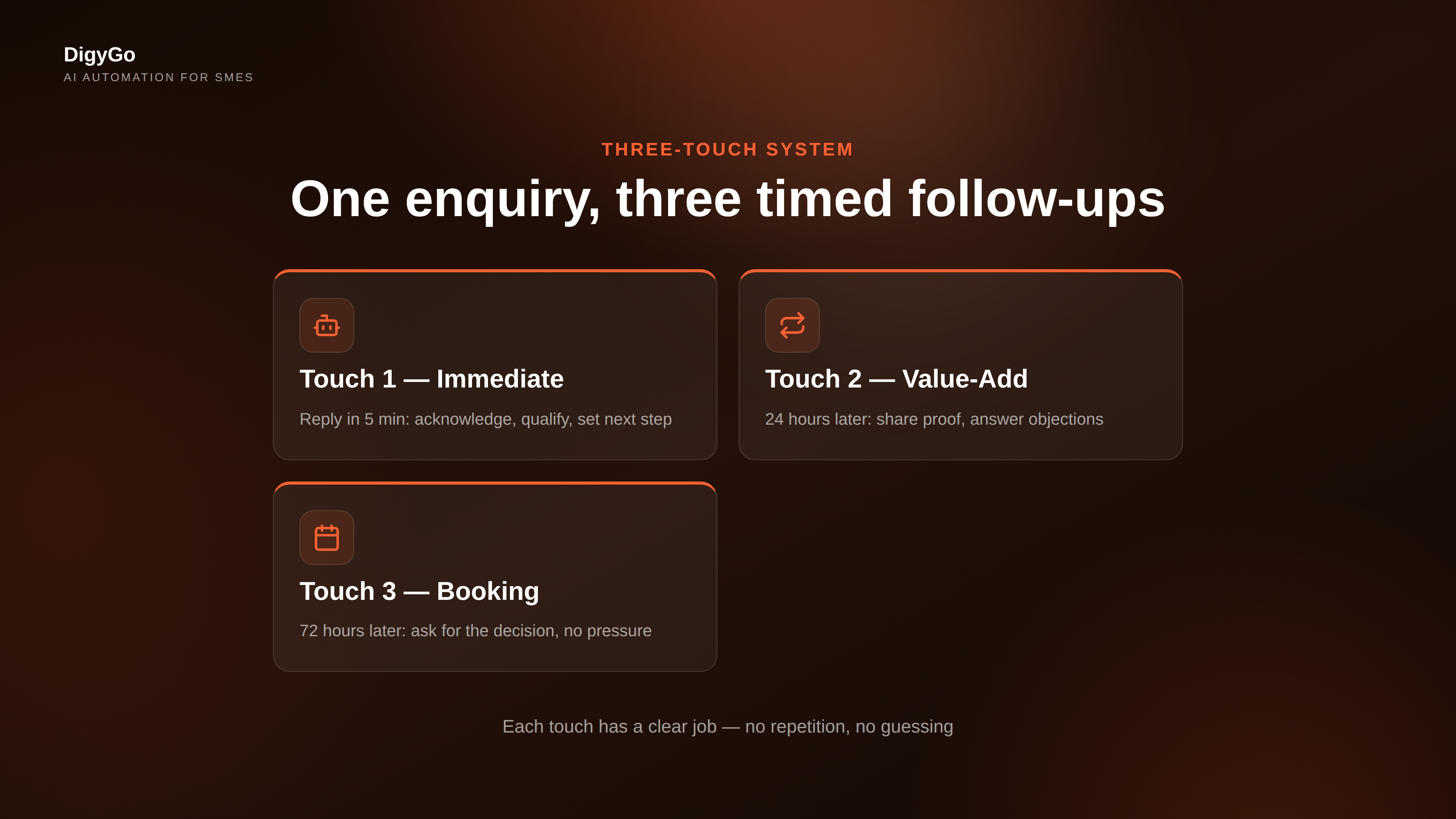
Touch 2 — the value-add touch (24 hours later)
If the lead did not respond to your first reply — or responded but did not book — send a second touch roughly 24 hours later. This is the most important and most commonly skipped step. Do not send "just checking in." Instead, add value:
- Share a relevant example — "We recently did a similar job for [business type] and here is what it looked like"
- Answer a common question — "A few customers ask about [concern] — here is how we handle it"
- Send a testimonial or result — "One of our clients shared this feedback about the same service"
The second touch works because it is not a sales push. It builds credibility and answers unspoken objections. Many leads that ignore the first reply respond to this one — because now you have given them something useful, not just a prompt to buy.
Touch 3 — the booking prompt (72 hours later)
If the lead is still quiet after two touches, send a third and final touch at the three-day mark. This one is more direct but still respectful: it gives the lead a clear, low-friction way to take the next step.
- Open-ended ask — "If you are still exploring options, happy to answer any questions over a quick call"
- Calendar link — "Here is a link to pick a 10-minute slot that works for you — no obligation"
- Exit option — "If this is not the right time, just let me know and I will close the thread. No hard feelings."
This third touch works because it creates a decision point. The lead either books, asks a question, or opts out. Either way, you stop chasing a cold lead and focus on the next active enquiry. A clean exit is better than a stale thread that nobody touches for three weeks.
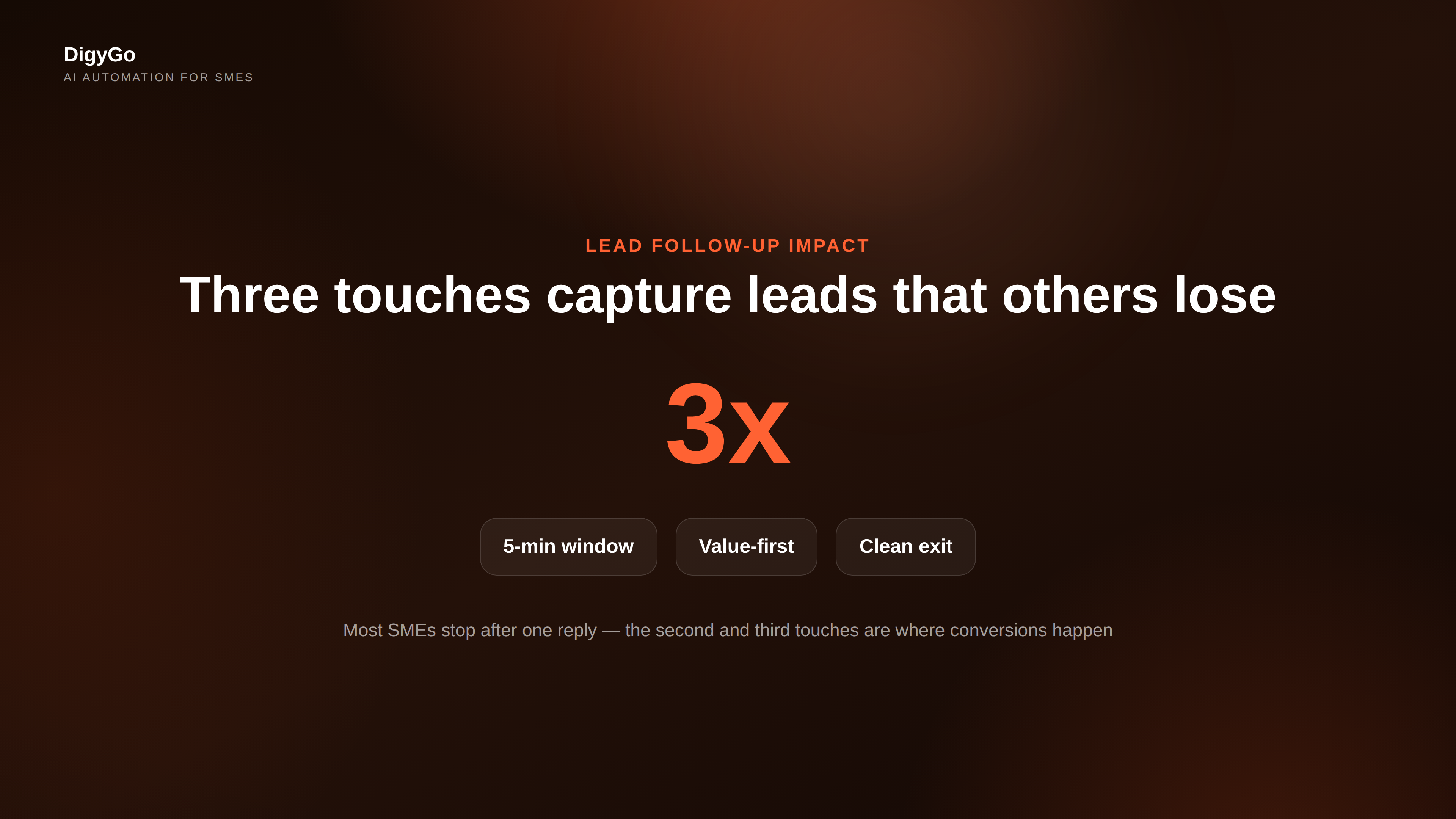
What the three-touch system looks like in practice
Here is how the same enquiry — a WhatsApp message asking "Do you do office painting?" — plays out through all three touches:
| Touch | Timing | Message | Goal |
|---|---|---|---|
| 1 — Immediate | Within 5 min | "Yes, we do. What is the size and do you have a deadline in mind?" | Acknowledge + qualify fast |
| 2 — Value-add | 24 hours later | "Here is a recent office we painted in your area — the client wanted it done over a weekend. We delivered in two days." | Build credibility |
| 3 — Booking | 72 hours later | "Would a quick visit to measure and quote work for you this week? I can come by at any time that suits you." | Create a decision |
Each touch has a single job. None overlaps. None repeats. The lead experiences a conversation that feels thoughtful and professional — not a broadcast that was sent to ten contacts at once.
How to build your own three-touch system
You do not need a CRM or an automation tool to start. Here is how any SME team can build this today:
- Identify your three most common enquiry types — for example, price enquiries, availability checks, and general service questions. Each needs its own three-touch sequence.
- Write Touch 1 for each type — a fast reply that acknowledges, asks one question, and sets a clear next step. Keep it under three lines.
- Write Touch 2 for each type — one value-add message per enquiry type. Pick the most common question or objection customers have and answer it proactively.
- Write Touch 3 for each type — a direct booking or opt-out ask. Include a calendar link or invitation to call.
- Set timers — use WhatsApp reminders, Google Tasks, phone alarms, or a shared notebook to trigger each touch at the right interval. The discipline of timing matters more than the tool.
- Track outcomes — note which touches get replies and which types of enquiries convert best. Iterate the content every month based on what actually worked.
FAQ
Is three touches too many? I do not want to seem pushy.
Three well-spaced touches are not pushy — they are professional. The first shows you are responsive, the second shows you are helpful, and the third gives the lead control. Pushy is sending the same message three times in two days. The three-touch system varies timing and purpose so every message earns its place.
What if the lead responds after Touch 1?
Move into a real conversation. The three-touch system is designed for leads who go quiet or need time to decide. If they respond, qualify, answer, and move toward a booking directly — skip the remaining touches.
Can I automate this?
Yes — with simple tools or AI. A bot can send Touch 1 immediately, a reminder can prompt you for Touch 2, and a third can be scheduled. But even manual execution with WhatsApp quick replies and phone alarms works well. The system matters more than the automation.
What about leads from different sources?
The three-touch flow works for any source — WhatsApp, website form, phone call, Google Maps enquiry, or Facebook message. The words change but the rhythm stays the same: acknowledge fast, add value after a pause, then ask for the decision.
What if the lead opts out at Touch 3?
A clean opt-out is a win. You save time, avoid chasing a cold lead, and leave a professional impression. The lead may come back later or refer someone — especially if your last message was polite and gracious.
Ready to build a follow-up system that turns every enquiry into more booked conversations? Talk to the DigyGo team →