Most SME founders run their business week to week. They fix the urgent thing, chase the hot lead, put out the fire. And that rhythm works — until the business drifts. The offers that worked six months ago stop landing. The team is busy but the growth numbers flatline. A quarterly strategy review is the simplest fix for drift. It is a three-hour meeting every three months that reconnects the weekly work to the bigger direction. No complex frameworks, no OKR tools, no consultants needed.
A practical Growth Systems guide for SME founders on using a simple three-hour quarterly strategy review to pick one metric, assign one owner, and keep growth systems from drifting between busy quarters.
- Why quarterly reviews matter more than daily firefighting for growth
- A simple four-part agenda that works in 3 hours
- How to pick one metric and one action per quarter
- The difference between a review rhythm and yet another meeting
Why a quarterly rhythm beats a weekly fix
Weekly reviews catch leaks and keep the team honest. But they work inside the existing system. If the system itself is pointed in the wrong direction — selling to the wrong audience, using the wrong channel, pricing below value — then getting faster at being wrong just compounds the problem faster.
A quarterly strategy review exists to check the direction. It answers four questions:
- Are we working on the right thing? — not just the urgent thing
- Is the current approach still working? — or did the market shift
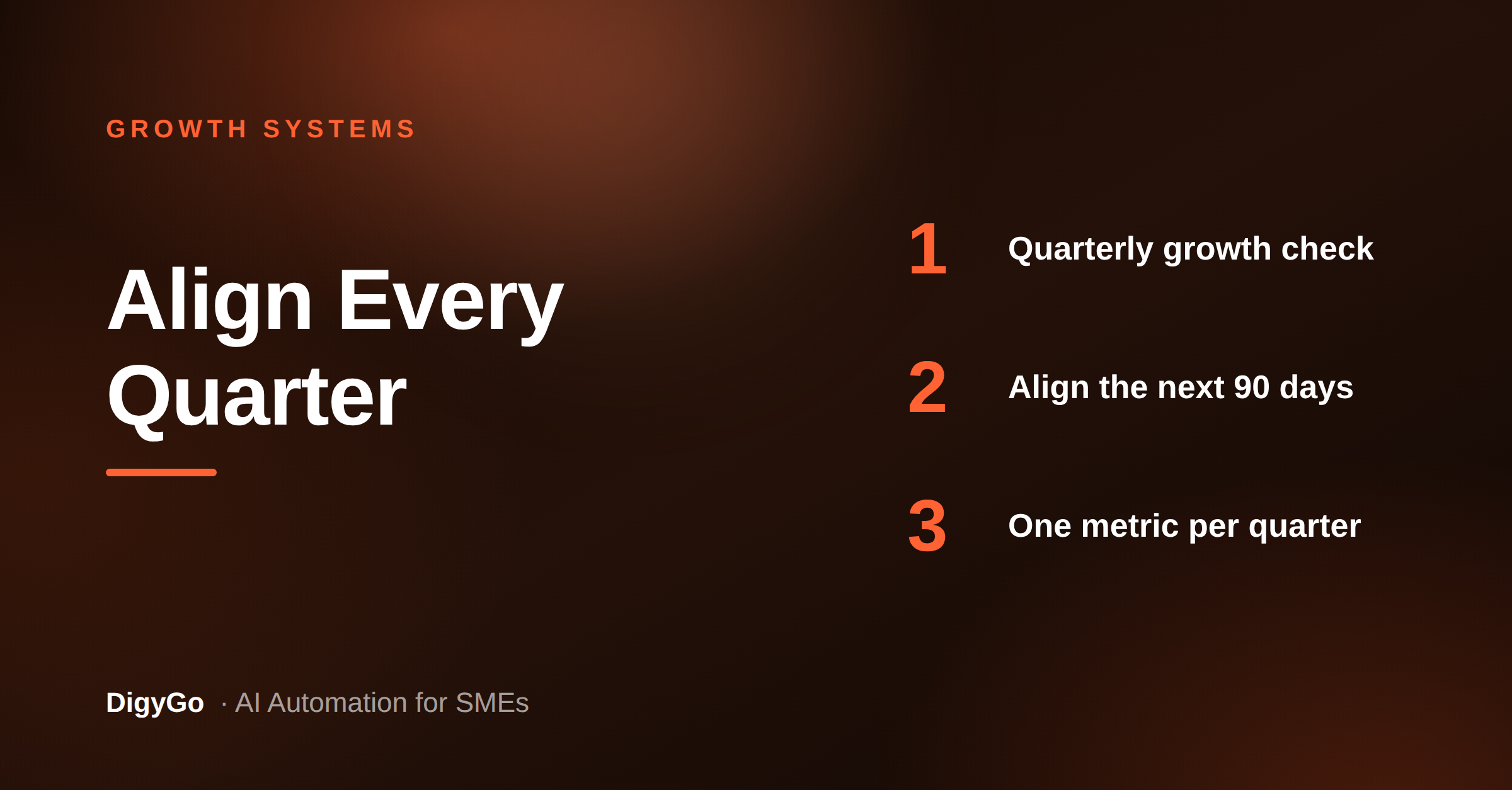
- What is the one metric that matters most this quarter? — defend that number
- Who owns the next 90 days? — one name per action, never a committee
Three months is the right cadence. One month is too short for any real strategy to show results. Twelve months is too long to adjust when something stops working. Ninety days gives enough runway to see a change through and enough checkpoints to course-correct early.
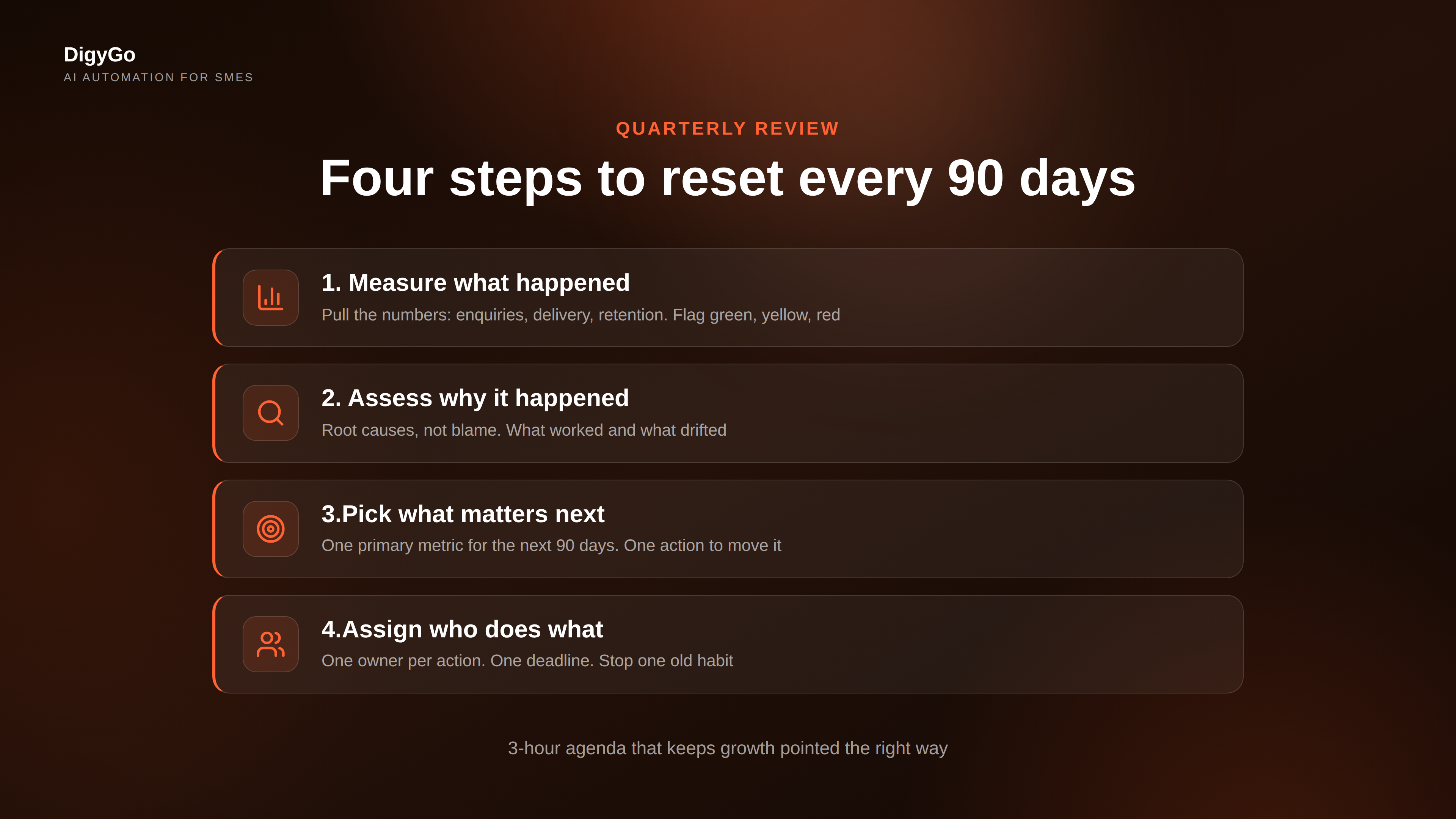
The four-part quarterly review agenda
A quarterly review does not need slides, printed reports, or a projector. It needs a whiteboard (or a shared doc), the four questions above, and three uninterrupted hours. Here is the agenda that works for SMEs with 3 to 30 people.
Part 1: Measure — what happened (45 min)
Start with the facts. Pull the numbers that mattered last quarter: total enquiries, jobs delivered, revenue collected, clients retained. Compare against the metric you picked last quarter. Did you move it? Did it stay flat? Did the number get worse despite more effort? Write each number on the board and flag every green (moved), yellow (flat), and red (dropped). Do not explain or justify yet just get the data visible.
Part 2: Assess — why it happened (45 min)
Now discuss the story behind the numbers. Why did that red metric drop? Was it a seasonal change, a competitor move, a broken handoff in the team? Why did the green one improve? Can the team repeat that next quarter, or was it a one-time win? Focus on root causes not blame. The goal is to understand what the business is telling you so the next three months have a clearer starting line.
Part 3: Pick — what matters next (60 min)
Choose exactly one primary metric for the coming quarter. It could be: increase monthly enquiries from ads by 20%, improve job completion rate from 85% to 90%, reduce average response time from 4 hours to 30 minutes. One number. Not three, not five. One metric that if it moves, everything else gets easier. Then brainstorm three to five actions that could move that number. Pick the single action with the highest leverage and lowest effort as the quarter priority. Assign one owner, one deadline, and one weekly check-in point.
Part 4: Assign — who does what (30 min)
Every action from Part 3 needs one named person. Not a department, not the team, not "we should". One name. That person owns the outcome and reports progress at the weekly review. Also decide what to stop doing this quarter. Every business accumulates habits that are no longer useful. Stop one thing so the team has capacity for the new priority.
The tools you already have are enough
Some SME founders think quarterly reviews need expensive planning software, dashboards, or OKR certifications. They do not. A Google Sheet with last quarter numbers, a shared document for the agenda, and a calendar invite are the only tools needed. The review works because of the rhythm and the discipline, not because of a tool.
Here is what the setup actually looks like:
One metric per quarter protects focus
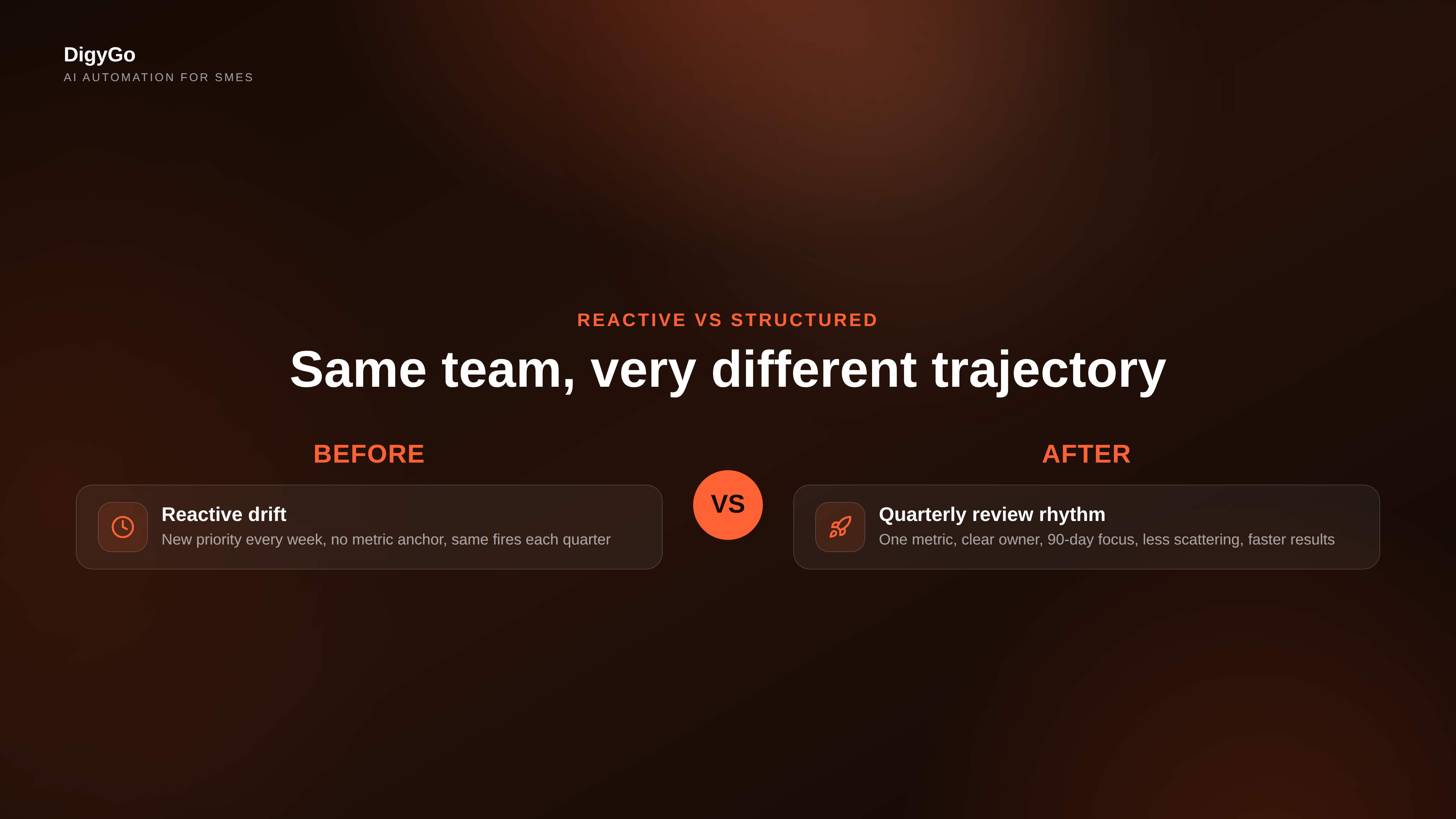
The biggest risk in an SME is scattering attention across too many priorities. Every quarter, one new feature, one new channel, one new offer. Individually each seems reasonable. Together they exhaust the team and none of them land well.
A single quarterly metric acts as a guardrail. Whenever someone proposes a new initiative, the test is simple: does this move the quarterly metric? If the answer is unclear, defer it to the next quarterly review. That does not mean good ideas get killed. It means they get evaluated on a schedule that protects execution, not on whoever shouted loudest in a Tuesday morning chat.
When to hold the review and who attends
Schedule the quarterly review in the last week of the quarter. That gives the team time to wrap up the current quarter and start the next one with the new priority already assigned. Block three hours. No phones, no Slack, no interruptions. Anyone who owns a key function attends: the founder, the sales lead, the operations manager, the marketing person. Three to six people is the ideal size. Larger teams split into groups and the founder reports back from each group.
Put the next quarterly review on the calendar before the current one ends. The booking discipline matters more than any agenda item. If the next review is not scheduled, it will keep getting pushed — and the business will drift for another three months before anyone notices.
From quarterly review to daily execution
The quarterly review sets the direction. The weekly review keeps the direction alive. They are not competing rhythms they are two layers of the same growth system. The quarterly review asks: are we pointed the right way? The weekly review asks: are we moving forward today? Together they close the loop between strategy and execution.
After the quarterly review, the owner of the priority metric adds it to every weekly review that follows. The weekly agenda shifts slightly: instead of asking "what happened this week", the first question becomes "did we move the quarterly number this week". That small change turns a quarterly intention into a weekly habit.
FAQ
How is a quarterly review different from a monthly meeting?
A monthly review checks operational health — are leads coming in, is delivery on track, are bills being paid. A quarterly review checks strategic health — is the current offer still right, are we targeting the right customer, is the business heading where the founder wants it to go. Both are valuable. They serve different purposes at different cadences.
What if the founder is the only person in the business?
Solo founders benefit even more from quarterly reviews. Without a team to provide natural pushback, drift can go unnoticed for months. A solo founder should still block three hours, look at the numbers honestly, pick one metric, and write it down. Send it to a mentor or peer for accountability.
Does every quarter need a new metric?
No. If the previous quarters metric is still the right one, keep it. The quarterly review is not a mandate to invent something new. It is a check: is this metric still the one that matters most? If yes, defend it harder. If no, replace it with clarity.
What if the team resists a new meeting?
Frame it as a strategy session, not a meeting. The review replaces status updates for the whole quarter. If the team sees that the quarterly review leads to fewer random requests and clearer priorities, resistance fades after one or two cycles.