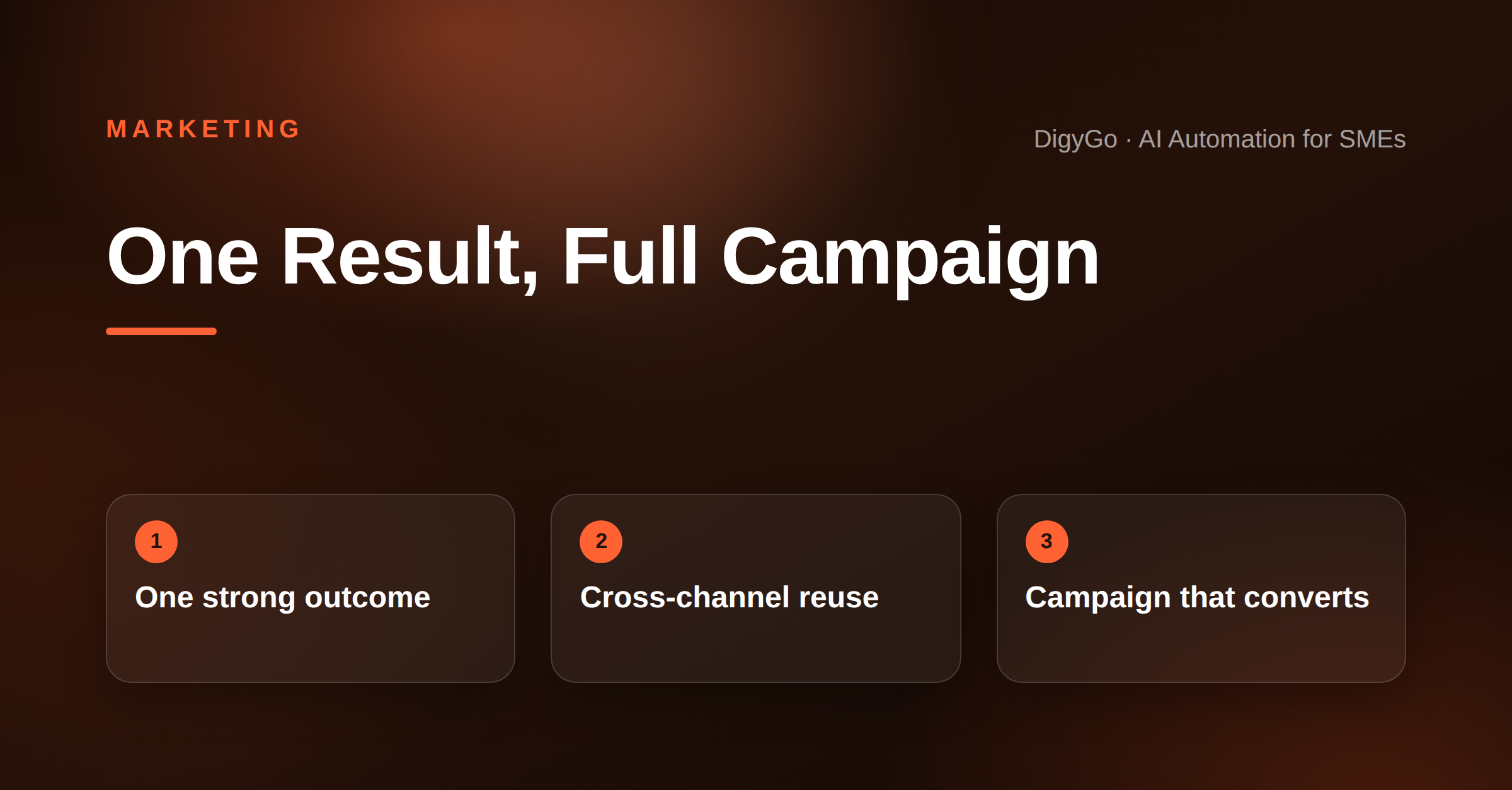
Most SMEs treat every new marketing campaign as a blank page. They start from scratch, scramble for ideas, and hope the ad or post lands. But the most efficient marketing campaigns do not start with a blank page — they start with one strong customer outcome. One real result, turned into a system that generates attention, trust, and enquiries across every channel.
A practical marketing system for SMEs on using one real customer outcome to fuel ads, service pages, social posts, and sales follow-up for a complete campaign cycle without starting from scratch every time.
- A single customer result is enough to power ads, posts, pages, and sales follow-up
- Outcome-led marketing builds trust faster than feature-led marketing
- Repurposing one result across channels keeps messaging consistent and reduces creative fatigue
Why One Customer Outcome Beats a Dozen Features
Buyers do not buy features. They buy outcomes — a problem solved, a result achieved, a risk removed. When an SME leads with a feature list, the buyer has to do the mental work of translating each feature into their own situation. Many will not bother. They move on to a competitor who makes the outcome obvious.
A single customer outcome does the translation for them. It says: this is what we did for someone like you, and here is the result. The buyer instantly sees themselves in that story. Trust forms faster, hesitation drops, and the conversation moves from "what do you do" to "can you do that for me?"
For SMEs with limited marketing time and budget, one strong customer result is the highest-leverage asset available. It costs nothing to produce (the work is already done), it is inherently credible (it really happened), and it can be reused across every marketing channel without sounding repetitive.
Build a Campaign System Around One Result
Here is how to turn one customer outcome into a full campaign cycle. The same result gets reshaped for each channel, but the core message stays identical.
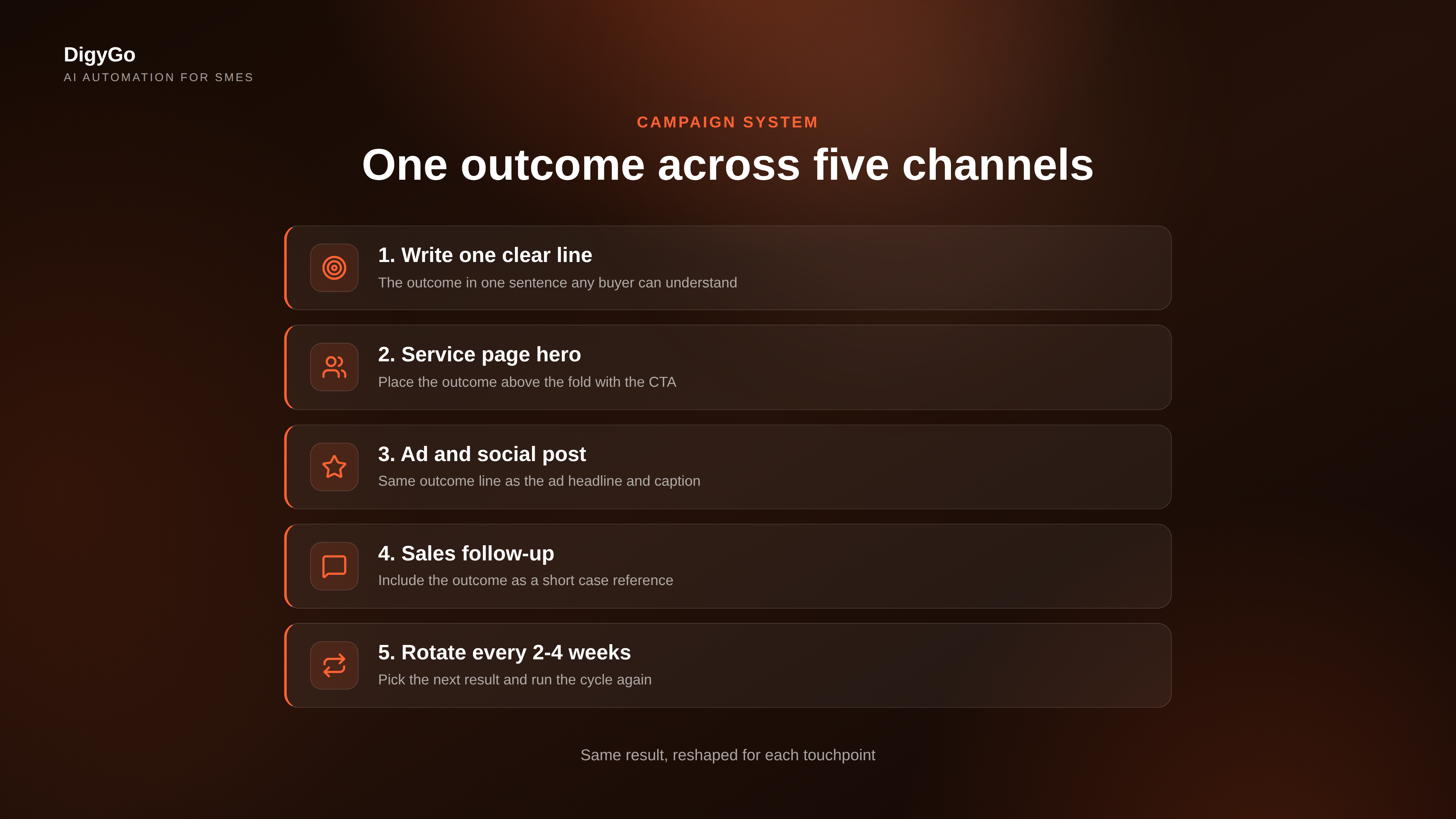
1. Write the outcome as a single, clear line
Before repurposing anything, boil the result into one sentence that any buyer can understand in five seconds. Example: "A Coimbatore electrical contractor booked 12 jobs in one month from website enquiries alone." That one line becomes the headline for every channel.
2. Turn it into the hero of your service page
Place the outcome line above the fold on the relevant service page. Add a one-sentence description of how it happened, and let the page CTA invite visitors to discuss a similar result. The page now sells the outcome instead of describing the process.
3. Build one ad and one social post from the same line
Use the same outcome line as the ad headline and the social post caption. Run one variant with a simple image and one without. On social, tag the customer (with permission) and let the engagement do the rest. A real customer result nearly always outperforms a clever marketing line.
4. Add the outcome to every sales follow-up
When a prospect is considering a proposal or quote, include the same outcome as a short case reference. "Here is what a business like yours achieved last month — we can walk through how it would apply to your situation." This turns the result from a marketing asset into a closing tool.
5. Run the cycle for 2-4 weeks, then rotate the next result
One result fuels the entire campaign for 2-4 weeks. During that time, every new touchpoint — ad, post, page, email, follow-up — reinforces the same outcome. When the cycle ends, pick the next strong customer result and repeat. Over time, the SME builds a library of outcomes that can run on rotation.
Why Outcome-Led Marketing Converts Better
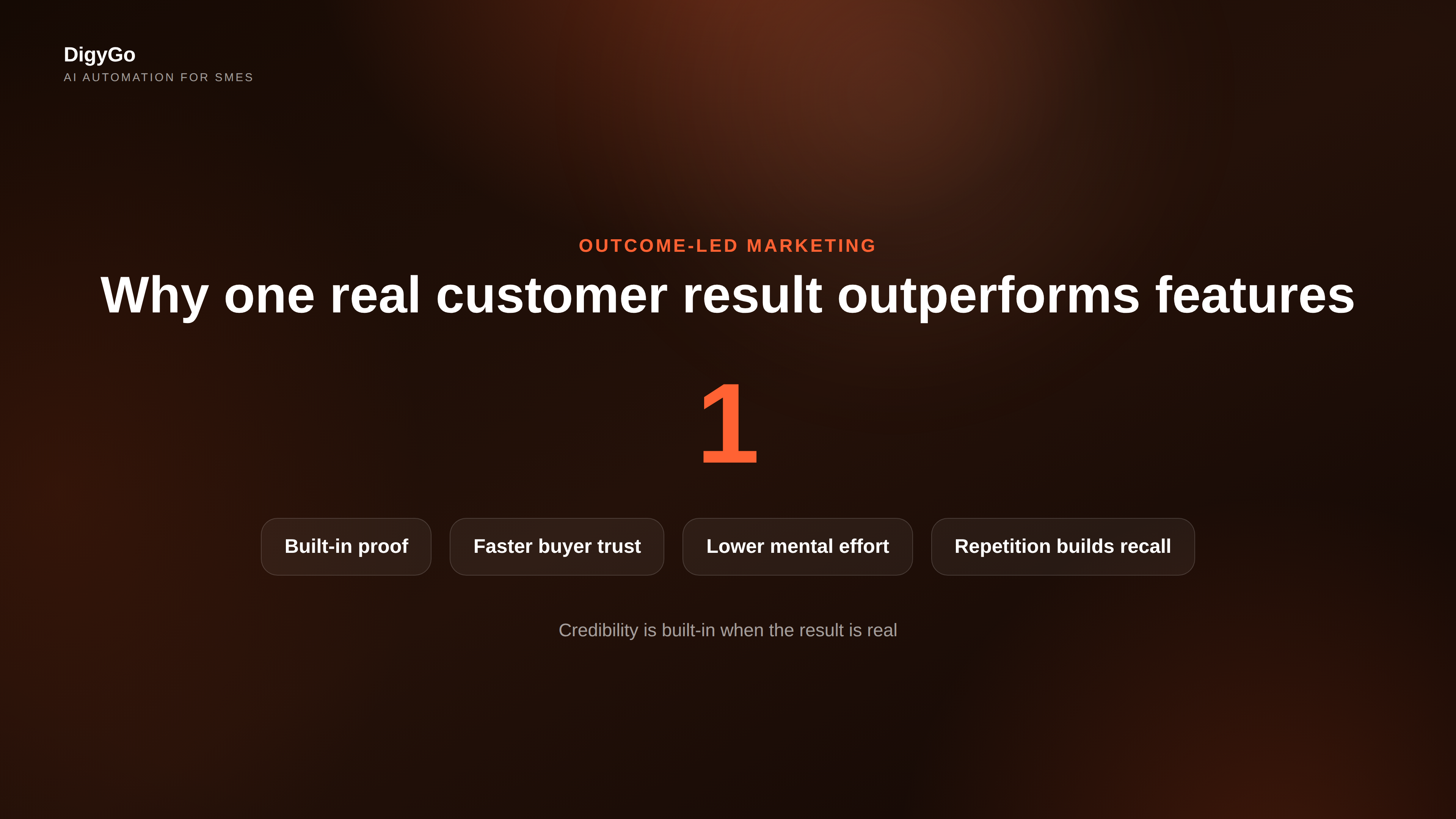
There are three structural reasons outcome-led marketing works better for SMEs than feature-led or brand-led approaches.
Credibility is inherent. A made-up claim requires proof. A real customer result is its own proof. The buyer does not have to decide whether to trust the message — the result speaks for itself. This is especially important for SMEs competing against larger businesses with bigger marketing budgets. A real result beats a polished ad every time.
The buyer's job is easier. When an ad says "we use advanced AI," the buyer must figure out what that means for their business. When it says "a salon in Trichy cut lead response time from 4 hours to 4 minutes," the buyer instantly understands the relevance. Lower mental effort means faster movement toward a decision.
Repetition builds recall. Hearing the same outcome across an ad, a page, and a sales conversation creates a pattern. The buyer remembers the result because they encountered it three times in three different contexts. That kind of repetition is impossible when every channel uses a different message.
Common Mistakes SMEs Make with Customer Outcomes
Even with a strong result, SMEs often weaken the campaign by making a few common mistakes.
Using the outcome as a testimonial instead of a headline. A testimonial buried on a page does little. The outcome should lead the campaign, not be a supporting element. Put it in the ad headline, the page hero, and the first line of the follow-up message.
Framing the outcome around the business instead of the buyer. "We helped a client increase revenue" is weaker than "This client booked 15 extra jobs per month after fixing their enquiry follow-up." The buyer should see themselves in the result, not read about the company that delivered it.
Rotating outcomes too fast. Three different customer stories in three weeks create scattered messages. Stick with one outcome for the full campaign cycle and let it saturate the channels before rotating.
Not asking for permission to use the result. Always confirm with the customer before publishing their outcome, especially on ads and social posts. A quick WhatsApp message is usually enough, and most happy customers will say yes.
Getting Started This Week
Pick the strongest customer result from the last three months. Write it as one clear outcome line. Then, in one day, publish it on the relevant service page and run one ad and one social post using the same line. That is the entire first campaign cycle — low effort, high leverage, and completely reusable when the next result becomes available.
For SMEs that want this cycle to run on autopilot, DigyGo's AI automation layer can capture every incoming enquiry, log outcomes, and trigger campaign prompts when a new strong result is identified. The system keeps the cycle running without manual tracking or scattered follow-up.
Stop starting every campaign from zero. One real customer outcome is enough to fuel your ads, your service page, your social posts, and your sales follow-up for an entire month. Pick one result, build the system, and let the outcome do the work.
Talk to DigyGo about building an outcome-led marketing system for your SME →
FAQ
| Question | Answer |
|---|---|
| How many customer outcomes do I need to start? | One. A single strong result is enough to fuel a 2-4 week campaign cycle. |
| What if I do not have any customer results yet? | Start with the clearest problem you solved for your first paying client. Even a small improvement counts if it is specific and verifiable. |
| Can I use the same outcome on ads and my service page? | Yes — that is exactly how the system works. The same outcome line should appear across every channel for consistency. |
| How often should I rotate outcomes? | Every 2-4 weeks. Running one outcome for too long leads to diminishing returns, but switching too fast scatters the message. |
| Do I need written testimonials to use a customer outcome? | A verbal confirmation or WhatsApp message is enough. Most happy customers will grant permission, especially when they see it as free advertising for their business. |