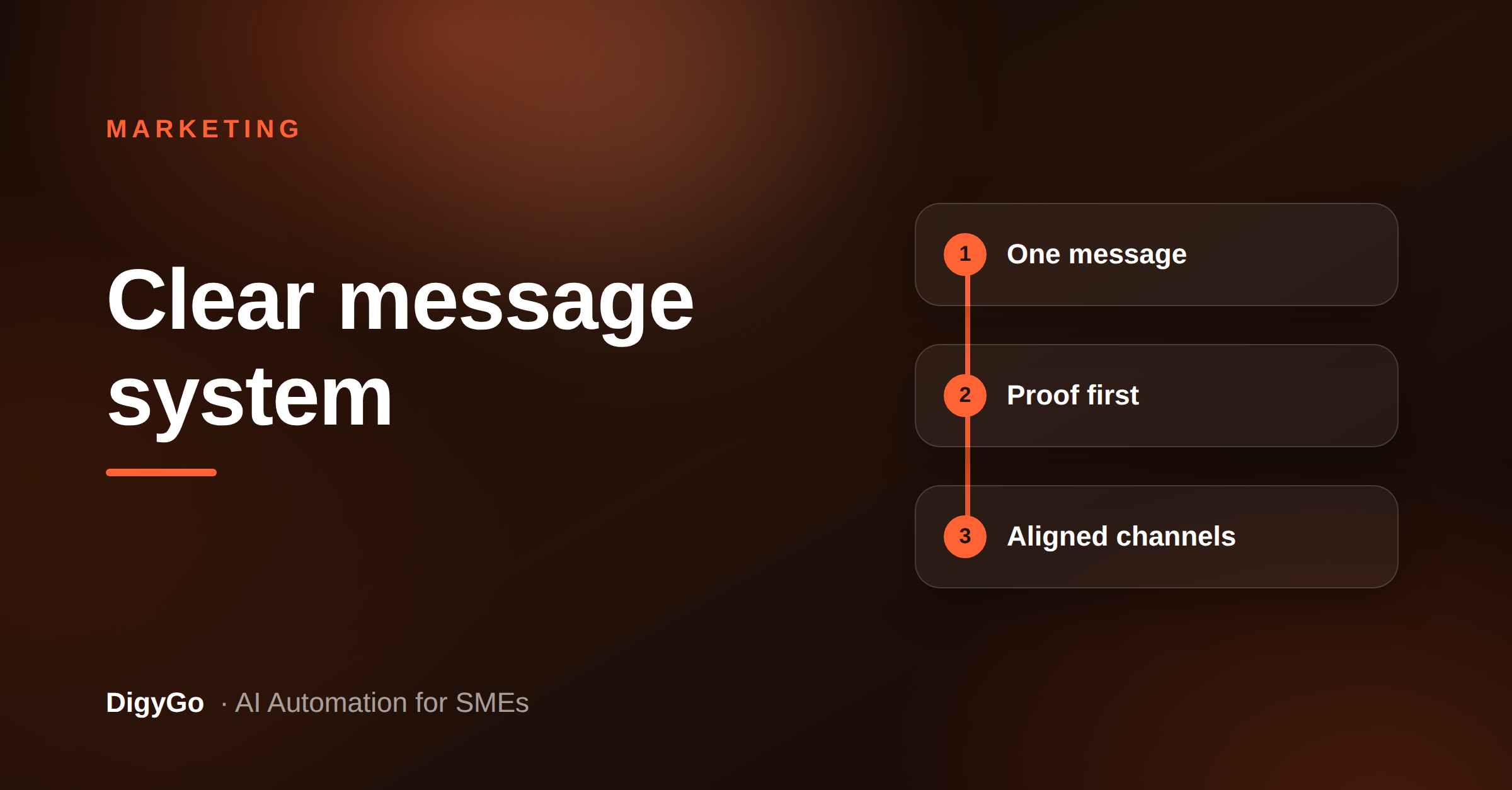
Most SMEs do not have a marketing problem first. They have a message problem. The website says one thing, the ads say another, and the sales team improvises a third version on the call. A message hierarchy fixes that drift so every channel repeats the same promise in the right order.
A message hierarchy keeps your website, ads, and sales follow-up aligned so every channel tells the same story and supports the same buying decision.
Key takeaways
- One message hierarchy makes every channel sound like one business.
- It gives marketing, sales, and content the same language to use.
- Clear message order is easier to scale than clever one-off copy.
What a message hierarchy does
A message hierarchy is a simple order for your marketing story. At the top is the one outcome you want buyers to remember. Under that sit the proof points, the benefits, and the supporting details. Instead of starting from scratch every time, your team pulls from the same stack.
For an SME, that usually means this order:
- Primary promise: the result your buyer wants most.
- Supporting proof: numbers, testimonials, process, or case studies.
- Secondary benefits: speed, reliability, convenience, or savings.
- Action step: the next clear move, like book a call or request a quote.
Why random copy fails across channels
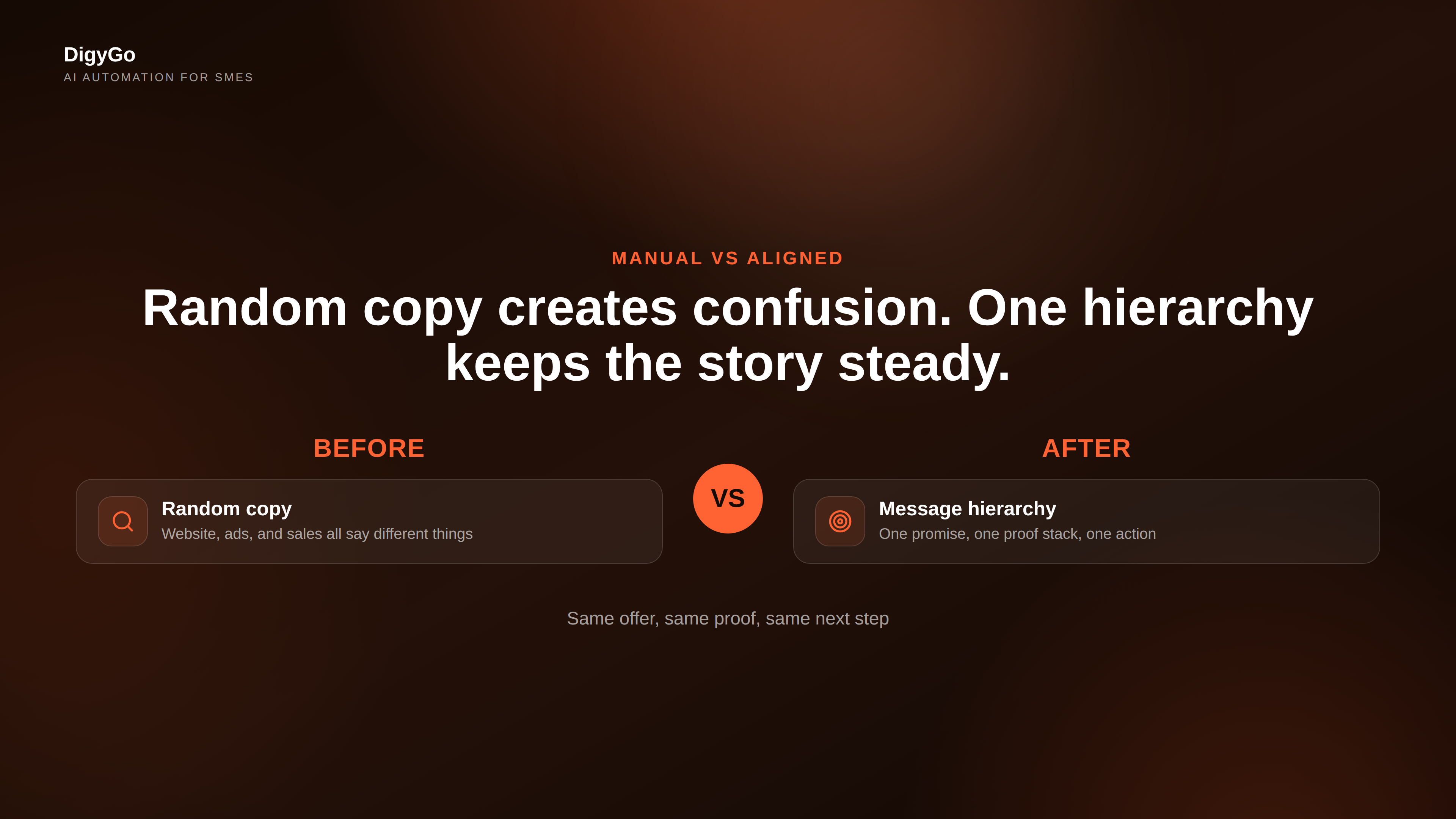
Random copy is usually the result of speed. A founder wants a post today. An ad needs copy now. A salesperson wants a short line for WhatsApp. Each person writes from memory, and the brand becomes inconsistent in public.
That inconsistency creates three problems:
- Buyers do more mental work. If the message changes every time, they have to reconnect the dots.
- Proof gets buried. A strong case study can be lost behind generic claims.
- Sales conversations reset. The team keeps explaining the same thing in different ways.
A message hierarchy reduces that friction. It makes the homepage, ad copy, brochures, and sales scripts feel connected even when the formats are different.
Think of it this way: your channels can change the words slightly, but they should not change the story.
How to build a message hierarchy for SME marketing
You do not need a big workshop to start. Build the hierarchy on one page and keep it practical.
- Write the one outcome. What should the buyer get from you: more leads, lower effort, faster turnaround, or better quality?
- List the top proof points. Use real numbers, customer names, before/after results, or process details.
- Add the business benefits. Translate features into outcomes the buyer cares about.
- Set the channel order. Homepage first, then ads, then social, then sales follow-up.
- Give the team a copy bank. Turn the hierarchy into approved headlines, hooks, and CTA lines.
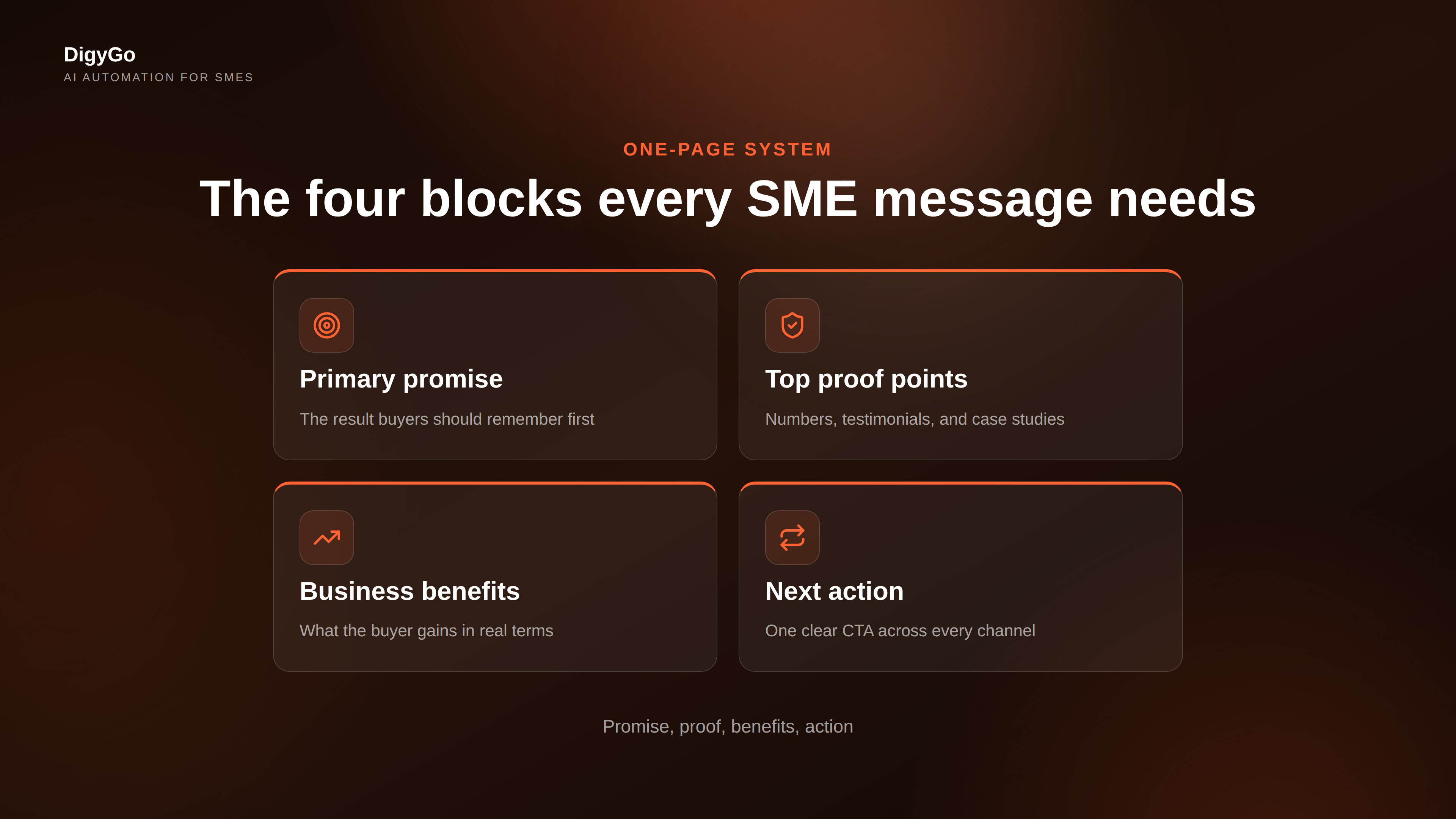
When this is done well, the team stops asking, “What should we say?” and starts asking, “Which proof point fits this channel best?” That is a much healthier marketing conversation.
Where to use the hierarchy first
Start with the places that shape first impressions and lead quality.
- Homepage hero: one promise and one proof point.
- Service pages: the problem, the outcome, and the evidence.
- Paid ads: one sharp angle pulled from the main promise.
- Sales follow-up: the same promise repeated in a shorter, clearer form.
- Content posts: each article should support the same core message.
The best part is that the hierarchy does not kill creativity. It gives creativity a frame. Your team still writes different hooks, but they stay anchored to the same business story.
Common mistakes to avoid
- Too many messages: if everything is important, nothing is.
- Proof without promise: numbers are useful, but only when they support a clear outcome.
- Creative drift: clever copy that does not match the sales call creates confusion.
- No owner: if nobody maintains the hierarchy, it slowly goes stale.
For most SMEs, the fix is not more content. It is better alignment. One message hierarchy can make every campaign feel more intentional without increasing the workload.
FAQ
Is a message hierarchy the same as a brand guideline?
No. Brand guidelines usually cover tone, visuals, and rules. A message hierarchy focuses on what to say first, what to prove next, and how to lead the buyer forward.
How long should a message hierarchy be?
One page is enough for most SMEs. If it becomes hard to scan, it is probably too long to use in real marketing work.
Who should own it?
Marketing should draft it, but sales and leadership should help shape it. The best version reflects both what buyers care about and what the team can prove.
Need help turning your SME message into a clearer marketing system? Talk to DigyGo.