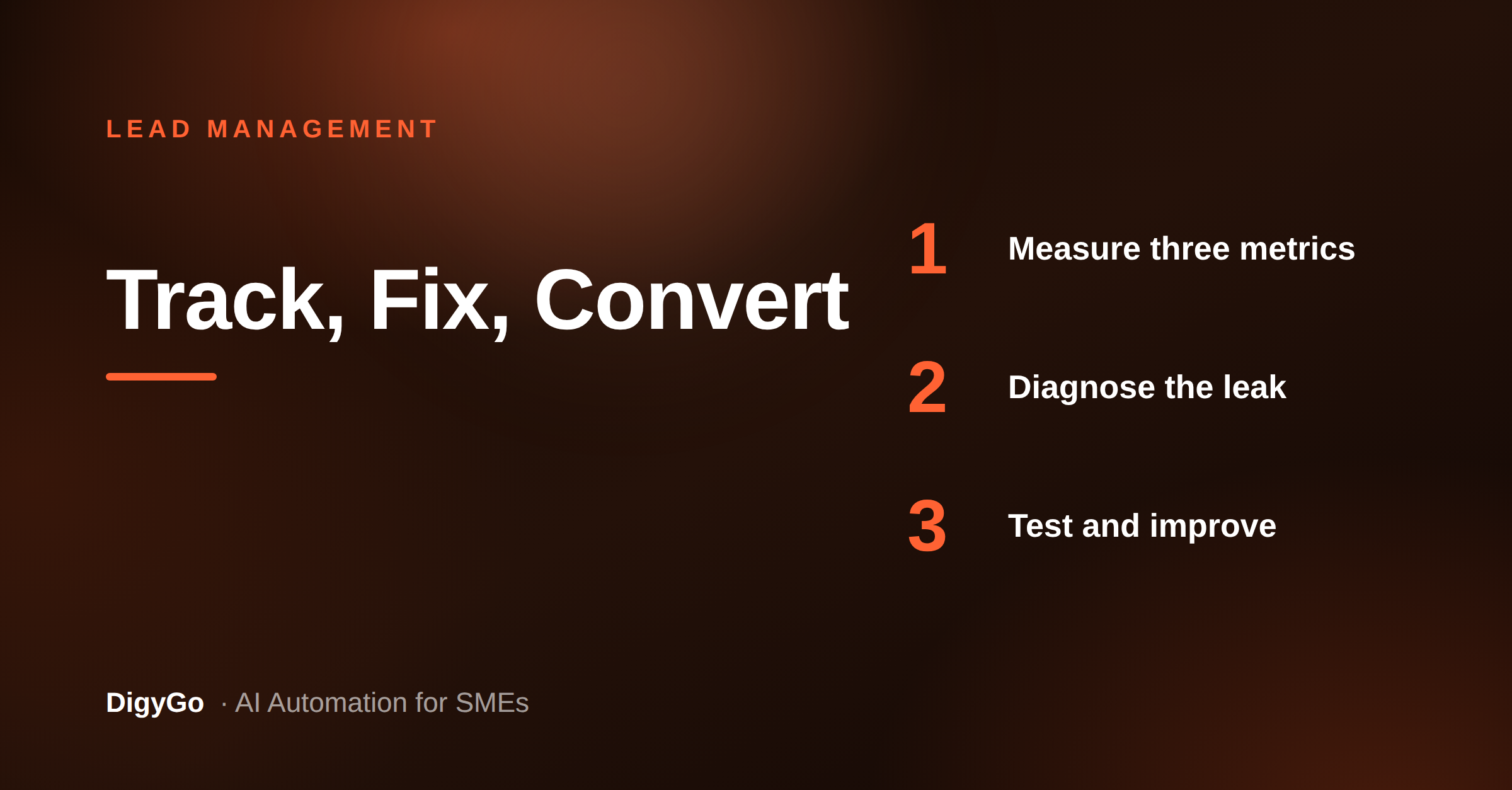
Most SMEs track their leads — but almost none track how well their team responds to them. If you do not measure response time, reply quality, and conversion per source, you are guessing which part of your lead process costs you revenue. The fix is a three-step cycle that any SME team can start this week.
A practical guide for SMEs on measuring lead response time, contact rate, and conversion rate — then running simple tests to improve each metric without adding headcount.
Key takeaways
- Three measurable metrics — response time, contact rate, and conversion rate — tell you exactly where your lead response is leaking
- A one-week audit baseline costs nothing and reveals opportunities most teams miss
- Small, tested changes compound into 20-40 % higher conversion without adding headcount
Why most SMEs skip measurement (and what it costs them)
When every enquiry feels urgent, there is never time to stop and ask whether the current response approach is working. Teams reply, book, follow up, and move on. The problem is that without measurement, a slow response that costs you half your leads can go unnoticed for months.
Founders and sales leads often assume that replying within the same day is fast enough. Studies consistently show that the first five minutes after an enquiry arrives are the highest-conversion window. If your team's actual average response time is two hours — or the next morning for evening enquiries — you are losing deals you never knew existed. Measurement closes that blindspot.
The three-metric system that works for SMEs
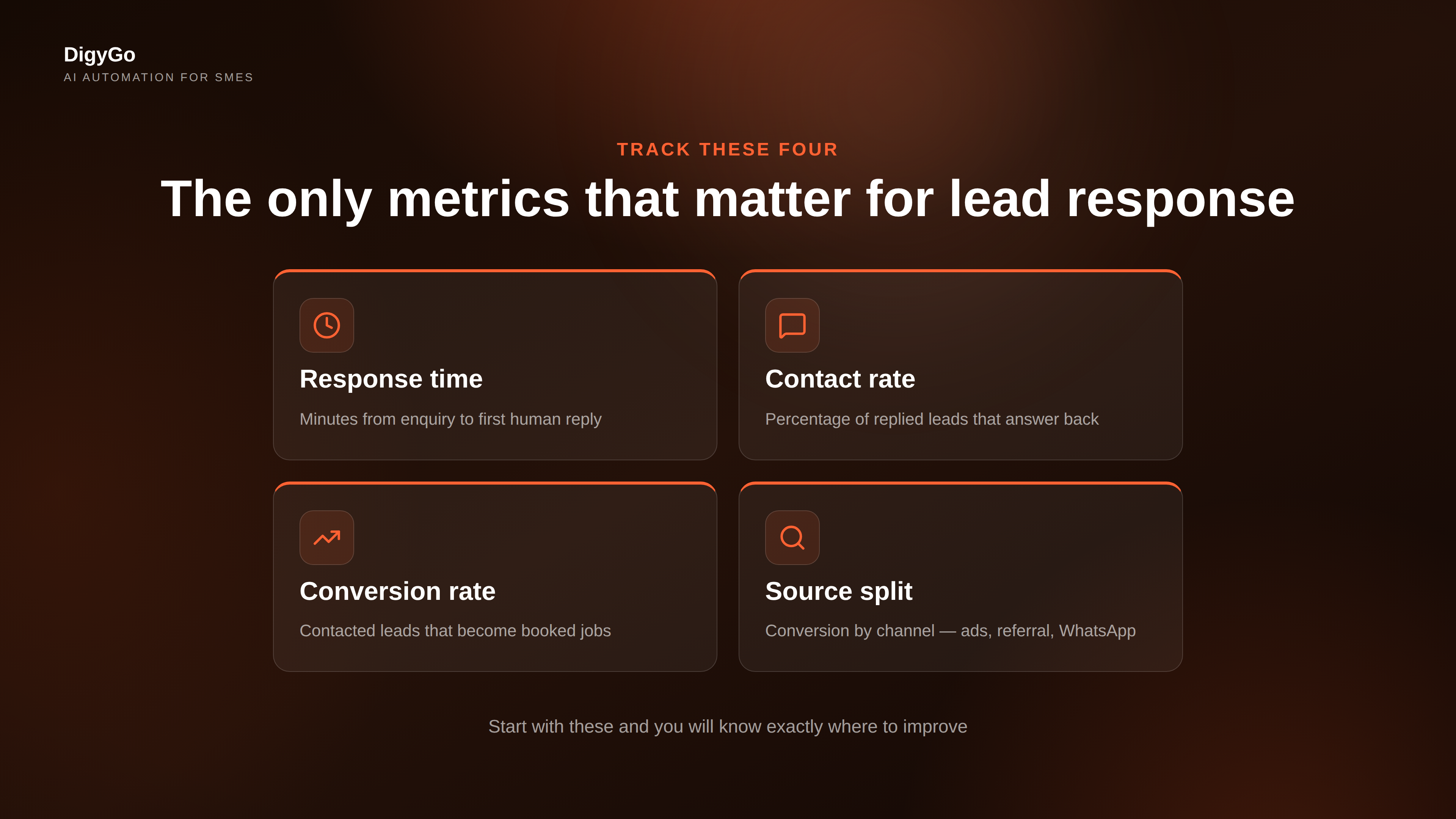
You do not need a dashboard or a CRM plugin to start. Three numbers, collected manually for one week, give you a complete picture:
1. Response time — the most important single number
Record the minutes between every incoming enquiry and the first human reply (automated acknowledgements do not count). At the end of the week, calculate your median — not average, because a few very slow outliers will skew the average. A median over 15 minutes for WhatsApp enquiries or over 60 minutes for web forms is a clear red flag.
2. Contact rate — the reply quality metric
Of the leads you replied to, how many replied back? A lead that receives a response and never answers has entered a follow-up cycle that takes more time and energy. If your contact rate is below 60 % for warm enquiries (web form, call-back request, missed call), your first-reply content needs work — not more speed, better substance.
3. Conversion rate — the revenue metric
How many of the leads you made contact with turned into a booked job, a paid invoice, or an agreed next step? This is your real conversion number. Track it by source (Google Ads, referral, WhatsApp, walk-in) so you know which channels deliver hot leads vs. browsers.
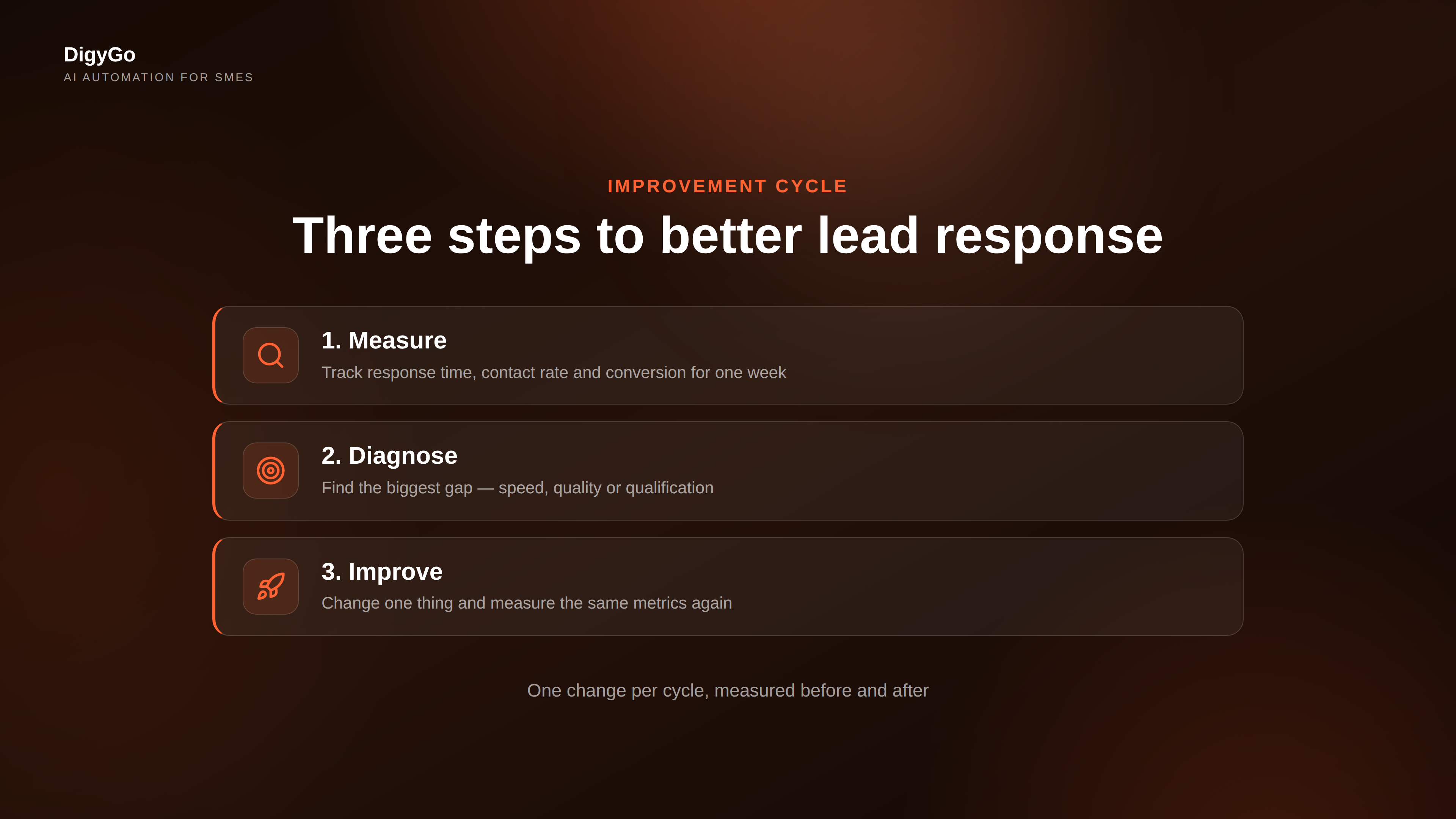
Week one: establish the baseline
Start with a simple shared spreadsheet or notebook. One row per enquiry, three columns: time of enquiry, time of first human reply, and whether the lead replied back within 24 hours. At the end of day five, calculate your three metrics for the week.
Do not change anything yet. The goal of week one is purely to see what is actually happening, not what you think is happening. Most teams discover that their actual response time is 3–5× slower than they believed. That discovery alone is worth the exercise.
Real example
A Coimbatore electrical services SME tracked response times for one week and found that evening enquiries (after 6 PM) were not answered until 10 AM the next day — a 16-hour gap. Simply adding an auto-reply with booking hours and a promise to call back by 9 AM lifted their next-day contact rate from 35 % to 72 %.
Week two: diagnose the biggest leak
With a baseline, you can now identify the single change that will move the needle most. Look at your three metrics and ask:
- If median response time is over 30 minutes: the priority is speed. Identify whether the bottleneck is notification (lead sits in an inbox nobody checks) or assignment (the right person does not see it quickly enough).
- If contact rate is under 60 %: the priority is reply quality. Your first message may be too long, too salesy, or missing a clear next step. Try a shorter, warmer template and measure whether more leads reply.
- If conversion rate is under 20 % from contacted leads: the priority is qualification. Your team may be spending time on enquiries that were never going to convert. Add one qualifying question in the first reply to filter out mismatched leads earlier.
Pick exactly one area. Trying to fix all three at once spreads your attention and makes it impossible to know which change worked.
Week three: run a controlled test
Make one change and track the same three metrics for another week. For example, if you decide that response time is your biggest leak:
Set a rule: every team member who handles leads checks the shared inbox at the top of every hour for 10 minutes. Add a simple notification — a WhatsApp group alert when a new form comes in. At the end of week three, compare your metrics against the baseline.
A ten-minute improvement in median response time is a real win. A 15 % increase in contact rate is significant. If the numbers move in the right direction, lock in the change and move to the next area. If they do not move, try a different fix next cycle.
Three months from now
After three or four improvement cycles, most SMEs see:
- Median response time under 5 minutes for WhatsApp and under 30 minutes for web forms
- Contact rate above 70 %
- Conversion rate from first contact to booked job up by 20–40 %
The gains compound because each improvement also makes your team's job easier: faster responses mean fewer follow-ups, clearer first replies mean less back-and-forth, and better qualification means less time on leads that were never going to book. You close more with less effort, which is the only sustainable growth model for a small team.
Turn measurement into a habit
Once you have run three improvement cycles, make the audit a monthly 30-minute review. Keep tracking the three metrics — even roughly — so you catch drift before it costs you revenue. A lead response that was 5 minutes in January can quietly slip to 45 minutes by June if nobody checks.
The businesses that grow consistently are not the ones with the fanciest CRM or the biggest ad budget. They are the ones that measure what actually happens with their leads and fix the leaks, one at a time, every month.
Frequently asked questions
Do I need a CRM to track these metrics?
No. A simple spreadsheet works for the first few months. Once the process is solid, a CRM makes tracking easier but is not required to start.
What if I get only 5–10 enquiries per week?
That is enough to calculate meaningful metrics. Track for two weeks instead of one to get a more stable baseline. Every enquiry is a data point.
Should I count automated replies as response time?
No. Only count the first human reply. An automated "thanks for your enquiry" message sets expectations but does not convert on its own. Speed matters most once a person is actually engaging.
How do I handle leads that come in on holidays or Sundays?
Track them separately as after-hours leads. Your response time SLA for after-hours may be longer, but knowing the gap helps you decide whether weekend auto-response or a partial coverage rota is worth testing.
What is a good conversion rate to aim for?
It depends on your service and price point. For service-based SMEs, 20–40 % from contacted lead to booked job is a healthy range. Compare against your own baseline rather than an industry average.
Ready to stop guessing how your lead response is performing? Talk to the DigyGo team about setting up lead response tracking for your business →