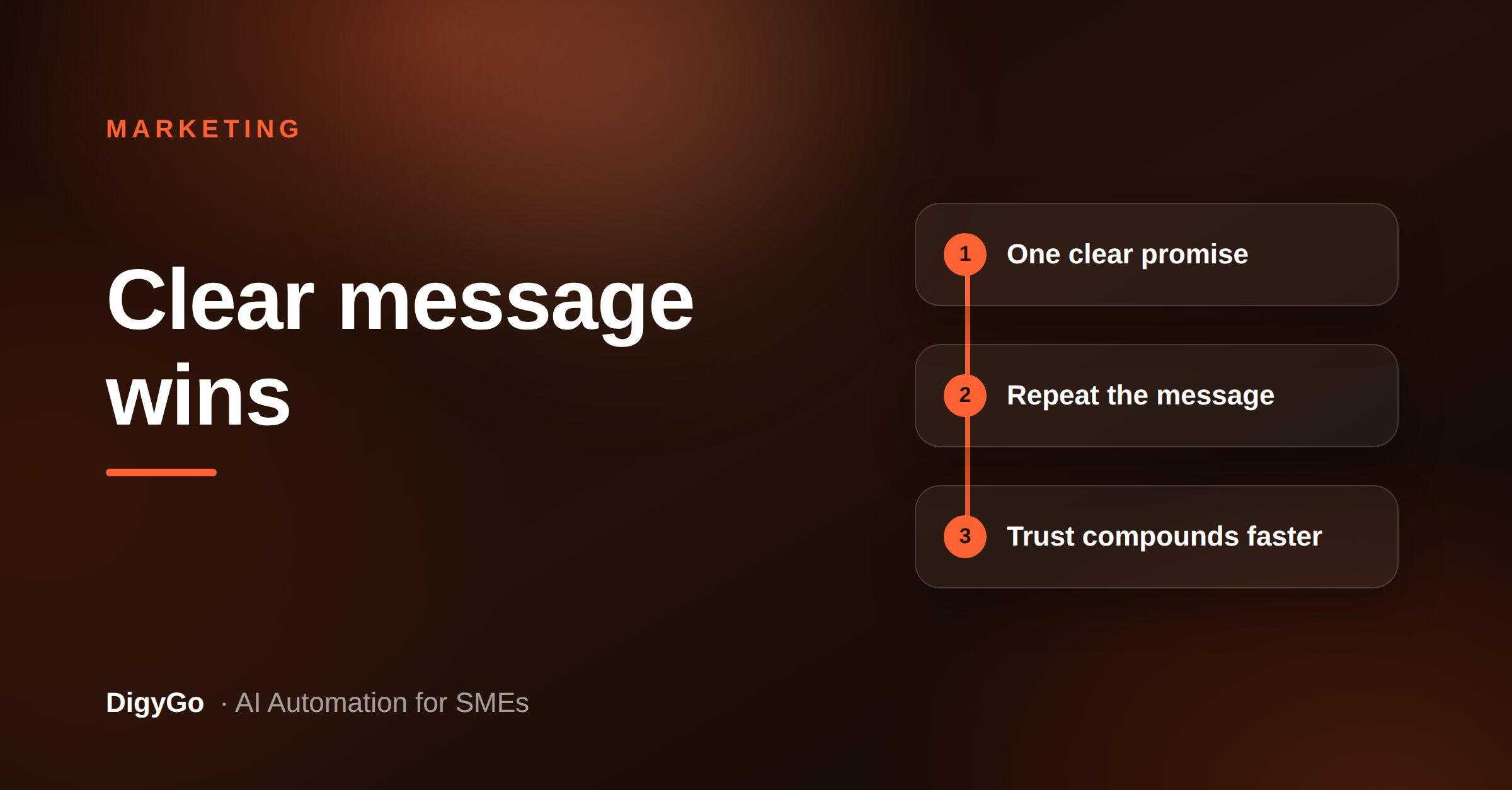
If your marketing feels active but not effective, the problem is often not effort — it is inconsistency. SMEs win attention faster when every post, ad, and follow-up message reinforces the same promise, the same audience, and the same next step.
A practical guide for SMEs on why consistent messaging across posts, ads, and follow-up creates more trust and better conversions than random content bursts.
Why random posting wastes good effort
Most small businesses do not lose because they are invisible. They lose because the market cannot quickly understand what they stand for. One post says speed, another says price, and a third says every service to everyone. That kind of spread confuses the buyer and weakens recall.
Consistency helps people recognise you faster. It also makes your content more reusable, because each post can build on the last one instead of starting from zero.
- One clear message is easier to remember than ten mixed messages.
- Consistent content compounds trust across ads, posts, and follow-up.
- A simple content system is better than random bursts of posting.
Build one message before you build more content
Before you write the next caption, decide three things: who you are speaking to, what problem you solve, and why your approach is different. When those answers are fixed, your homepage, social content, email newsletters, and sales messages all start pulling in the same direction.
This is not about sounding identical everywhere. It is about repeating the same positioning in different formats so the audience hears one coherent story.
A simple content system for SMEs
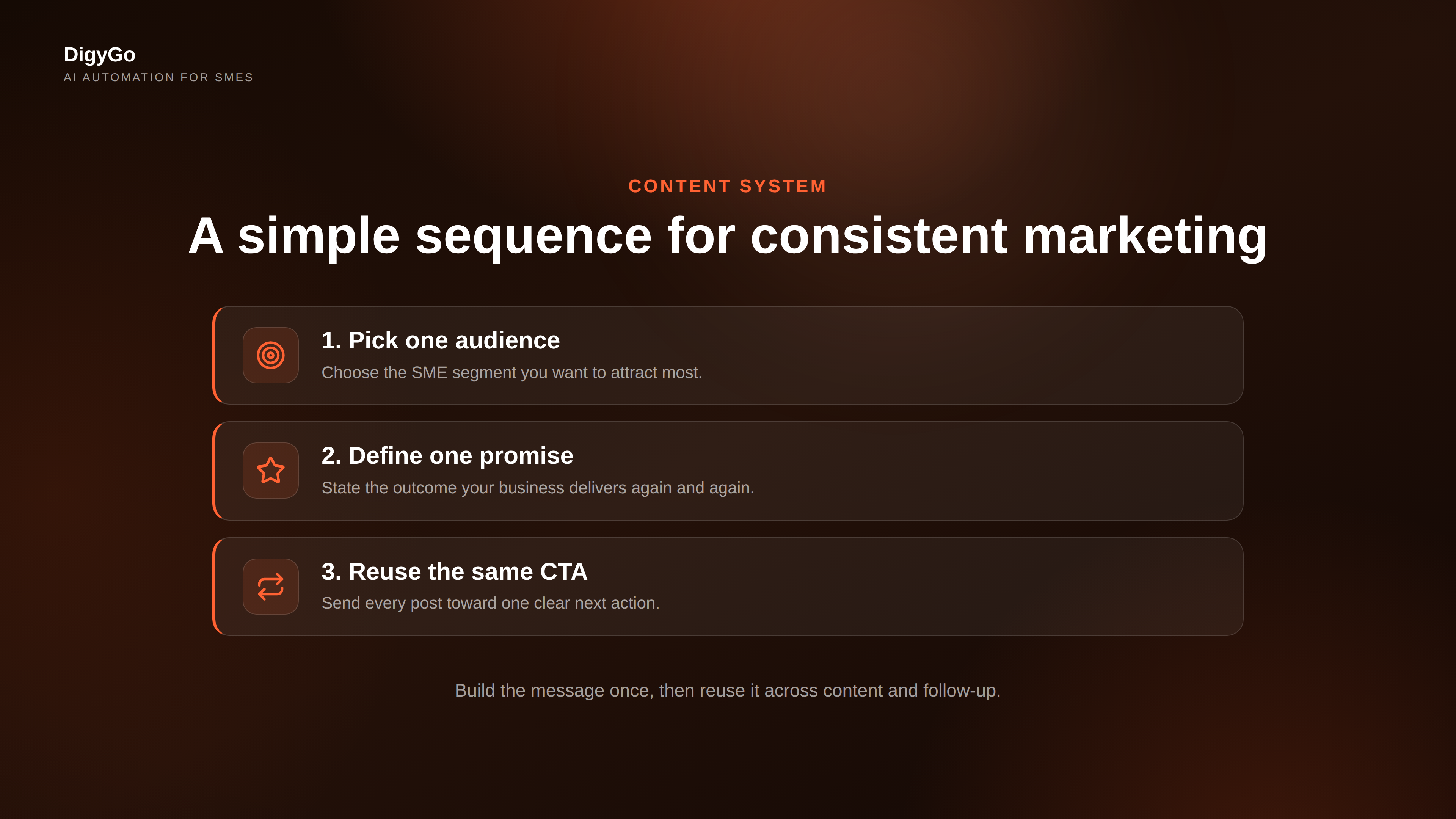
- Pick one audience segment. Example: local service businesses, founders, or operations teams.
- Choose one core promise. Example: faster lead response, clearer positioning, or more booked calls.
- Map three content themes. For example: problem awareness, proof, and practical how-to.
- Repeat the same CTA. Send readers to one action, not five different options.
What consistency looks like across the funnel
Consistency is not only a social media issue. It should show up in your ads, enquiry replies, nurture emails, and sales follow-up. If the ad promises one outcome, but the first reply sounds generic, the trust you created disappears quickly.
That is why the strongest SMEs treat messaging like infrastructure. The content may change, but the core positioning stays stable enough for the buyer to recognise you at every step.
How to audit your marketing for mixed signals
Run a quick check on your latest five posts, three ads, and one sales message. Ask whether they all point to the same buyer problem and the same outcome. If they do not, rewrite the weakest pieces first.
- Does the headline match your best customer?
- Does the proof support the same promise?
- Does the CTA ask for one clear next step?
Fixing this usually creates a bigger lift than posting more often. It improves clarity, which improves clicks, replies, and conversions.
FAQ
Is consistency more important than frequency?
Usually yes. A consistent message published less often is often stronger than frequent posts that confuse the market.
What if my services are broad?
Pick one entry point. You can still sell multiple services later, but the content should start from one clear problem.
How long before consistency pays off?
For most SMEs, the signal gets stronger within a few weeks, but the real compounding comes when the same message is repeated across months.
Want a marketing message that stays consistent across every touchpoint? Talk to DigyGo.