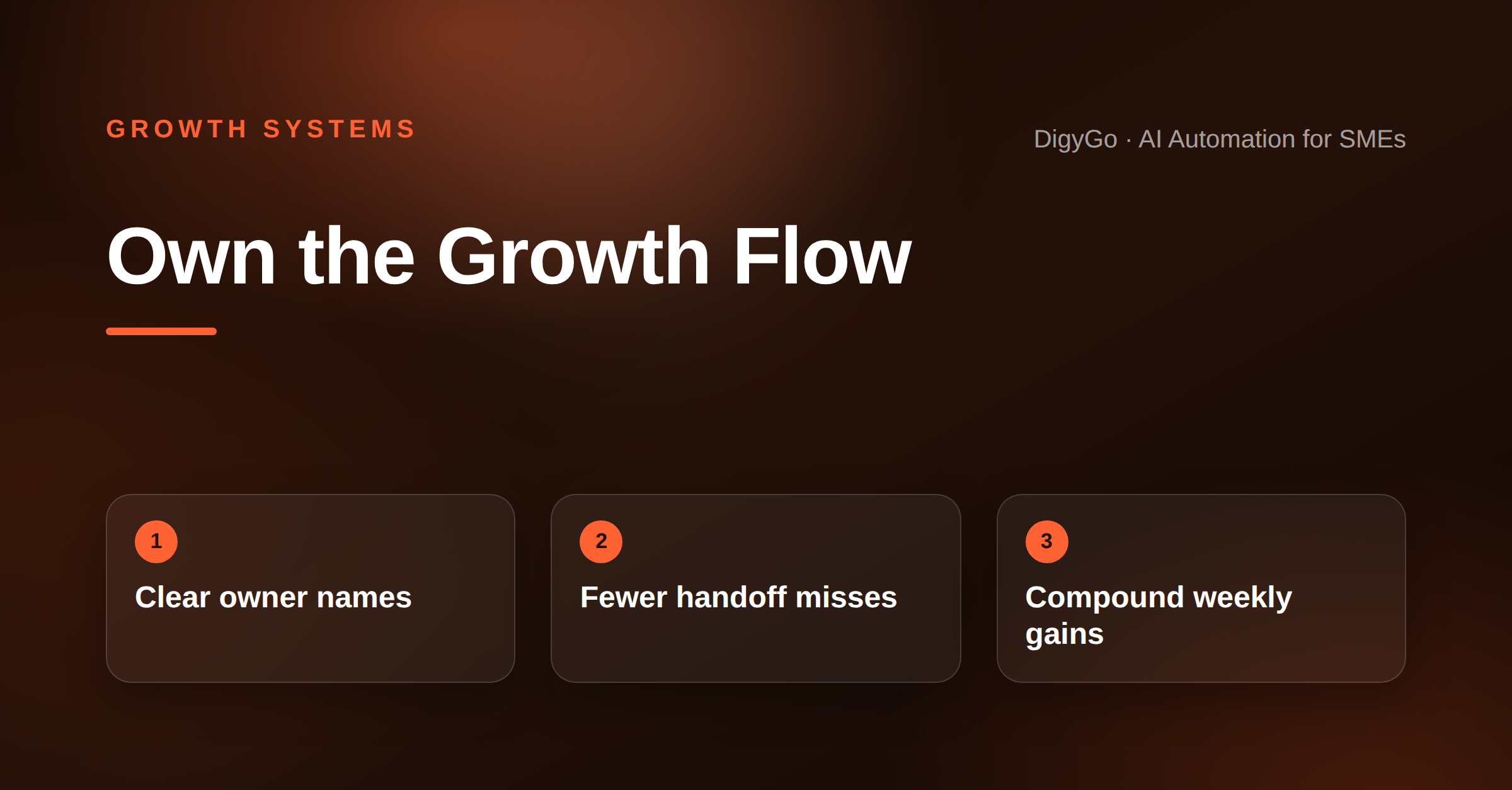
Growth usually slows when ownership gets fuzzy. A growth ownership map gives SME teams one place to see who owns lead flow, delivery, retention, and review work so small fixes turn into compound gains instead of repeat chaos.
A practical guide for SME founders on using a growth ownership map to assign clear accountability, reduce handoff drift, and make growth systems compound.
Why growth systems drift without clear ownership
Most SMEs do not lose momentum because they lack effort. They lose it because the same work keeps bouncing between people. A lead gets handled, then forgotten. A customer issue gets fixed once, but no one owns the prevention step. A weekly review happens, but the action list never gets finished.
A growth ownership map solves that by making four things visible at once: the process, the owner, the next action, and the review date. That gives founders less chasing, fewer handoff misses, and a cleaner way to keep growth work moving.
The four parts of a useful ownership map
You do not need a complicated system. Start with one page and four columns. Keep the language simple enough that the whole team can use it daily.
- Process: what work is being handled.
- Owner: one person accountable for the next move.
- Trigger: what tells the team the work has started or stalled.
- Review date: when the owner checks whether the fix actually stuck.
Once this is visible, growth systems stop living in scattered chats and inboxes. They become a repeatable operating rhythm.
Where the map creates the biggest lift
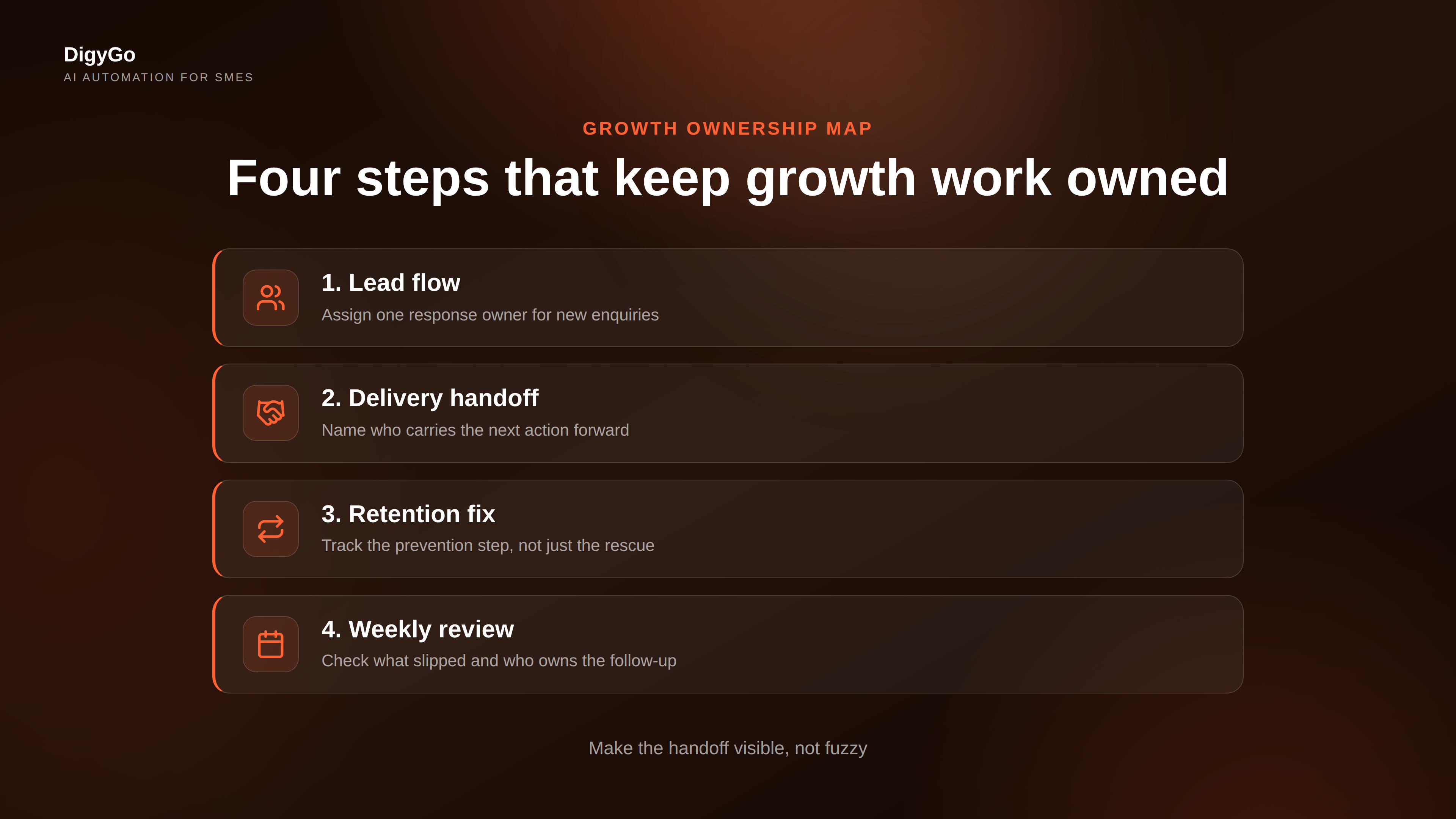
The best place to use this is at the seams between teams. That is where work is most likely to slip. One person generates the lead, another answers it, another books the next step, and someone else has to make sure the customer actually stays active.
When those handoffs are not owned clearly, the business ends up paying for the same problem twice. First in lost time, then in lost revenue.
| Growth area | Common leak | Ownership fix |
|---|---|---|
| Lead flow | Enquiries sit unanswered | Assign one response owner |
| Delivery | Tasks bounce between people | Define the handoff and deadline |
| Retention | Customer issues are solved once only | Own the prevention action |
| Weekly review | Action items disappear after the meeting | Give every fix a named owner |
How to build the map in one afternoon
Start with the work that leaks most often. Do not try to map every process at once. Pick the three or four growth paths that affect revenue and retention the most.
- List the recurring work that moves money or customer experience.
- Mark where it currently slows down or gets re-assigned.
- Assign one owner for each step, even if it is shared operationally.
- Set a review cadence so the owner checks whether the issue is fixed permanently.
If the map is too large, it will not be used. If it stays lean, the team will actually refer to it when work gets busy.
Manual chaos vs clear ownership
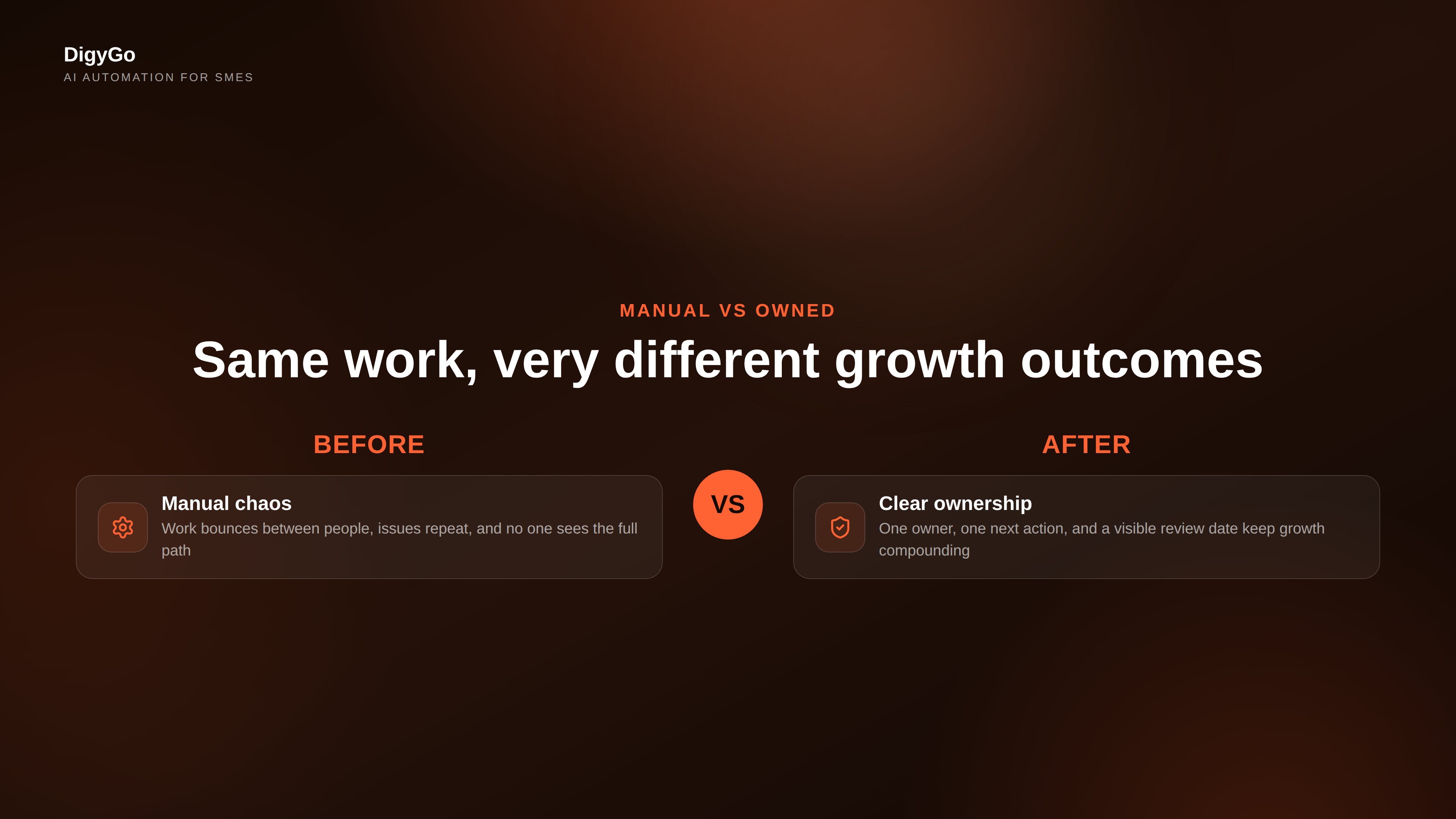
The difference is easy to spot. In a messy system, everyone knows the problem but no one knows who owns the fix. In a clear system, the right person sees the issue early, acts on it, and reports back with proof.
That is what makes growth compound. The team stops solving the same leak every week and starts removing it from the system.
- Manual mode: repeated chasing, mixed responsibility, slow fixes.
- Owned mode: visible accountability, faster correction, cleaner recurrence prevention.
What to review every week
The map only works if it is kept alive. A short weekly review is enough. Ask three questions: What slowed down? What got fixed? What needs a new owner?
That keeps the system from drifting back into guesswork. It also helps founders spot whether the business has a process problem, a handoff problem, or a capacity problem.
For SMEs, that difference matters. You cannot compound growth if the same operational leak keeps reopening every week.
FAQ
Do I need software for a growth ownership map?
No. A spreadsheet or shared document is enough. The value comes from clarity, not the tool.
How many owners should one process have?
One owner per process is best. Support can be shared, but accountability should not be.
What is the first process to map?
Start with the part of the business that leaks most often, usually lead handoff, delivery handoff, or retention follow-up.