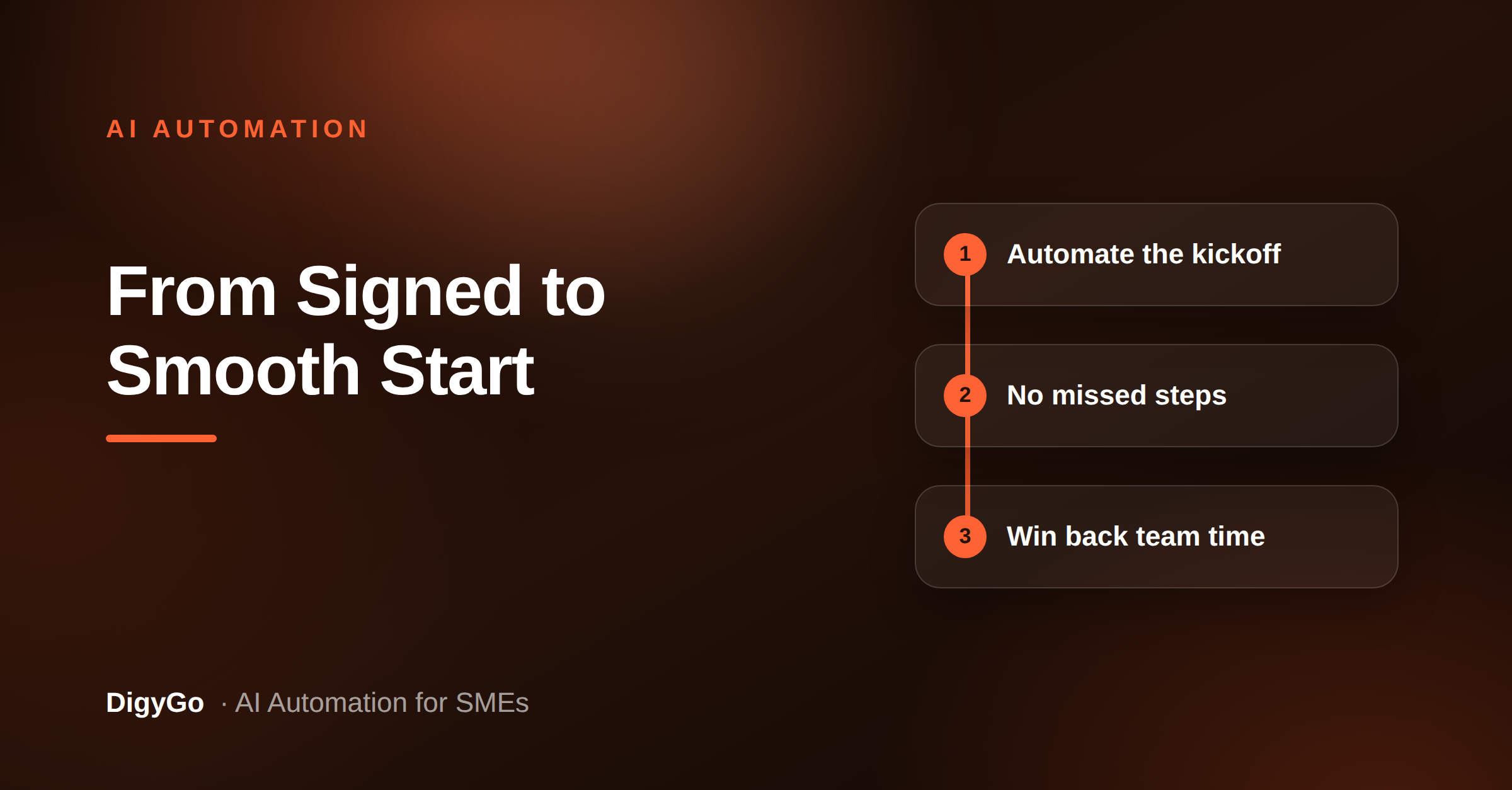
Closing a sale feels great. But what happens next — the welcome email, the CRM entry, the kickoff meeting, the team introductions, the access setup — can take hours of manual work. For SMEs with lean teams, every new client starts a scramble of copy-pasting, switching tabs, and reminding coworkers. An AI onboarding agent can automate that entire sequence so every client starts on the right foot without adding admin overhead.
Closing a sale is the easy part. An AI onboarding agent automates the welcome email, CRM record, project board, and task assignment so every new client starts fast, organised, and happy without adding admin overhead.
Key Takeaways
- Manual client onboarding costs SMEs 3–5 hours per new client in repetitive admin work
- An AI onboarding agent sequences welcome steps, CRM updates, and task assignments automatically
- Automated onboarding cuts time-to-kickoff by up to 70% and reduces missed steps
- New clients get a consistent, professional first impression every time
Why Manual Onboarding Is a Hidden Drain on SME Operations
When a new client signs up, the operational load is spread across a handful of people. Someone creates the CRM record. Someone drafts a welcome message. Someone sets up the project board and assigns a team. Someone schedules the kickoff. And somewhere in between, a step gets missed — the intro email never went out, the access credentials arrived late, or the onboarding checklist was half-filled and forgotten.
Each missed step chips away at the client's first impression. A structured onboarding system is the foundation of retention, but even a good system falls apart when the execution relies on manual reminders across Slack, email, and sticky notes. The core problem is not the checklist — it is the coordination. Someone has to remember to run the checklist, track each item, and chase the people responsible. That someone is usually the busiest person in the room.
What an AI Onboarding Agent Actually Does
An AI onboarding agent is a workflow automation layer that fires the moment a deal is marked Closed Won in your CRM. It does not replace the human relationship — the kickoff call, the personal intro, the trust-building conversation. It handles the operational sequence that follows every sale, whether the team is awake or not.
Trigger and intake
The agent picks up the client's details — name, service type, agreed scope, billing terms — from the deal record. It creates a client profile in the CRM with zero manual typing. No one has to remember to open the add-contact form.
Welcome sequence
Within minutes, the agent drafts and sends a branded welcome email that includes the client's agreement summary, the team members they will work with, and a link to book their kickoff call. The email goes out immediately, while the deal is still fresh in the client's mind.
Kickoff scheduling
The agent sends the assigned project lead a notification with the client's preferred time windows and asks them to confirm within 24 hours. If no one picks a slot, it escalates to the operations manager. The kickoff is never left hanging on someone's to-do list.
The Automated Workflow That Runs Behind the Scenes
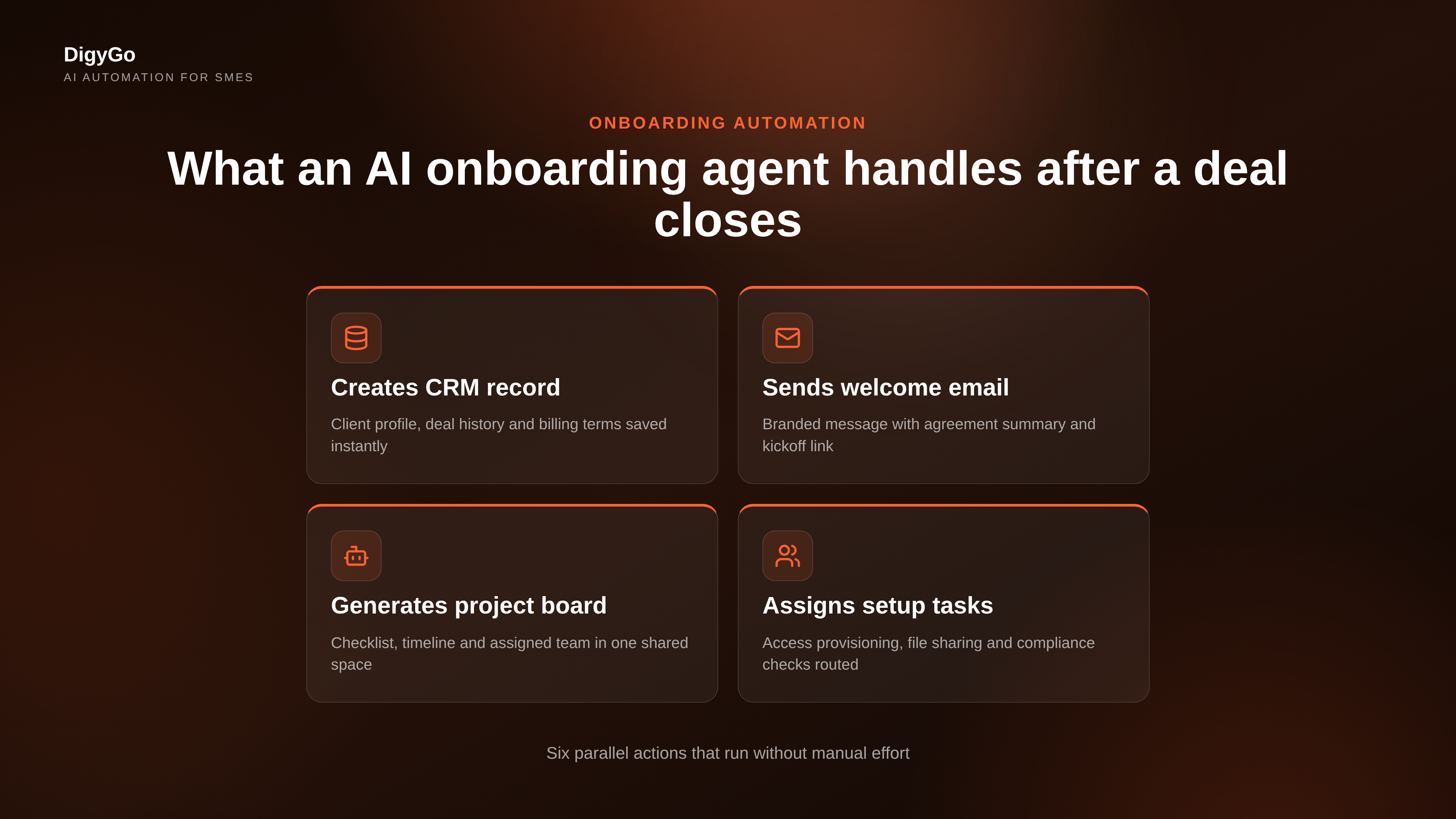
The real power of an AI onboarding agent is not a single email. It is the orchestrated sequence of actions that happen across your tools in parallel, without anyone touching a keyboard.
When the deal closes, the agent:
- Creates the CRM record — Contacts, company, deal history, service agreement, and billing terms written to the correct pipeline stage.
- Generates the project board — A new project with the onboarding checklist, timeline, assigned team members, and milestone dates. Each item has a due date and an owner.
- Sends the welcome email — Branded, personalised, with the agreement summary, team roster, and kickoff booking link.
- Assigns onboarding tasks — Internal setup tasks assigned to the right people: access provisioning, file sharing, tool invitations, and compliance checks.
- Triggers the kickoff cadence — A three-part sequence that ensures the kickoff happens within the agreed window, with reminders and an escalation path if the call is not booked.
- Logs everything to the operations logbook — Every action, timestamp, and assignment is recorded so there is never a question of who did what and when.
Each of these steps is configurable. An SME that does software implementation will have a different onboarding checklist than one that runs a cleaning service. The agent follows the playbook you define — it just runs it every time without forgetting.
What Changes When Onboarding Is Automated
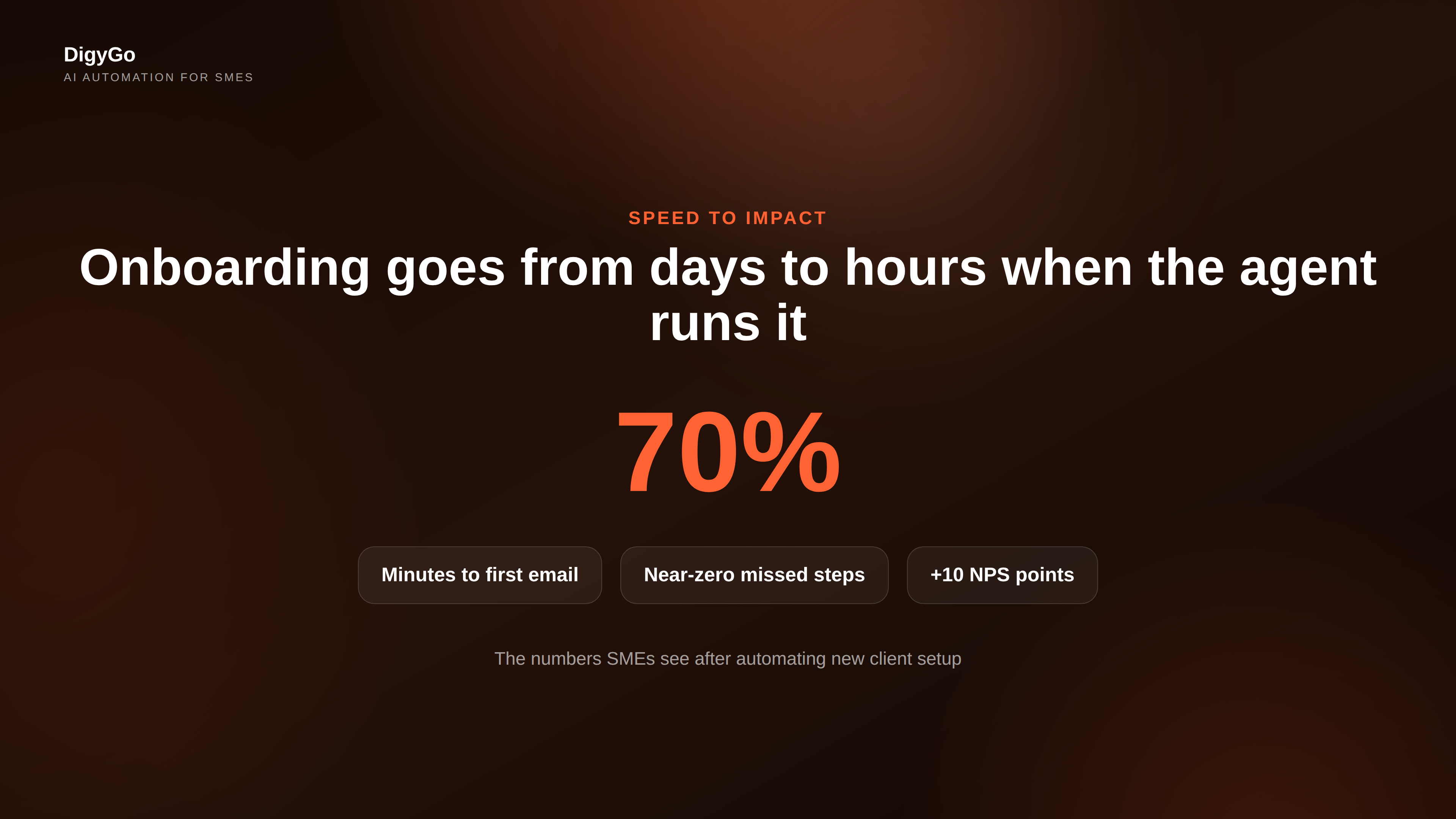
The most visible difference is speed. Instead of a client waiting 24–48 hours for a welcome email and another 2–3 days for a kickoff invitation, the first message arrives within minutes of the deal closing. The kickoff link follows within the same hour. The client experiences a business that is responsive, organised, and ready to serve — not one that fumbles after the payment goes through.
Internally, the team spends less time on admin and more time on the work that actually serves the client. The project manager is not copy-pasting email addresses or updating spreadsheets. The assigned team sees the new project appear on their board with a clear checklist and deadlines. Nothing waits on a Slack ping that might get buried.
Real improvement numbers
SMEs that automate onboarding with AI agents typically see:
- Time-to-kickoff drops by 60–75% — from days to hours.
- Missed onboarding steps fall to near zero — because the agent checks every item off the list.
- Client NPS scores improve by 8–12 points — first impressions matter, and a smooth start sets the tone for the entire relationship.
When Does an Onboarding Agent Make Sense for Your SME?
The threshold is lower than most founders think. If you onboard more than 5–10 clients per month and spend more than two hours on setup per client, an onboarding agent will pay for itself in team time alone. The consistency benefit — every client getting the same high-quality start — compounds with every repeat client and referral.
Businesses that benefit the most:
- Agencies that onboard new retainer clients every week
- Service businesses with a repeatable delivery process
- SaaS or software companies with a structured implementation phase
- Professional services firms (accounting, consulting, legal) with recurring clients
FAQ
Does an AI onboarding agent replace the kickoff meeting itself?
No. The agent handles the operational setup — CRM, emails, task assignment, scheduling — but the human kickoff call remains essential for building trust and alignment. The agent makes sure everything is ready before that call happens.
Can the onboarding sequence be customised per client type?
Yes. The agent runs different playbooks based on the service type, deal size, or client segment defined in your CRM. A premium onboarding flow can include a welcome call scheduling, while a standard flow sends a self-guided setup link.
What tools does the onboarding agent need to connect to?
Typically: your CRM (to read the deal stage and write the client record), your project management tool (to create the project board), and your email platform (to send the welcome sequence). The agent sits on top of these tools and orchestrates across them without moving data manually.
How long does it take to set up an onboarding agent?
The first playbook takes one to two days to configure, test, and deploy — defining the triggers, sequences, and tool connections. Once the template is built, every new client runs through it automatically.
Will the onboarding agent send incorrect information if the CRM data is wrong?
The agent uses the data from the deal record as its source of truth. If the CRM fields are populated correctly — client name, service scope, billing terms — the emails and records will be accurate. It is good practice to keep your deal-stage data clean, which most teams already do at closing time.
"The moment a deal is marked closed, the onboarding agent should be writing the welcome email — not the project manager. That is the speed your clients notice."
Build your AI onboarding agent — talk to the DigyGo team →