Most SMEs track how many new enquiries they get. Very few track how many customers they are quietly losing. A customer who stops replying, skips a service, or delays payment is usually not gone suddenly — they have been signalling disengagement for weeks. AI automation can catch those signals, score each account's health, and prompt a proactive intervention before the customer ever thinks about switching.
A practical guide for SME founders on using AI automation to monitor customer behaviour signals, score account health weekly, and intervene before at-risk customers go silent or switch to a competitor.
This is not about building a data-science platform. It is about connecting the signals your business already produces — response patterns, service frequency, payment behaviour, support interactions — into a simple health-scoring system that flags at-risk accounts automatically.
The Cost of Reactive Retention
Most SMEs notice churn only after it happens. A customer stops booking, the team shrugs, and the revenue is gone — but the replacement cost to acquire a new one is three to five times higher. The problem is not that SMEs do not care about retention; it is that the signals are scattered across WhatsApp chats, call logs, booking records, and email threads. No single person sees the pattern until it is too late.
An AI system does not have that blind spot. It monitors every touchpoint, assigns a health score each week, and surfaces the accounts that need human attention before they go silent.
What Signals Matter for SME Churn Prediction
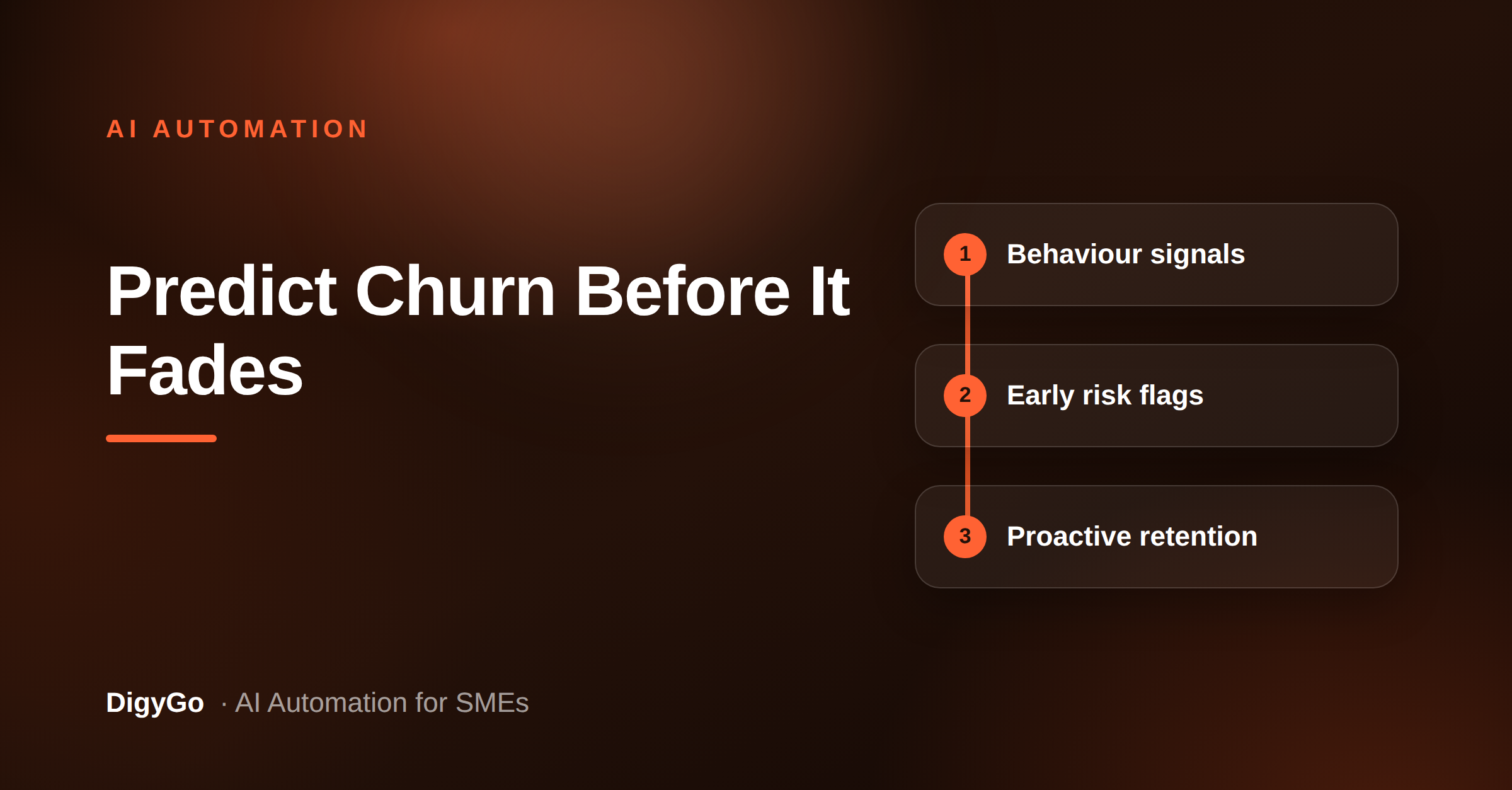
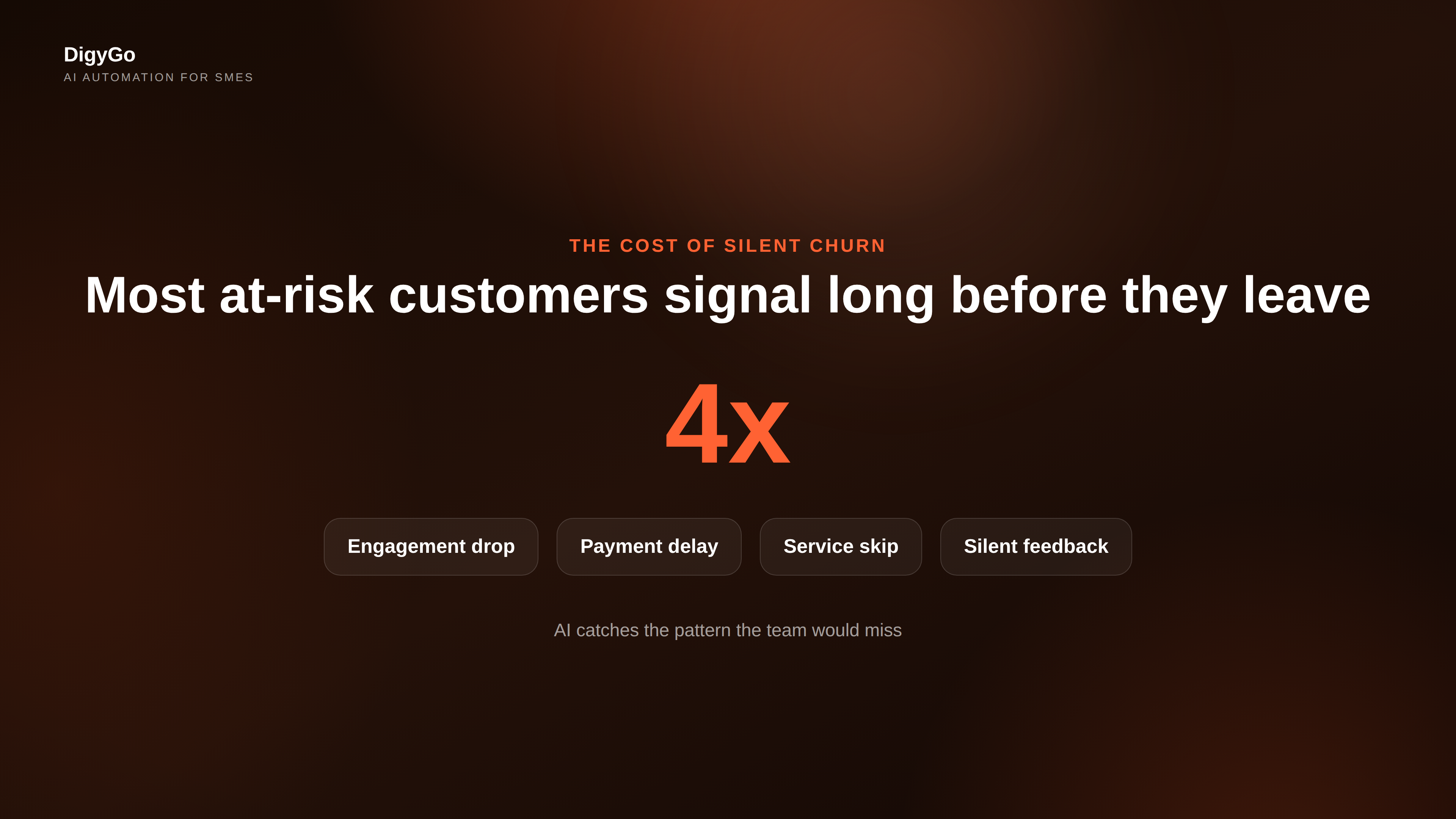
You do not need a dozen data points. Most SME churn can be predicted from four categories of behaviour:
1. Engagement signals
Has the customer stopped opening your messages? Are they taking longer to reply? A drop in response rate over two to three weeks is the earliest and most reliable churn indicator. AI can track response latency per customer automatically and flag anyone whose reply time has doubled compared to their baseline.
2. Service-frequency signals
A customer who used to book every month and has now skipped two cycles is not busy — they are drifting. AI compares each customer's actual booking interval against their historical pattern and marks anyone who has fallen outside their typical cadence.
3. Payment behaviour
Late payments, partial payments, or invoices that need multiple reminders are often the first financial signal of dissatisfaction. When a previously reliable payer starts delaying, the AI raises the account's risk level.
4. Support-interaction signals
Customers who submit complaints, request refunds, or send frustrated messages are obviously at risk. But so are customers who have stopped giving feedback altogether — silence after a period of active communication can indicate they have already made the decision to leave. AI sentiment analysis on WhatsApp and email threads can detect negativity or disengagement long before a human would notice the pattern.
Building a Simple Customer Health Score
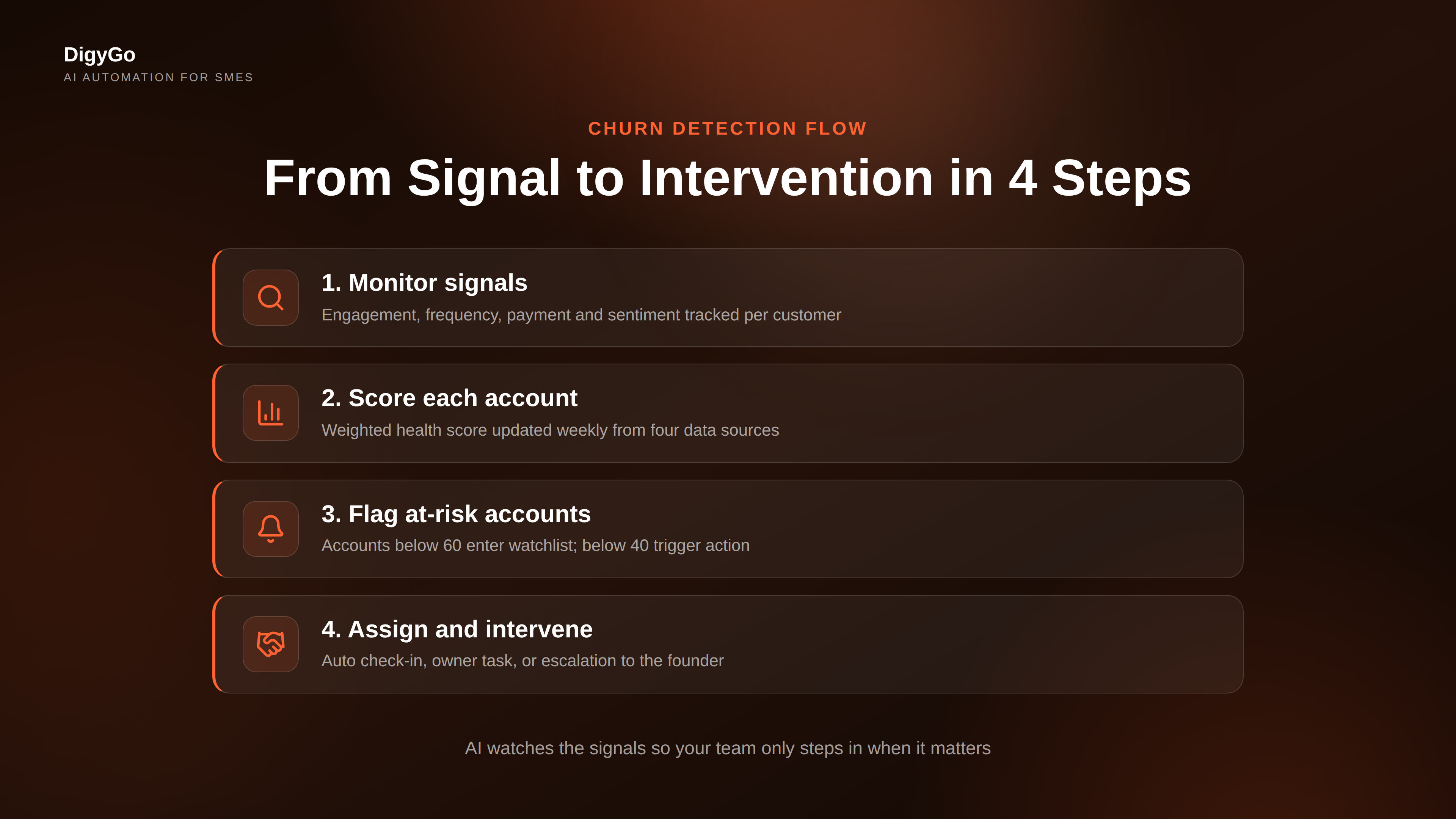
A practical health score does not need machine-learning models. A weighted points system — 40 % engagement, 30 % service frequency, 20 % payment reliability, 10 % support sentiment — updated automatically each week, gives you a single number per customer. Accounts that drop below a threshold (say, 60 out of 100) enter a watchlist. Those below 40 trigger an automated intervention sequence.
The AI does not replace the human relationship. It does the monitoring so the team only steps in when it matters.
From Signal to Action: The Intervention Flow
Once a customer is flagged, the AI does three things automatically:
- Sends a low-touch check-in — a friendly message asking how things are going, or sharing something useful relevant to the customer's industry. No sales pressure. The goal is to reopen the channel.
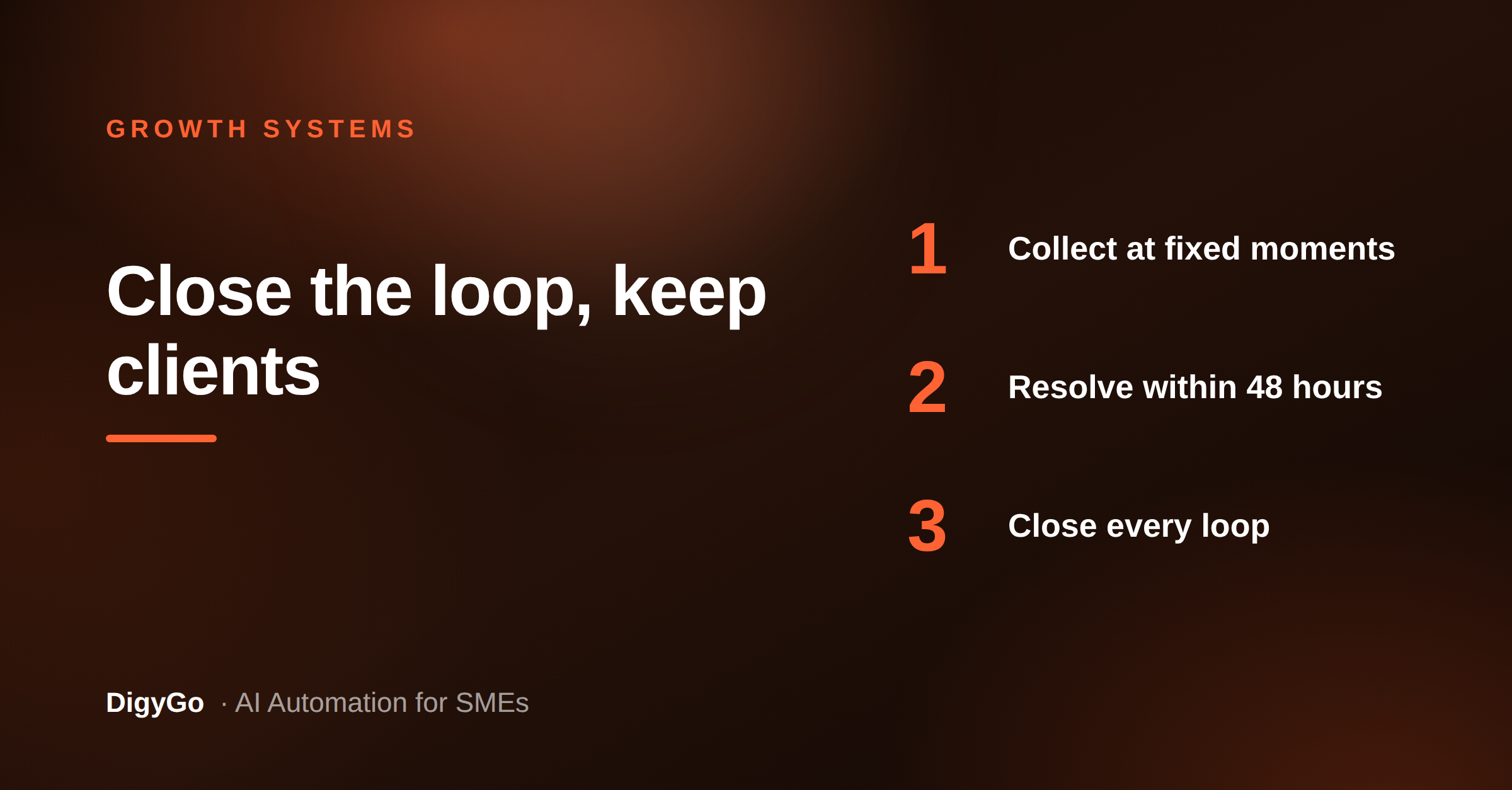
- Creates a task for the right owner — if the check-in gets no reply within 48 hours, the AI creates a structured follow-up task with the customer's history, risk factors, and suggested talking points attached.
- Escalates to the founder or manager — if a high-value account stays flagged for two consecutive weeks, the system sends a brief to the decision-maker so they can intervene personally before the account is lost.
This flow runs in the background. The team never has to check dashboards or remember to follow up. The AI owns the monitoring loop; the team owns the relationship.
What This Looks Like in Practice
A Coimbatore service SME with 200 active customers set up a basic health-scoring system using their CRM data and WhatsApp message logs. In the first month, the AI flagged 14 accounts as at-risk. The team called the top 5 — three re-engaged and booked again within the week. One had already decided to leave but gave honest feedback that improved the service. Over three months, the business reduced monthly churn from 8 % to 4.5 %, effectively doubling the lifetime value of their retained customer base without spending a rupee on acquisition.
The system cost less than one new customer acquisition to set up. The return on retention was immediate.
Start with the Signals You Already Have
You do not need a fancy platform. Start by connecting the three touchpoints your SME already uses — your booking or invoicing tool, your primary communication channel (WhatsApp, email, or phone log), and your support thread. Feed the data into a simple weekly score. Set a threshold. Assign an owner for flagged accounts. Run the flow for two months and measure the difference.
Churn prediction is not a luxury for enterprises with data teams. It is a practical automation layer that every SME can build with the signals they already generate. The customers who are about to leave are already telling you. AI just makes sure you hear them in time.
Frequently Asked Questions
How much data do I need to start predicting churn?
Three to six months of interaction history per customer — booking dates, message response times, and payment records — is enough to establish baselines. The AI can start flagging anomalies from week one and gets more accurate as more data accumulates.
Do I need a data scientist to set this up?
No. A simple weighted score (engagement + frequency + payment + sentiment) can be built with spreadsheet logic or a basic workflow tool. The AI layer adds automatic monitoring and task creation — no machine-learning expertise required.
What if my SME has fewer than 50 customers?
Health scoring works at any scale. With fewer customers, each lost account represents a larger percentage of revenue, making early detection even more valuable. The same signals apply; the intervention is more personalised.
Can AI churn prediction work with WhatsApp as the primary channel?
Yes. WhatsApp message logs — reply times, frequency of contact, emoji and language sentiment — are excellent input signals. Most SME customer communication happens on WhatsApp, which makes it the richest single data source for engagement monitoring.
How long before I see results from churn prediction?
Most SMEs see their first at-risk flag within the first week of monitoring. The real impact — measurable churn reduction — typically shows within two to three months, as the team intervenes early enough to retain accounts that would otherwise have been lost.