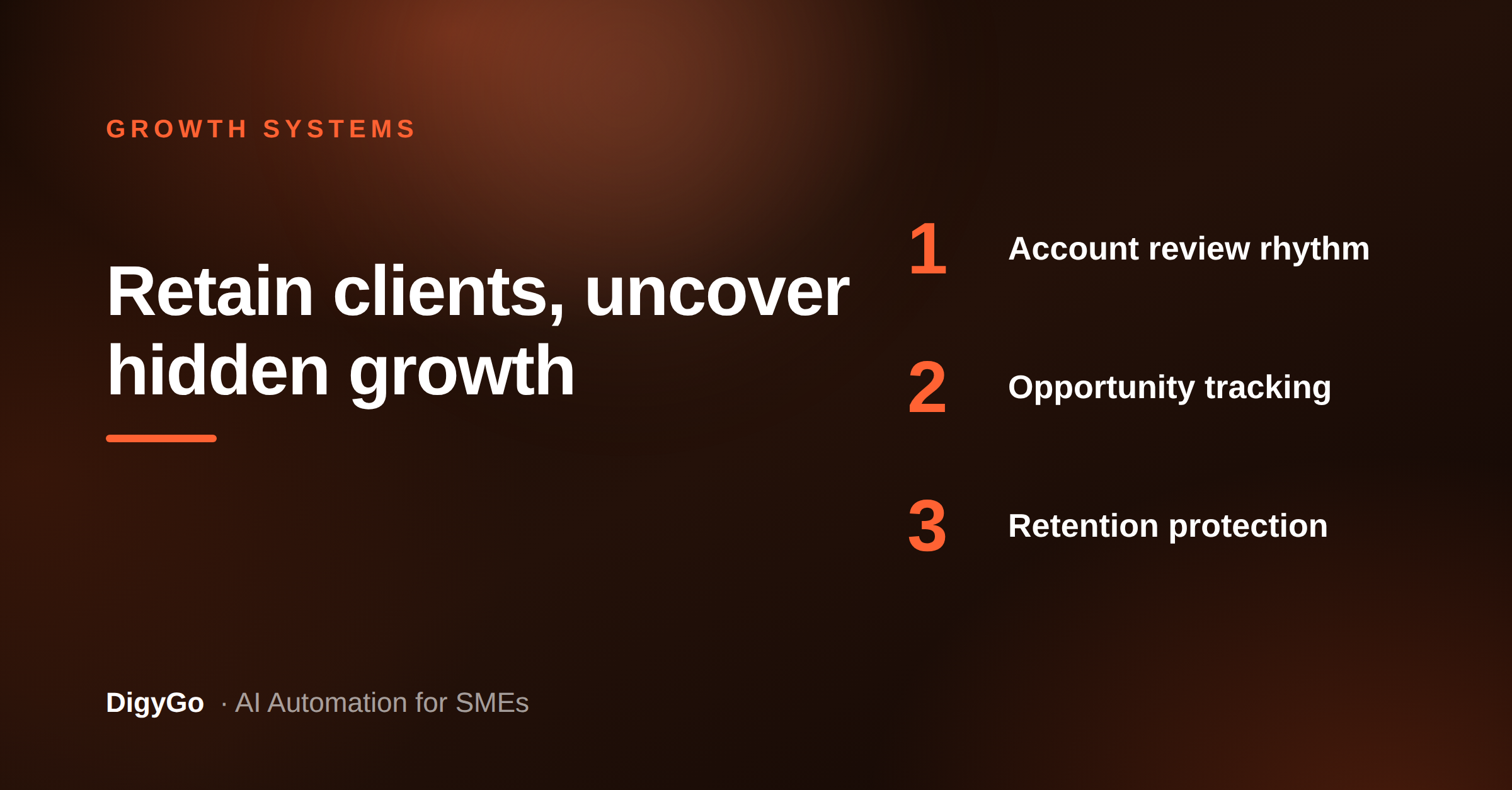
Most SMEs lose growth opportunities not because they lack good clients, but because they never sit down to review them. When you are busy delivering work every day, it is easy to keep serving the same clients the same way — and miss the moment they are ready to buy more, refer you, or quietly drift away. A simple account review system changes that. It turns random client conversations into a repeatable growth rhythm that protects retention and uncovers expansion at the same time.
Most SMEs lose growth opportunities not because they lack good clients, but because they never sit down to review them. Learn how a simple account review system protects retention and uncovers expansion at the same time.
Why reactive account management leaks revenue
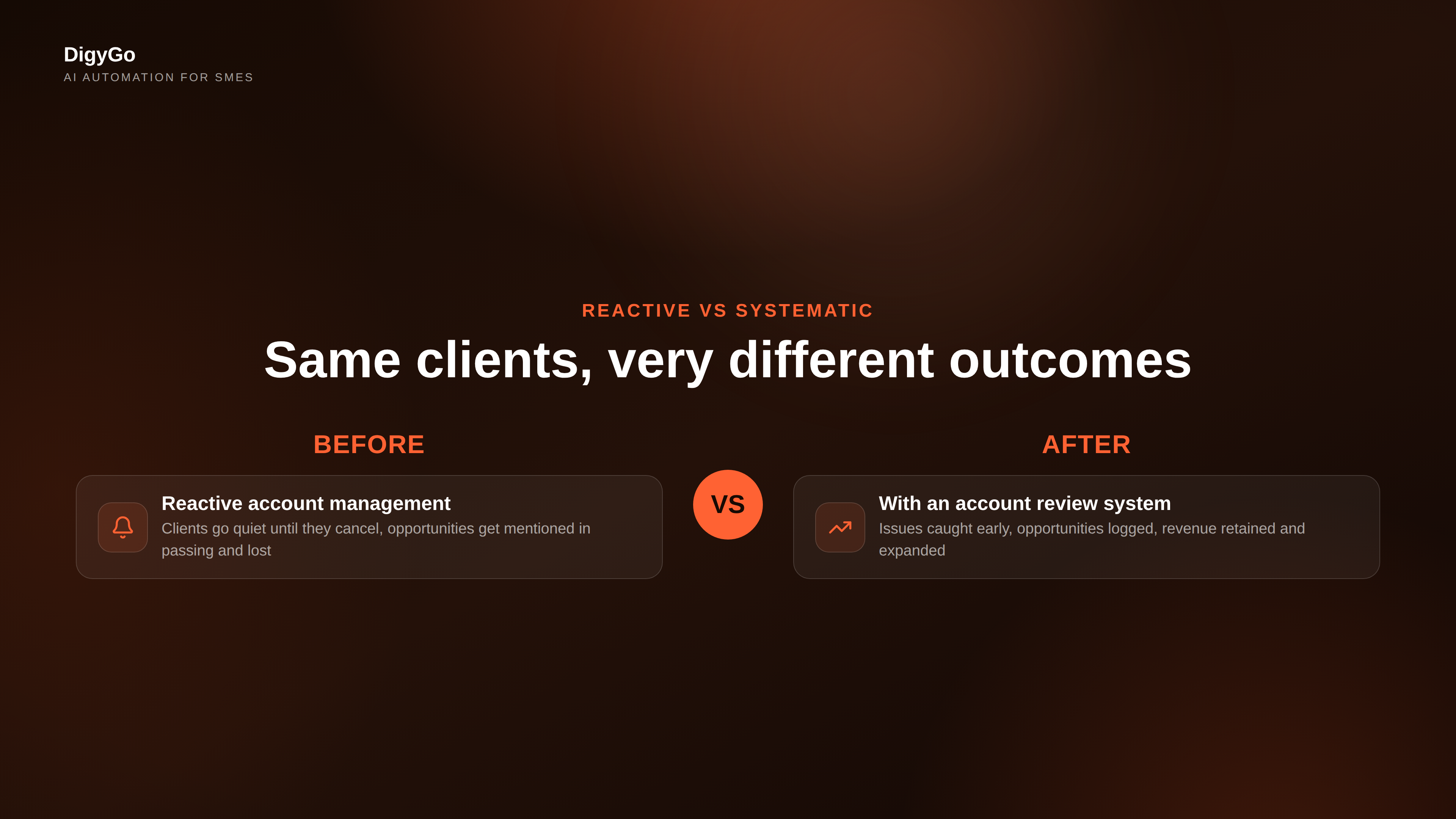
The default approach for most SME teams is reactive account management. You hear from a client when they have a problem, when an invoice is due, or when they need a new job done. Between these events, the relationship sits in silent maintenance mode. Nothing breaks, but nothing grows either.
A reactive approach creates two hidden revenue leaks. First, small frustrations go unspoken until they become big enough to prompt a cancellation — by which time the client has already made up their mind. Second, expansion opportunities (a new location, a new service line, a referral need) come up in passing conversation and get forgotten because there is no structured follow-up. Both leaks are invisible until the revenue is already gone.
What a client account review system looks like
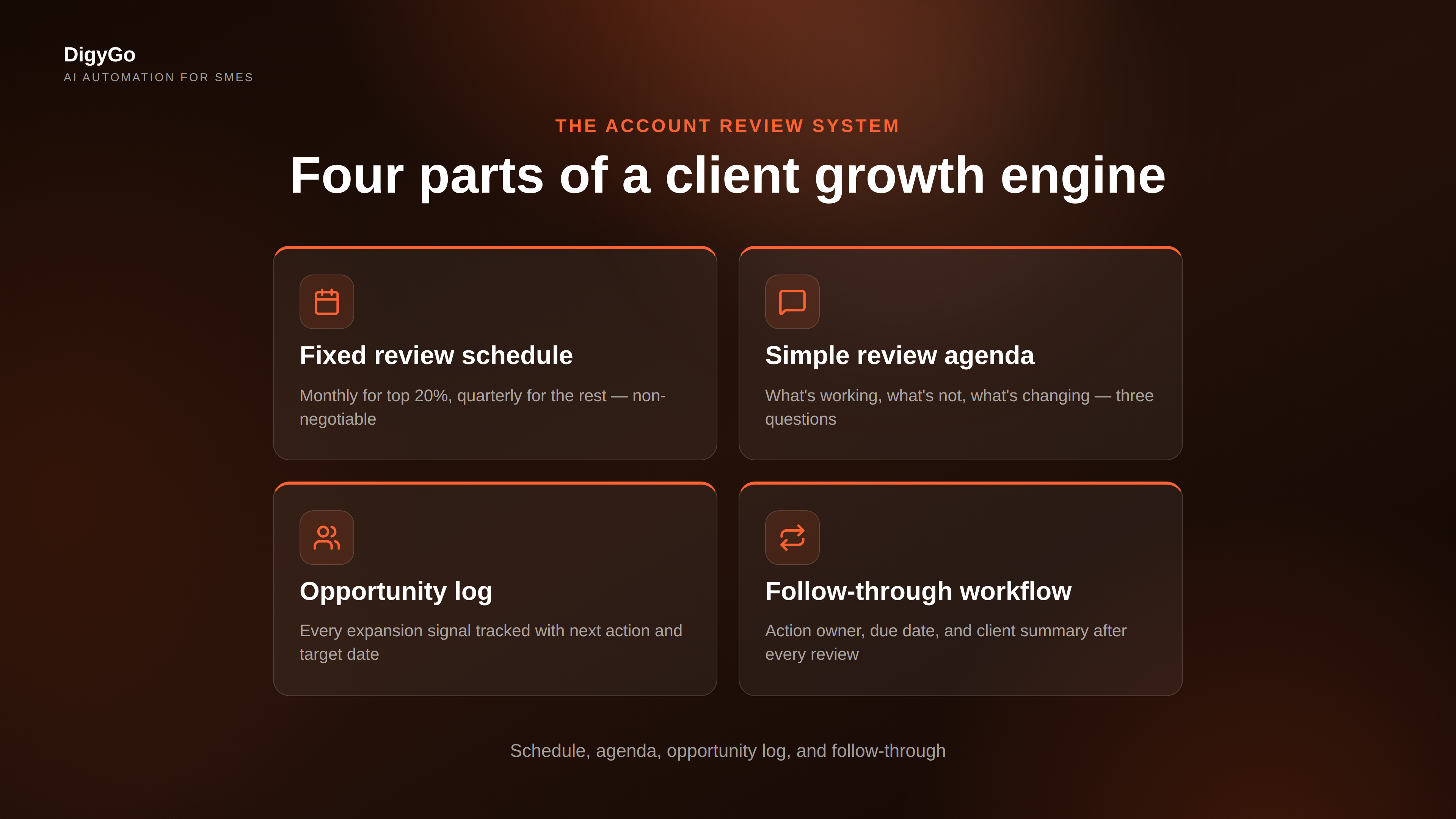
An account review system is a recurring meeting rhythm — not a sales pitch, but a structured conversation between your team and the client about how things are going, what is changing, and what is next. The system has four working parts.
1. A fixed review schedule
Set a recurring calendar slot for every active client. Monthly for your top 20% of clients by revenue, quarterly for the rest. The schedule is non-negotiable — it goes on both your calendar and theirs. A 25-minute review every month is enough to surface issues early and keep the relationship warm.
2. A simple review agenda
Every review follows the same three-question structure:
- What is working? — What delivered value since the last review? Celebrate wins and log proof points.
- What is not working? — Any friction, delay, or expectation gap? Surface it here before it becomes a complaint.
- What is changing? — Any new projects, team changes, budget shifts, or growth plans on the client side? This is where expansion opportunities live.
Writing these three answers into a shared doc (a simple Google Doc or Notion page per client) creates a running relationship record that survives staff changes and keeps context from slipping.
3. An opportunity log
Every expansion signal that surfaces during a review — "we are opening a second branch", "we need training for our new hires", "our current vendor is unreliable" — goes into an opportunity log. This is a single table or sheet shared across your team. Each row has the client name, the opportunity, a potential value estimate, a target date, and a next action. Review this log as a team once a month to decide which opportunities to pursue and which to leave for the next cycle.
4. A follow-through workflow
The review is useless without follow-through. After each review, send the client a one-paragraph summary of what was discussed and what you committed to. Then assign every action from the review to a specific owner with a due date. If the review uncovered a cross-sell opportunity, someone owns the proposal within seven days. If the client raised a concern, someone owns the resolution within 48 hours. This discipline is what separates a system from a meeting that goes nowhere.
How reviews protect retention
The biggest retention risk for an SME is silence. When a client stops raising issues, many teams read it as satisfaction. In reality, quiet clients are often clients who have stopped investing in the relationship — they are either disengaged or already planning to leave. An account review forces the conversation that would otherwise never happen.
A manufacturing client of ours was quiet for three months before their quarterly review. During the review, they mentioned that a key contact had left the company and our deliverables were now being reviewed by someone new who had never been briefed on the project. What could have led to a "surprise cancellation" turned into a 15-minute re-onboarding session — and the relationship is still active a year later. That single review saved about ₹4.8 lakh in annual recurring revenue.
How reviews uncover expansion
Account reviews are the single richest source of expansion opportunities for an SME service business. During a 25-minute check-in, a client might casually mention that they are launching a new product line, hiring a new team, or opening a new location. In a reactive model, that comment gets lost in the noise of daily work. In a review system, it gets written into the opportunity log and followed up within a week.
We have seen teams generate 30% of their annual new revenue from expansion opportunities discovered during routine account reviews — work that would never have materialised through cold outreach or inbound enquiries.
Making it stick without adding overhead
A common objection from SME teams is that regular reviews take too much time. They do not, when you keep it simple:
- Use a shared template so you never start from scratch.
- Batch your reviews — schedule all monthly reviews for one week and all quarterly reviews for one week.
- Keep the meeting to 25 minutes. Use a timer if you have to.
- Assign one person (a project manager, account manager, or the founder) to own the review rhythm across all clients.
A team of three can review twenty active clients per month with about three hours of total meeting time. The return on those three hours — in retained revenue and discovered opportunities — is almost always higher than any other growth activity you could spend that time on.
Start with your top five clients this month
You do not need to build a full system overnight. Pick your five highest-revenue clients, schedule a 25-minute review with each before the end of this month, and use the three-question agenda. At the end of the month, look at what you learned — the issues you surfaced and the opportunities you discovered. That data will convince you to build the full system for the rest of your client base.
How often should I review small or low-revenue clients?
Quarterly reviews are enough for clients who are below your top 20% by revenue. If a small client shows signs of growth or strategic value, move them to a monthly review.
Who should conduct the review?
The person who owns the client relationship — usually the project manager, account manager, or founder. The key is consistency: the same person should conduct every review with that client so the relationship deepens over time.
What if a client does not want a regular review?
Frame it as a value-add, not a burden: "We review all our active clients monthly to make sure we are delivering what you need and catching issues early. It is a 25-min check-in." Most clients appreciate the structure. If they still decline, offer a quarterly review instead and log the date to follow up.
How do I track expansion opportunities from reviews?
A simple spreadsheet or CRM pipeline view works. Create a custom pipeline stage called "Account Review — Opportunity" and log every expansion signal there with a next action and target date. Review the pipeline as a team once a month to decide what to pursue.
Can this system work for a solo founder?
Yes. A solo founder with 10–15 active clients can run account reviews in one focused day per quarter. The time investment is small compared to the cost of losing a single client or missing one expansion opportunity.
Ready to build an account review system that protects your revenue and uncovers hidden growth? Talk to us about setting up your client review rhythm.