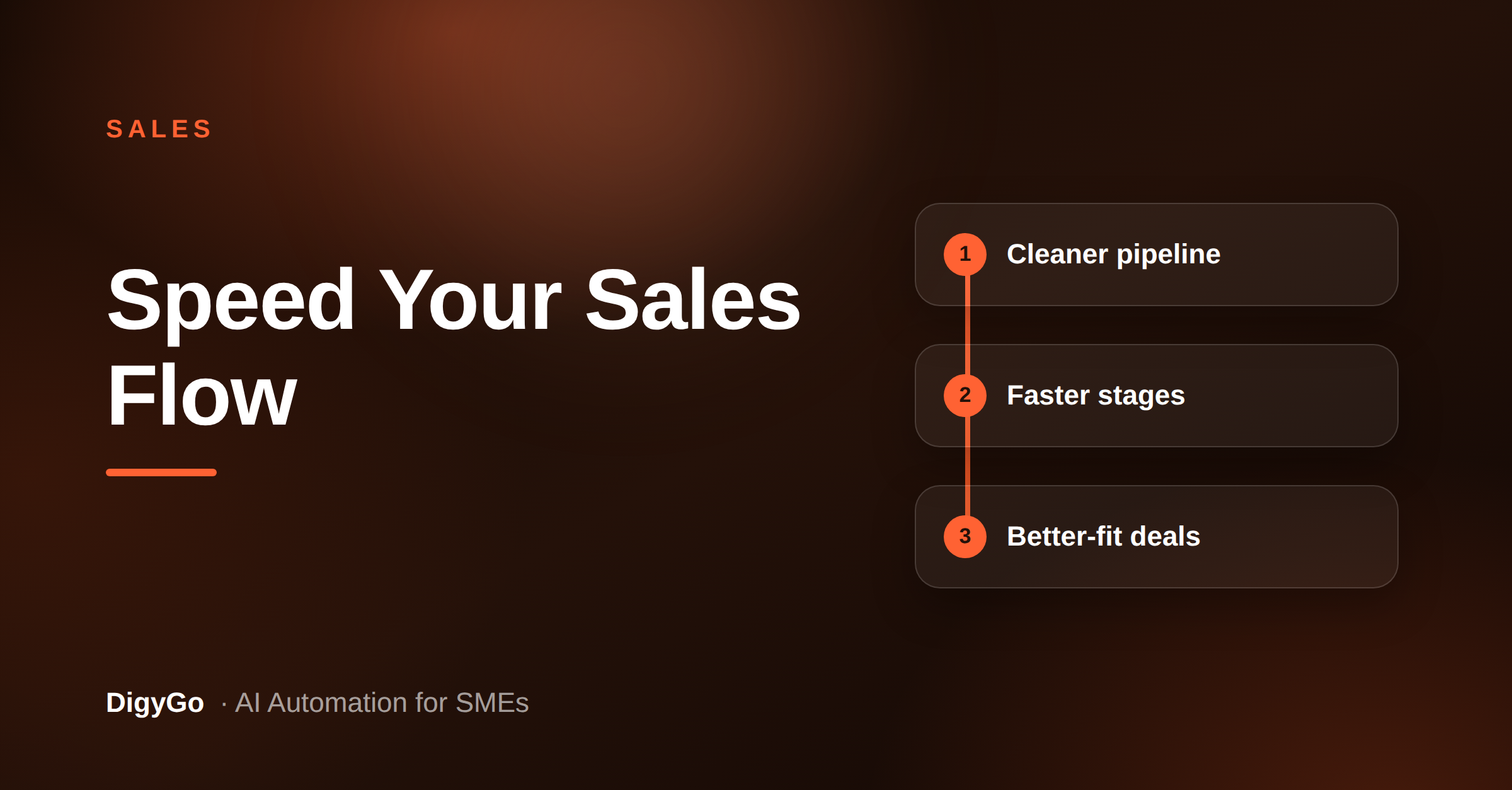
Most SME founders measure how many deals are in their pipeline. Far fewer measure how fast those deals actually move through it. Pipeline velocity — the speed at which a lead travels from first conversation to closed won — is the single most actionable metric you are probably not tracking. And you do not need to chase harder or discount deeper to improve it. You just need to remove the friction that slows every stage down.
Pipeline velocity is the single most actionable metric most SME founders are not tracking. Learn how to shorten your sales cycle, remove internal friction, and close better deals without chasing harder or discounting.
What Pipeline Velocity Actually Tells You
Pipeline velocity is a simple formula:
Number of qualified opportunities × Deal value × Win rate ÷ Length of sales cycle
Most founders obsess over the top half — more leads, bigger deals, better batting average. The bottom half — cycle length — is where a surprising number of deals stall and die. A lead that sits in your pipeline for three weeks has more time to go cold, forget why they called you, and get sold by someone else. Shortening that window without rushing the customer is the whole game.
For Tamil Nadu SMEs, the cycle-length drag is especially real. Founders are hands-on. A quote waits for the owner's sign-off. A follow-up slides because production took over the day. A prospect says "I'll call you back" and never does — not because they are not interested, but because nobody kept the thread moving. Pipeline velocity is a lens that surfaces exactly where the friction lives, so you can fix the process instead of feeling like you have to push harder.
Four Levers That Control Velocity
Before you can accelerate anything, you need to know which levers actually move the needle. Every slow pipeline I have seen inside an SME business traces back to at least one of these four gaps.
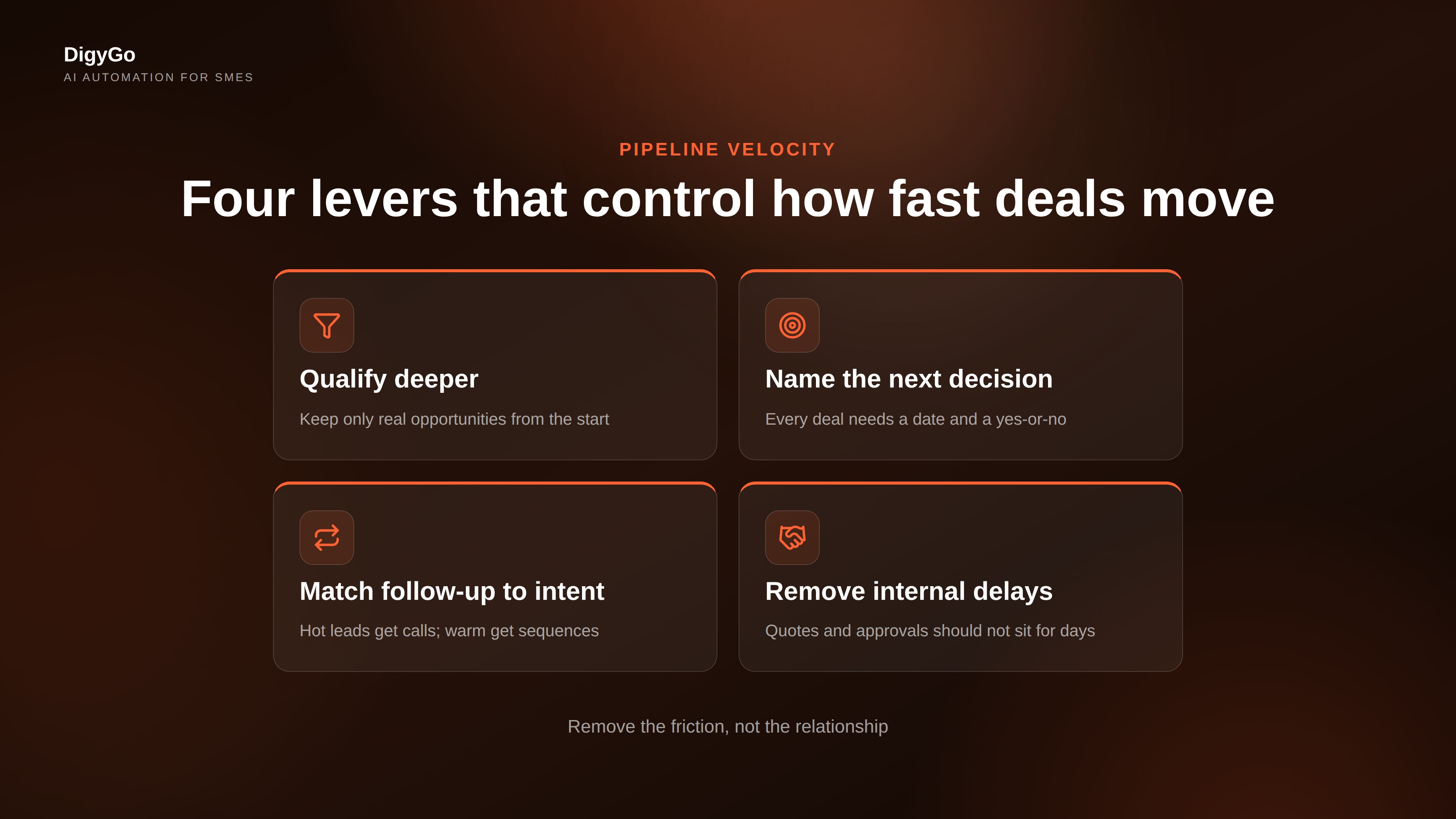
1. Qualification Depth at the Top
Most pipeline bloat is caused by leads that were never really opportunities. A prospect who calls, asks for a quote, and goes silent for two weeks — that was not a deal. That was a tire-kicker who never had budget, timeline, or authority to decide. The fastest way to shorten your cycle is to be honest about who belongs in the pipeline at all. A five-minute qualifying conversation upfront saves hours of proposal-writing and weeks of silence downstream.
2. Decision-Point Clarity Mid-Pipeline
Deals stall when neither side knows what the next step is. You send a proposal. The prospect says "Let me review it." That is not a next step — that is a black hole. Every active deal should have a named next decision: "We will review your pricing in our Tuesday meeting," or "I need to check with my partner before Thursday." Without a date and a decision, the deal is parked, not progressing. When you track who is waiting on whom, you can see which handoffs are falling through the cracks.
3. Follow-Up Cadence That Matches Intent
One email and a prayer is not a follow-up sequence. High-velocity pipelines use a structured follow-up that matches the prospect's stage of interest. A hot lead who asked for a custom quote gets a personal call within hours. A warm lead who downloaded a brochure gets a three-touch sequence over five days — email, message, call — before you park them for nurture. The principle is simple: match your energy to their signal, and never let a lead sit for more than 48 hours without a nudge.
4. Internal Handoffs That Do Not Add Delay
This is the drag that SME founders rarely notice. A sales conversation happens on a call. A quote has to wait for the owner to approve it. That approval takes three days because the owner is on site. By the time the quote reaches the prospect, the moment has cooled. Remove the you — automate the handoff. If a qualified lead's quote does not need custom pricing, let the system generate and send it the same hour. If it does need approval, route it to a mobile notification instead of a desk pile. Every internal handoff that adds more than one business day of lag is a leak in your velocity.
The Five Stages You Can Accelerate Right Now
Instead of trying to fix everything at once, focus on the five stages that have the biggest impact on cycle time. Each one has a specific fix that does not require a CRM overhaul or a sales trainer. Just a small change in how you run that stage.
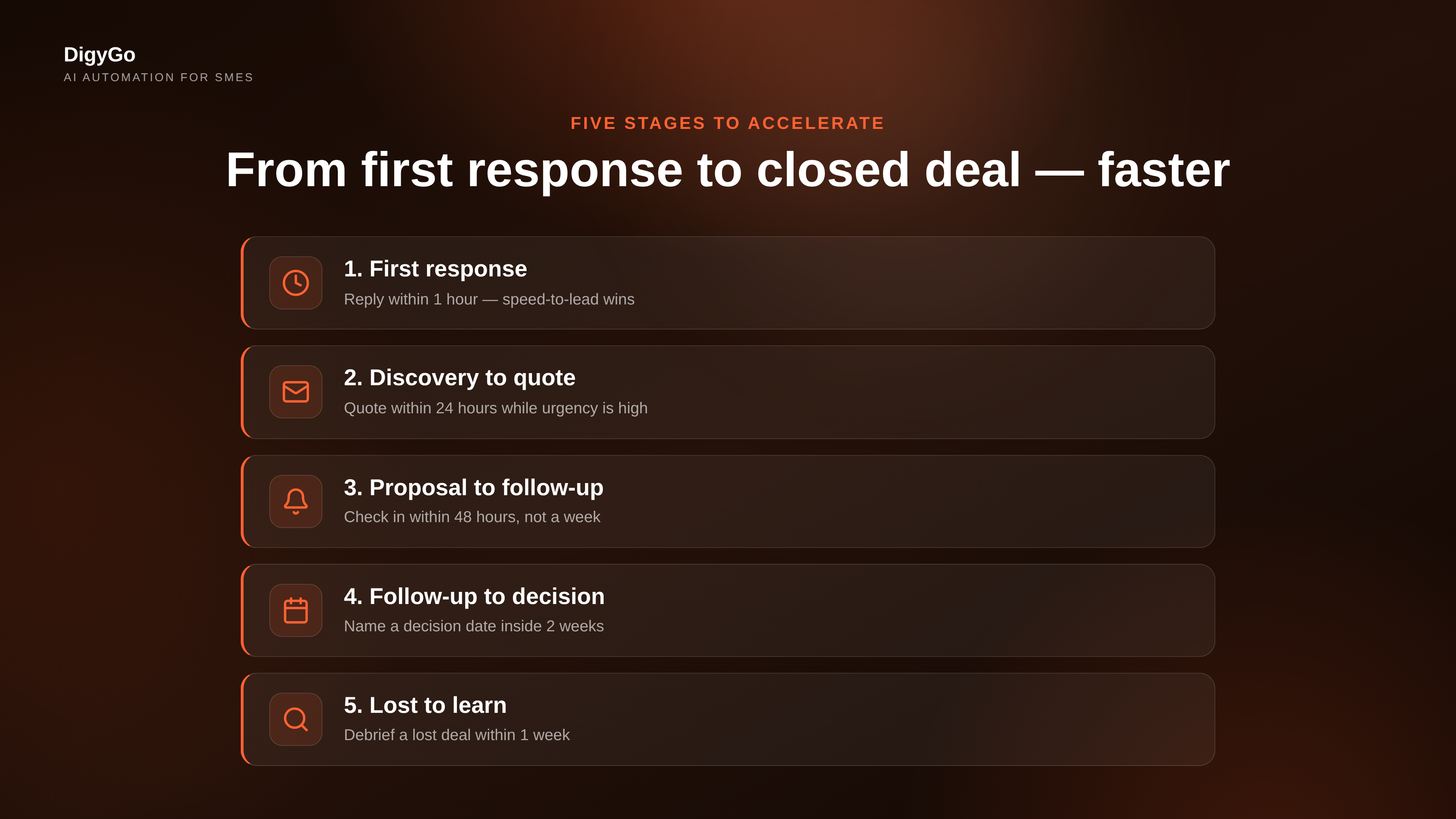
Stage 1: First Response (Target: Within 1 Hour)
The data is clear — responding to a lead within the first hour dramatically improves conversion. Do not let a qualified lead land on your website, fill out a form, and wait until the next morning for a reply. Even an automated acknowledgment — "Thanks for reaching out, here is what happens next" — keeps the momentum alive while you prepare a real response. Speed-to-lead is the cheapest acceleration you can buy.
Stage 2: Discovery to Quote (Target: Same Day or Next Morning)
If you talk to a prospect and do not send a proposal within 24 hours, you are giving their urgency time to evaporate. The fix is not to write faster — it is to have a proposal template ready before the call. Tweak, do not draft. A qualified lead who receives a quote while they still remember the conversation closes at nearly double the rate of one who waits three days.
Stage 3: Proposal to Follow-Up 1 (Target: 48 Hours)
This is the most common drop-off zone. A proposal goes out, the prospect reads it, and nobody follows up. That silence reads as disinterest. Follow up within 48 hours with a single question: "Did the proposal answer everything you needed?" Not a push. Not a discount offer. Just a check-in that keeps the conversation alive. If they are still thinking, ask what they are weighing — that answer tells you exactly what objection to handle next.
Stage 4: Follow-Up to Decision (Target: Specific Date Within 2 Weeks)
If a deal has been sitting for more than two weeks after your last follow-up, it is not progressing — it is waiting to become a ghost. Name the decision date together. "When would you like to make a call on this? I do not want to keep bugging you — let us pick a date and I will check in then." A prospect who agrees to a decision date is still a real opportunity. One who dodges the date is telling you they are not serious.
Stage 5: Lost to Learn (Target: Within 1 Week)
Velocity is not just about winning faster. It is also about learning faster. When a deal dies, find out why within a week — while the memory is fresh. Was it price? Timing? A competitor? That intelligence feeds back into your qualification process and proposal templates, so the next deal through the pipeline moves faster because you already eliminated that friction.
Why Velocity Creates Better Deals, Not Just Faster Ones
There is a fear that accelerating pipeline velocity means rushing prospects into bad decisions. In practice, the opposite happens. When you shorten each stage, you surface mismatches earlier. A prospect who is not a fit discovers that within the first conversation instead of after three follow-ups. A deal that needs a specific discount gets addressed before a proposal goes out, not after it lands. Faster pipelines are cleaner pipelines — they contain fewer ghosts, fewer stale entries, and more real conversations that are actually going somewhere.
For the SME founder who is tired of feeling like they have to chase every deal personally, velocity is the alternative to effort. You do not need to push harder. You need a pipeline that does not fight you at every turn.
FAQ
| Question | Answer |
|---|---|
| What is a healthy pipeline velocity for an SME? | That depends on your average deal size and industry, but a good benchmark is 15–30 days from first contact to closed deal for service businesses. If you are over 45 days, you almost certainly have friction you can remove. |
| Does accelerating velocity hurt relationship-building? | Only if you skip the listening stage. Velocity is about removing internal delays and unclear next steps — not about rushing the customer. A faster proposal and a clear follow-up date actually build trust because the prospect sees you are organised. |
| Should I automate my whole sales pipeline? | Not at once. Start with first-response automation and proposal delivery. Those two stages add the most delay with the least customer-facing risk. Add follow-up sequences only after you have a feel for what your prospects respond to. |
| How do I track pipeline velocity without a CRM? | A simple spreadsheet with opportunity name, date entered, current stage, and date of last activity is enough. Calculate stage-to-stage days by hand for 10 deals and you will already see your biggest bottleneck. |
| What if my deals naturally take 3 months — should I still accelerate? | Yes, but focus on the active phases, not the waiting phases. Every deal has waiting periods (internal approvals, legal review) and active periods (discovery, negotiation). Shorten the active periods by preparing better, and make the waiting periods predictable so you are not chasing blindly. |