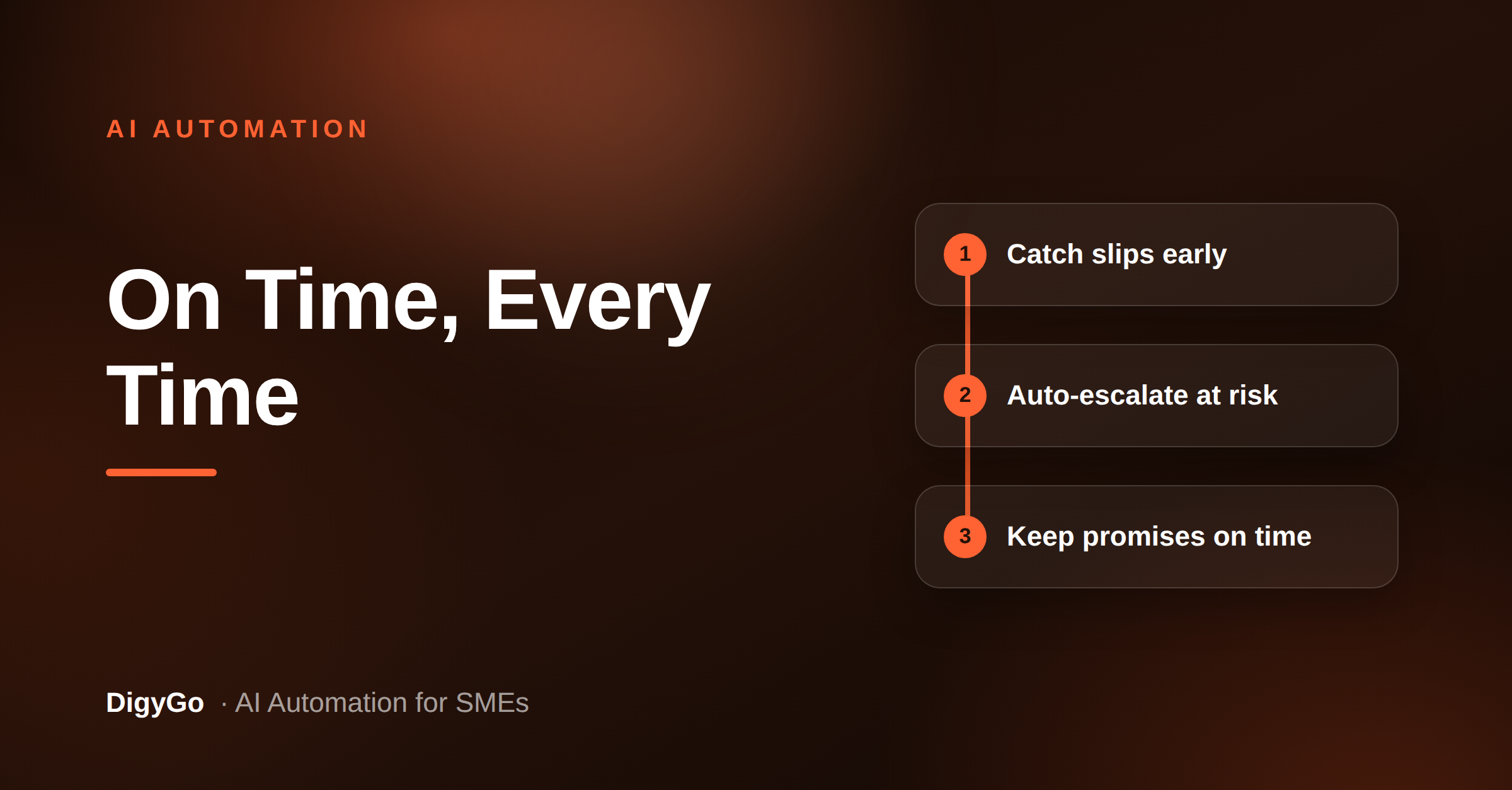
A promise made to a customer has a date on it. When that date slips, the rework, the refund, the apology call, and the lost trust quietly cost more than the original job ever earned. Most SMEs do not find out a deadline is at risk until it has already broken, because the work lives in WhatsApp, email, sheets, and someone's memory. An AI deadline watch agent closes that gap: it tracks every due date, flags work that is drifting, and escalates it before the customer has to ask.
How an AI deadline watch agent can track every SME task's due date, flag at-risk work before it slips, and keep customer promises on time without manual chasing.
Key takeaways
- Deadlines slip in SMEs because work is fragmented across channels, not because teams are careless.
- An AI deadline watch agent builds a single deadline map from every channel and watches it continuously.
- It flags at-risk work 48 hours early, escalates to the right owner, and logs every delay so patterns become visible.
- Start with customer-facing promises first: delivery dates, quotes, and renewals are where slippage hurts most.
Why deadlines slip even when everyone works hard
Walk through any small business on a busy day and you will see the same picture. An order comes in on WhatsApp at 9 am. A supplier quote lands by email at noon. A team member updates a sheet sometime after lunch. The delivery date that was promised on Tuesday lives in one conversation, the raw material delay lives in another, and nobody connects the two until Thursday, when the customer calls.
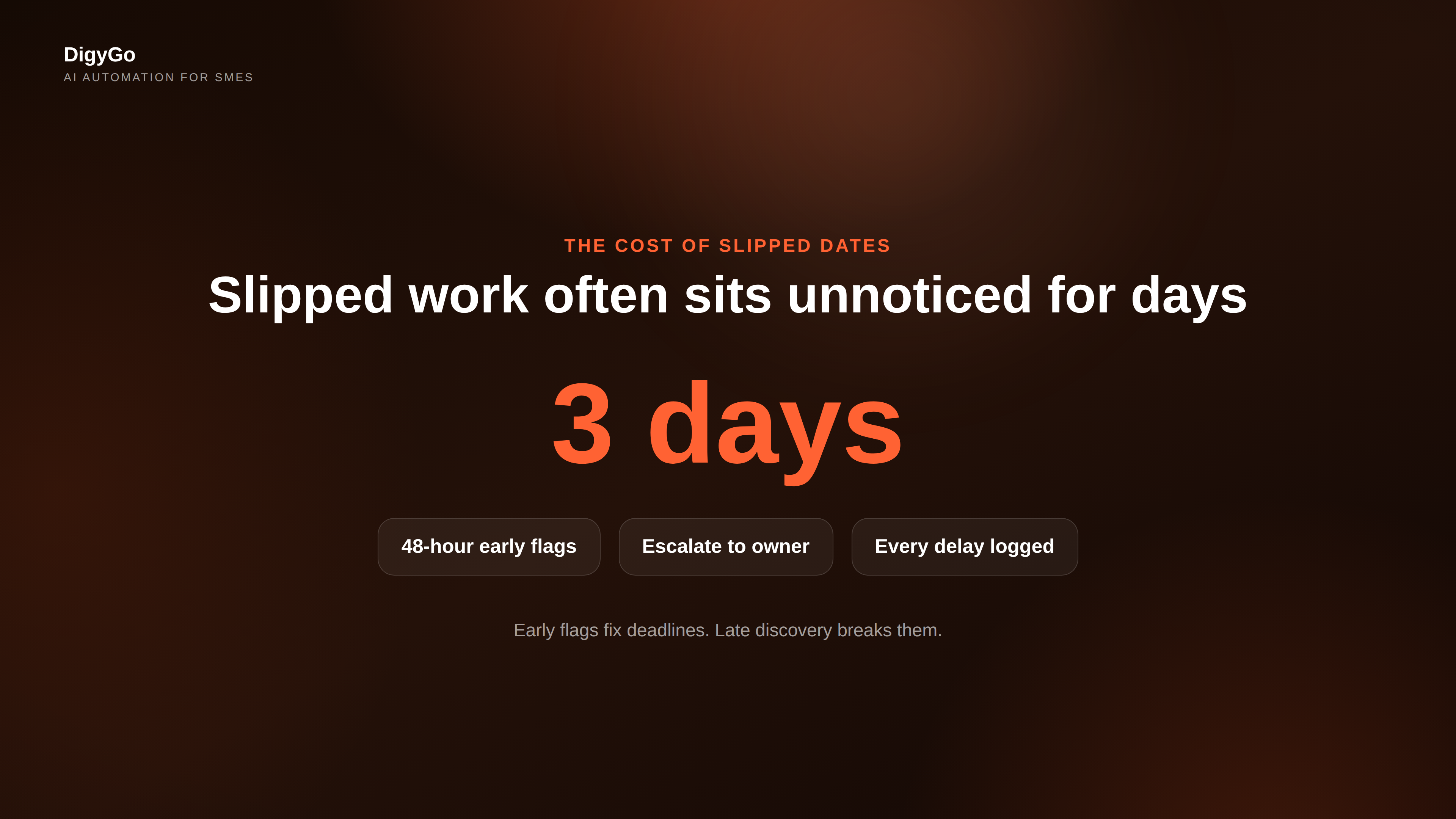
The problem is not effort. It is that no single person sees the whole chain. In most manual setups, work slips two to three days before anyone notices, and by then the fix is expensive: rushed delivery, overtime, partial refunds, or a damaged relationship. A deadline that gets flagged early is usually fixable. A deadline that gets discovered late almost never is.
What an AI deadline watch agent actually does
Think of it as a night-watch person for your operations, one that never sleeps and never forgets a date. The agent watches every place work enters your business, picks out anything that carries a commitment or a due date, and tracks it against a simple rule: what was promised, to whom, by when, and who owns it.
When a date starts drifting, it does not wait for a weekly review. It flags the task, names the risk in plain language, and routes it to the person who can act, with the context they need to fix it. The result is not more software to check, it is fewer surprises. Your team keeps working the way they work; the agent just makes sure nothing falls past its date silently.
The four parts of a deadline watch system
You do not need a big platform to get this working. A deadline watch agent for an SME is four small pieces wired together, and each one is simple on its own.
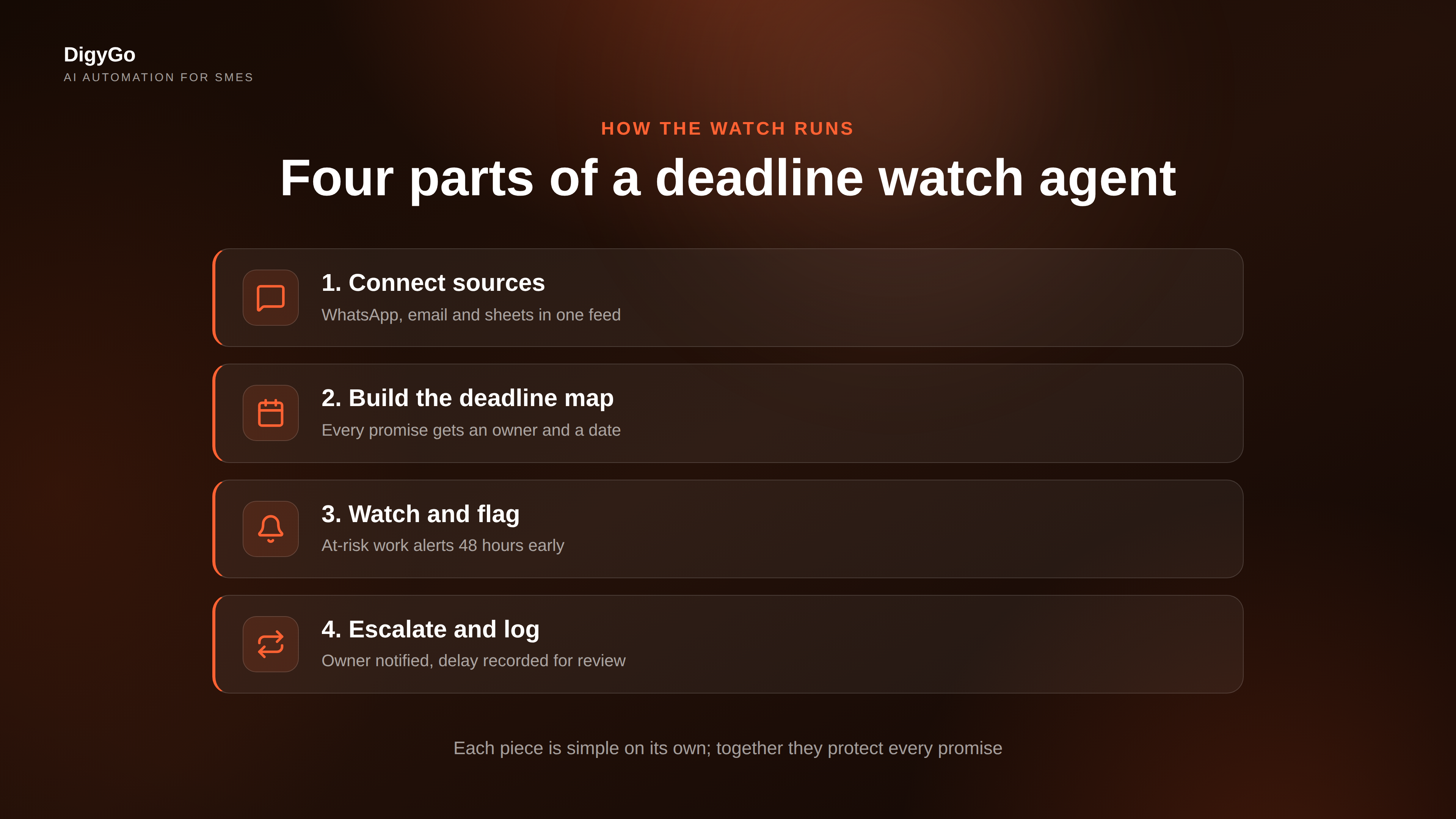
- Connect your sources. WhatsApp business, email, forms, and sheets all feed into one inbox. The agent reads the same conversations your team already has, no new habits required.
- Build the deadline map. Every task gets a customer name, a promise date, and an owner. The map is the single version of truth for everything your business owes anyone.
- Watch and flag. The agent checks the map continuously. Work that is drifting, stalled, or missing a required input gets flagged early, typically two days before the date is at risk, not two days after.
- Escalate and log. The right owner gets notified with context, the delay is logged, and the pattern becomes visible in a weekly review so you can fix the cause, not just the instance.
A real example: the fabrication workshop
Take a small fabrication unit that promised a client a 7-day delivery on three gates. On day two, the raw material supplier sends a WhatsApp message saying the steel will arrive a day late. A human reading that message sees an update. The deadline watch agent sees a chain reaction: one supplier delay, three customer dates at risk, and a scheduling conflict forming around the workshop's only welding bay.
Before the customer even senses a problem, the owner gets a flag: "Two of three gate deliveries move to at-risk if steel arrives late. Re-sequence jobs 4 and 5 to keep promise dates." The owner calls the supplier, pulls one job forward, reorders the bay schedule, and the client still gets their gates on time. Nobody chased anyone, and the relationship never felt the impact.
That is what early visibility buys. Not more work, just earlier decisions, made while there is still room to fix things.
The three deadlines worth automating first
Start narrow. Three types of commitments carry most of the risk for an SME, and they map to the biggest trust wins:
- Customer delivery promises. Any job with a committed date. This is your reputation, tracked per order.
- Quotes and proposals. A quote sent late is a deal lost to a faster competitor. Track the promised "quote by" date as seriously as the delivery date.
- Renewals and compliance dates. Licenses, contracts, AMCs, and filings. These slip quietly and cost money in penalties and lost coverage.
What the agent does not replace
An AI deadline watch agent is deliberately narrow. It does not decide which customer matters more, it does not negotiate with suppliers, and it does not choose which job to sacrifice when two dates collide. Those are judgement calls, and they belong to the owner or the team lead.
What the agent removes is the invisible work that makes those calls impossible: the tracking, the remembering, the digging through old chats to find out what was promised. You keep the judgement. The agent just makes sure you always have the full picture, on time.
How to start in one week
You can have a first version running inside a week without changing how your team works. Day one, list every customer promise you made this month. Day two, connect your WhatsApp and email so the agent can read incoming commitments. Day three, set the watch rules: who owns each task type and how early a flag should fire. Day four, run a parallel pilot alongside your normal process and let the agent flag in a test channel. Day five, review the flags, tune the rules, and switch it on. The morning brief each day then shows one thing: what is on track, what is at risk, and what needs a decision today.
FAQ
Will this replace our project tracker or sheet?
No. Most SMEs do not have a single tracker to replace. The agent works with whatever you already use, including nothing but WhatsApp and email, and it can feed its deadline map into a sheet if you want a visible board.
What if my team does not want to change how they work?
They do not have to. The agent reads the channels your team already uses in the way they already use them. There is no new tool to log into and no new form to fill.
How early can a deadline watch agent realistically flag risk?
With connected sources and clear ownership, flags fire 24 to 48 hours before a date is at risk, which is exactly the window where you can still re-sequence, renegotiate, or reschedule without customer damage.
Is this only for businesses that deliver physical goods?
No. Agencies, service providers, workshops, and retailers all make promises with dates. Any business that says "we will have it by Friday" gets value from a system that makes sure Friday actually happens.
How is this different from a normal reminder app?
A reminder app nags you about a date you already know. The agent reads the commitments you never logged, connects them across channels, and tells you what is at risk and why, based on the actual state of the work, not a calendar entry.
Want a deadline watch agent watching your customer promises? Talk to DigyGo about setting one up for your business.