Most SME founders I meet can tell me exactly how much they spent on marketing last month. Very few can tell me which channel actually brought in the enquiry that turned into a paid job. That gap — between spend and source — is where budgets get wasted and opportunities get missed.
A practical guide for SME founders on building a simple four-column marketing scorecard that connects every channel, enquiry, and cost to real business outcomes — no analytics tools or dashboards required.
You don't need a marketing analytics platform or a data scientist to fix this. What you need is a simple scorecard — one sheet you update every week that connects every marketing activity to a real business outcome. Here is how to build one.
- Why most SME marketing spend is effectively invisible
- The four metrics that belong on every scorecard
- A weekly rhythm that keeps the data honest
- How to use the scorecard to shift budget from guesswork to what works
The Problem: Marketing Spend Without a Feedback Loop
Here is a scenario I see repeatedly. An SME runs Facebook ads, posts on Instagram, sends a monthly email, and exhibits at a local trade show. At the end of the quarter, the owner looks at total revenue and total marketing spend and decides broadly whether they "worked." But they cannot point to a single channel and say "this brought in three enquiries and one closed deal."
That is not a criticism — it is the natural result of running a business without a structured way to capture source data. When every enquiry arrives through a different channel (phone call, website form, DM, walk-in), and nobody logs the source consistently, the data dissolves. You end up making decisions based on what feels right rather than what the numbers say.
What a Marketing Scorecard Actually Looks Like
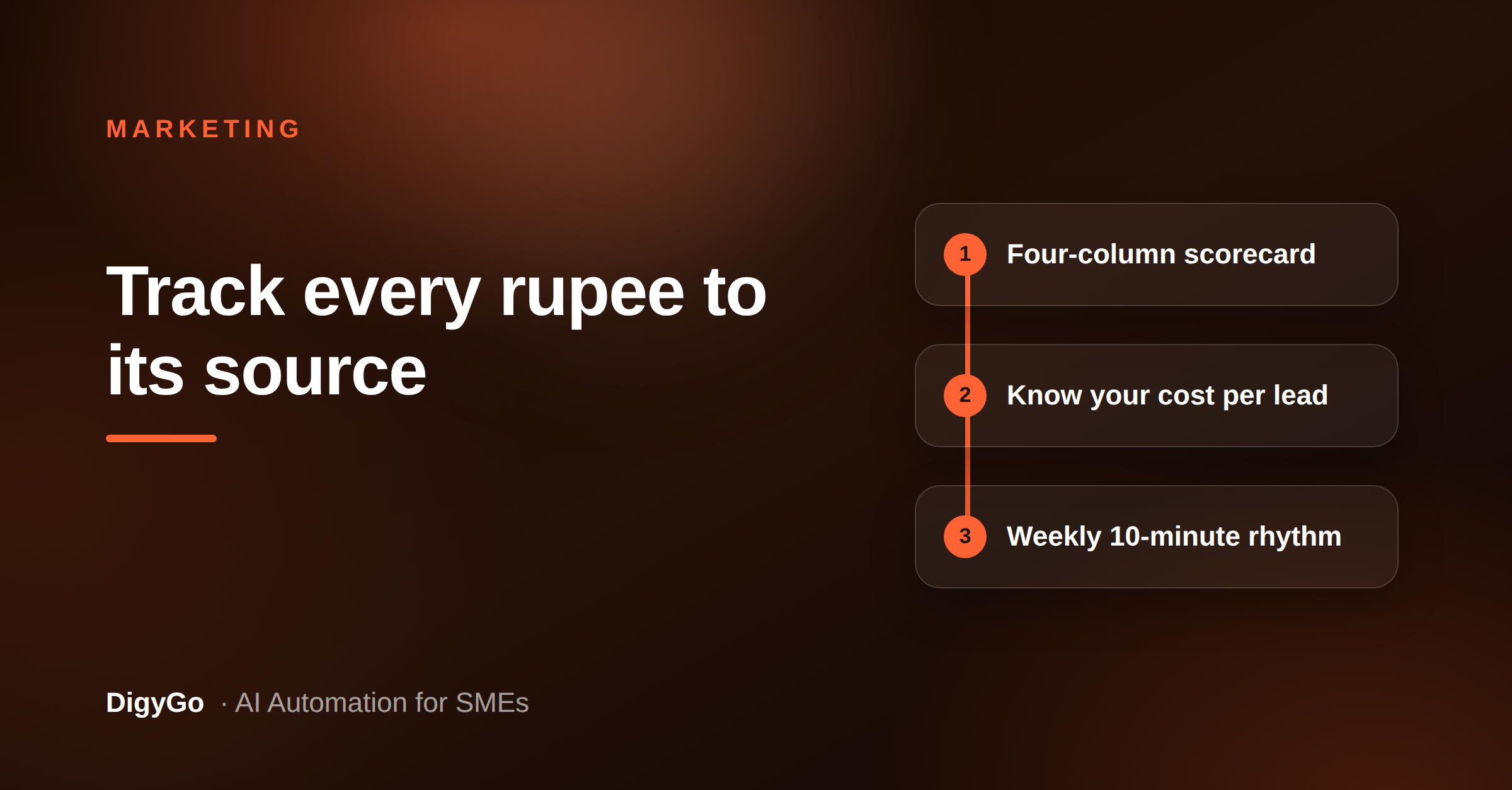
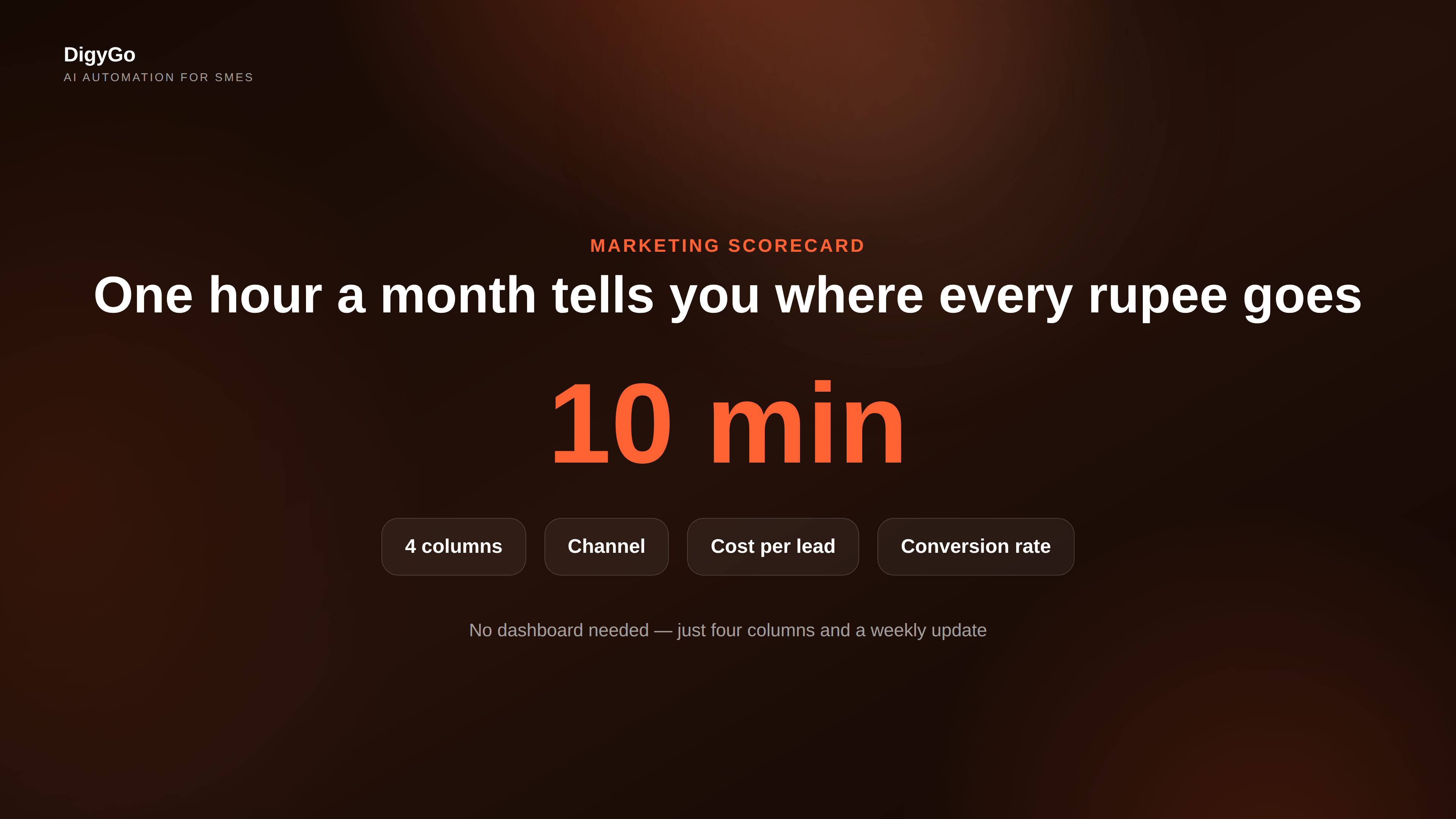
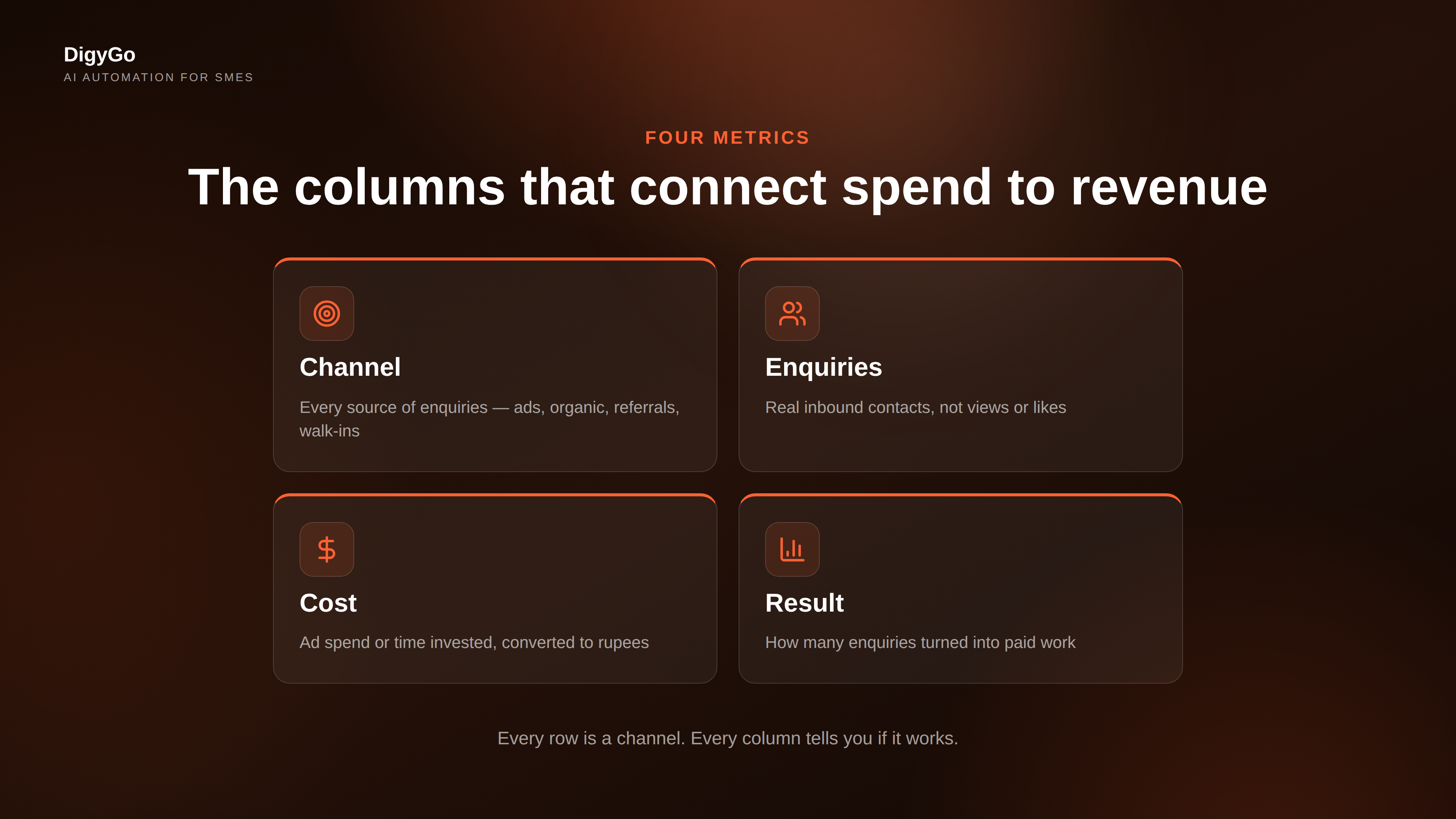
A marketing scorecard for an SME is not a dashboard with twelve charts. It is a simple table with four columns: Channel, Enquiries, Cost, and Result. That is it. Every marketing activity you run gets a row, and every row gets updated once a week.
What 5 Minutes of Tracking Reveals
When you start logging every enquiry by source, the pattern becomes visible fast. One channel may be generating three times the enquiries of another at the same cost. Another may bring plenty of leads but none that convert into paying work. The scorecard surfaces these differences in a way that gut feel never can.
The Four Columns That Matter
Let me walk through each column and what goes into it.
Channel
List every place a potential customer can find and contact you. Common rows include: Google Business Profile, Facebook Ads, Instagram organic, referrals, website organic search, email broadcasts, walk-ins, and local listings like Sulekha or Justdial. If you spent money on it or time on it, it gets a row.
Enquiries
This is the count of inbound contacts from each channel — not views, not clicks, not engagement. An enquiry is someone who raised their hand and said "I need what you do." A call, a form submission, a DM asking about pricing, a WhatsApp message asking for availability. Log the source the moment the enquiry lands, even if it is just a note in your phone or a tick on a whiteboard.
Cost
What did it cost to make that channel work? For ads, it is the actual spend. For organic channels like Instagram, it is the time you or your team invested (convert hours to a rough rupee figure). For referrals, it is zero — that is the point. Cost is what lets you calculate efficiency, not just volume.
Result
This is the most important column and the one most SMEs skip. Of the enquiries that came through a channel, how many turned into a booked job or a paid invoice? Track it as a simple number and a conversion percentage. A channel that brings ten enquiries but zero results is just expensive noise. A channel that brings two enquiries but both close is your goldmine.
The Four Metrics That Tell the Full Story
The Weekly Rhythm That Makes It Stick
A scorecard only works if it gets updated. Here is the rhythm I recommend to every SME I work with:
- Monday morning (10 minutes): Open last week's sheet. Enter enquiries per channel. Write the cost. Nothing else — just the raw numbers.
- Friday afternoon (10 minutes): Update the Result column. Which of this week's enquiries turned into a booking? Which are still open? Create a simple pipeline view.
- First of every month (30 minutes): Step back. Compare channels. Ask two questions: "Which channel gave me the best return per rupee?" and "Which channel gave me the best quality customer?"
That is about an hour a month. If you are spending ₹20,000 or more on marketing every month, that hour is the highest-return activity you can do.
Three Mistakes That Undermine the Scorecard
Referrals, walk-ins, and repeat customers are channels too. If you do not track them, you will over-invest in paid ads and under-invest in the things your customers already like about you.
Impressions, reach, and likes feel good but they are not enquiries. A scorecard built on vanity metrics tells you nothing about business impact. Stick to the four columns above — they are the only ones that connect to revenue.
If your team answers the phone and never asks "how did you hear about us?", you lose the data before it exists. Train every person who handles enquiries to log the source. A simple three-word question saves you the guesswork.
Start With One Sheet, Not a System
I have seen founders spend weeks building a Google Sheets dashboard with colour-coded charts and never fill in a single row after week two. Do not build the system first. Start with a piece of paper, a whiteboard, or a blank Google Sheet with four columns. Fill it every week for a month. After thirty days, you will have more useful data than most businesses collect in a year.
Once the habit is set and the data is real, then — and only then — consider automating the process. A bot that logs enquiry sources at the point of contact, for example, turns a manual discipline into a zero-effort system. But the scorecard has to exist before the automation makes sense.
Frequently Asked Questions
What if I get most of my enquiries by phone? How do I track the source?
Ask every caller "how did you hear about us?" as the second or third thing you say. It takes five seconds. Log it in your phone notes or a shared spreadsheet at the end of the day. Consistency matters more than precision — even a rough record is better than no record.
Do I need to track sources if I only use one marketing channel?
Yes, because enquiries come from more places than you spend on. A Google ad might be your only paid channel, but referrals, walk-ins, and repeat customers are still channels. Without tracking, you have no idea how much of your business comes from zero-cost sources.
How long before the scorecard tells me something useful?
About four weeks. With a full month of data, patterns around cost per enquiry and conversion rate become visible. Three months of consistent data will tell you which channels to double down on and which to pause.
What is a good cost per enquiry for an SME?
It depends on your average job value. A good rule of thumb: your cost per enquiry should not exceed 10–15% of your average ticket size. If your average job is ₹10,000, aim for a cost per enquiry below ₹1,000–1,500.
Should I stop channels that bring enquiries but no conversions?
Not immediately. A channel may bring unqualified leads because your message attracts the wrong audience. Before cutting it, change the messaging or targeting. If three months pass and conversions are still zero, then pause it.
Your next step: Open a blank Google Sheet right now. Create four columns: Channel, Enquiries, Cost, Result. Fill in last month's data from what you remember. Start this week's row on Monday. That simple start will tell you more about your marketing than most analytics tools ever will.
"The most important marketing tool for an SME is not an ad platform or a design tool. It is a single sheet of paper with four columns, updated every week."
Talk to DigyGo about building a marketing system that works →