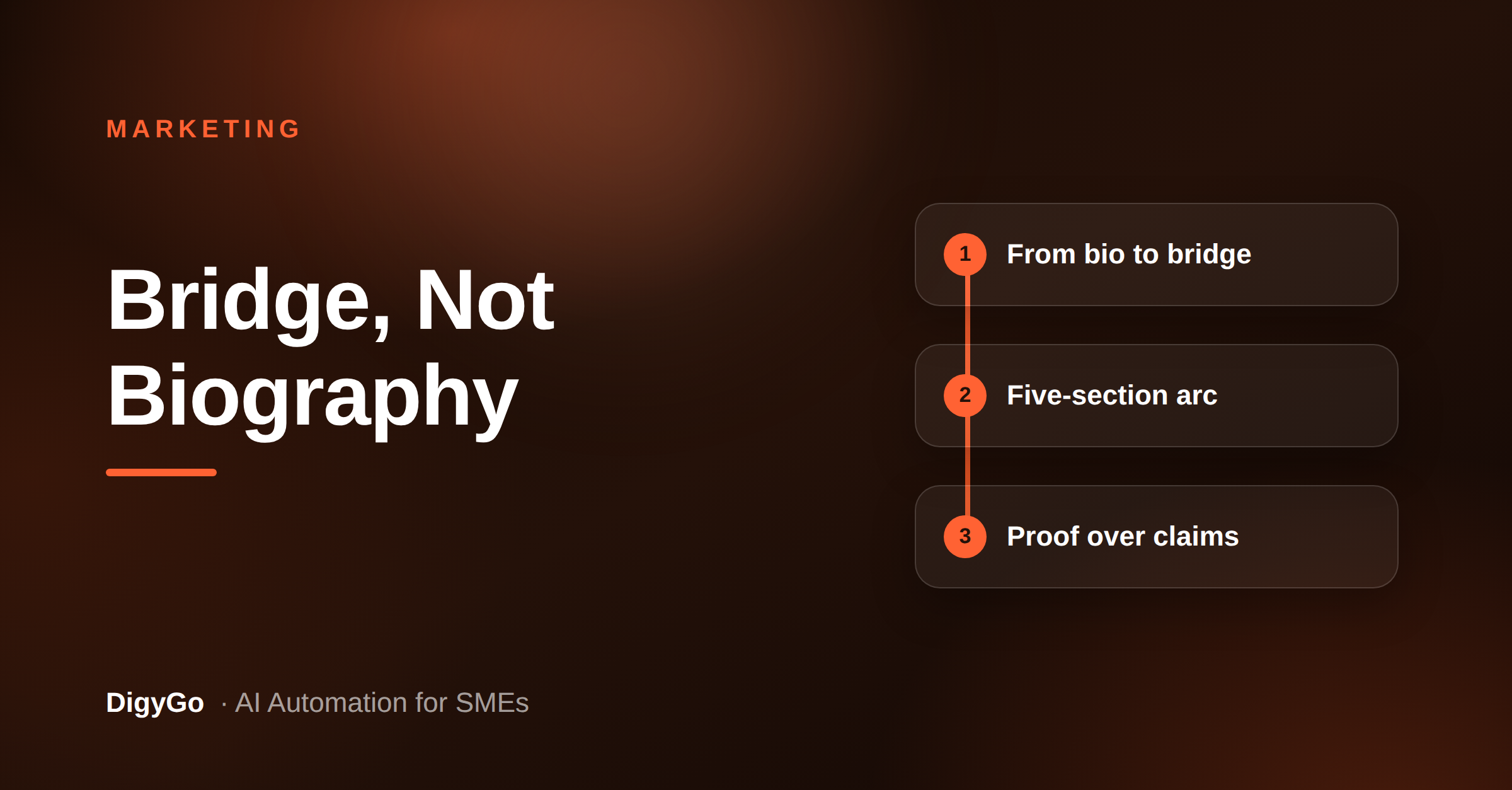
Most SME About pages are a biography. Yours should be a bridge.
A practical guide for SME founders on rewriting the About page from a biography into a bridge — one that names the visitor's problem, shows proof, and ends with a clear next step that converts readers into enquiries.
A visitor lands on your About page. They are not looking for your founding story, your diploma, or how many cups of chai you drink every morning. They are trying to answer one question: Can this business solve my problem?
If your About page answers that clearly, it becomes one of the most effective marketing assets you own. If it reads like a personal introduction written for nobody in particular, it lets visitors slip away without taking the next step.
Here is how to write an About page that builds trust and turns readers into enquiries — without guessing.
The Problem With Most SME About Pages
Most SME About pages fall into one of two traps:
- The biography trap: "We were founded in 2018 by our founder who has 15 years of experience..." — all about the business, nothing about the visitor.
- The feature dump: "We use the latest technology, have a team of 20 experts, and offer 24/7 support." — claims without context, proof, or connection.
Neither answers the visitor's real question. And when the page does not answer their question, they click away — often to a competitor whose About page does.
How to Shift From Biography to Bridge
The fix is not complicated. You stop writing about yourself and start writing about the visitor — through your business.
The structure that works for SME About pages follows a simple arc:
- Name the problem your visitor feels. Start with the tension that brought them to your page. "If your renovation project keeps running over budget, you are not alone. Most homeowners face the same frustration."
- Show you understand it deeply. One sentence that proves you have seen this problem before. "We have helped over 200 homeowners finish their projects on time and within their original estimate."
- Explain how you solve it — with proof. Not features. Real results. A named outcome with a specific number or a short testimonial.
- Describe who you work best with. Help the visitor self-identify. "Our clients are busy professionals who want quality without having to manage contractors themselves."
- End with one clear next step. Not "contact us" — "Tell us about your project and we will send a no-obligation estimate within 24 hours."
This sequence turns the About page from a static introduction into an active part of your enquiry flow.
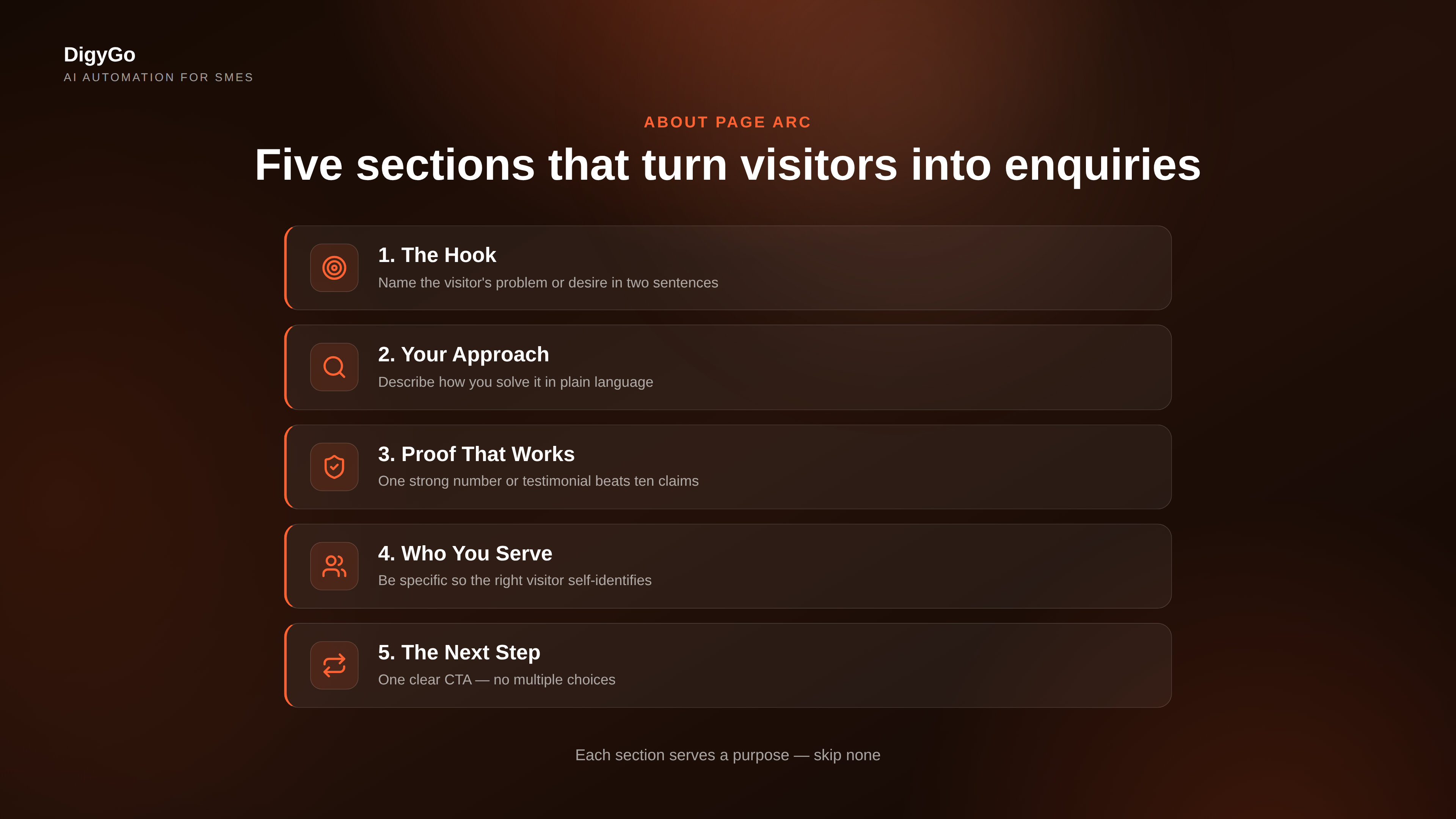
The Five Sections Every SME About Page Needs
Here is the template you can use. Adapt it to your business and fill each section with your real examples.
1. The Hook (2–3 sentences)
Start with the visitor's problem or desire, not your story.
"Running a small business means every hour counts. If you spend yours chasing invoices instead of serving clients, you are not alone — and you do not have to stay there."
2. Your Approach (3–4 sentences)
Describe how you solve the problem. Use simple language. Avoid jargon and business buzzwords.
"We built a simple system that handles invoicing, reminders, and follow-ups automatically — so you can focus on the work that actually earns you money."
3. Proof That It Works (2–3 proof points)
Numbers, testimonials, or specific outcomes. One strong number is worth a paragraph of claims.
- "Our clients save an average of 8 hours per week on admin."
- "94% of enquiries get a first response within 5 minutes."
- "We have helped 50+ service businesses reduce unpaid invoices by 60%."
4. Who You Serve (2–3 sentences)
Be specific so the right visitor immediately knows they belong.
"We work with home-service businesses in Coimbatore and Chennai — electricians, plumbers, painters, and interior designers who want to spend less time on paperwork and more time on projects."
5. The Next Step (one clear CTA)
Tell the visitor exactly what to do next. Give them a reason to act now.
"Tell us about your business and we will show you how our system works, with a free 15-minute walkthrough. No contracts. No sales pitch."
Three Common Mistakes to Remove
Even with the right structure, a few mistakes can undo the trust you are building. Here is what to watch for:
Remove these from your About page:
- Vague claims without proof. "We are the best" or "We use cutting-edge technology" — every competitor says this. Replace with a specific number or a short client quote.
- Too many options. "Call us, email us, fill this form, book a consult, or visit our office" — too many choices paralyse the visitor. Offer one clear path forward.
- Dated content. An About page that mentions "founded in 2017" with no update since 2021 looks abandoned. Refresh the proof, numbers, and team section every quarter.
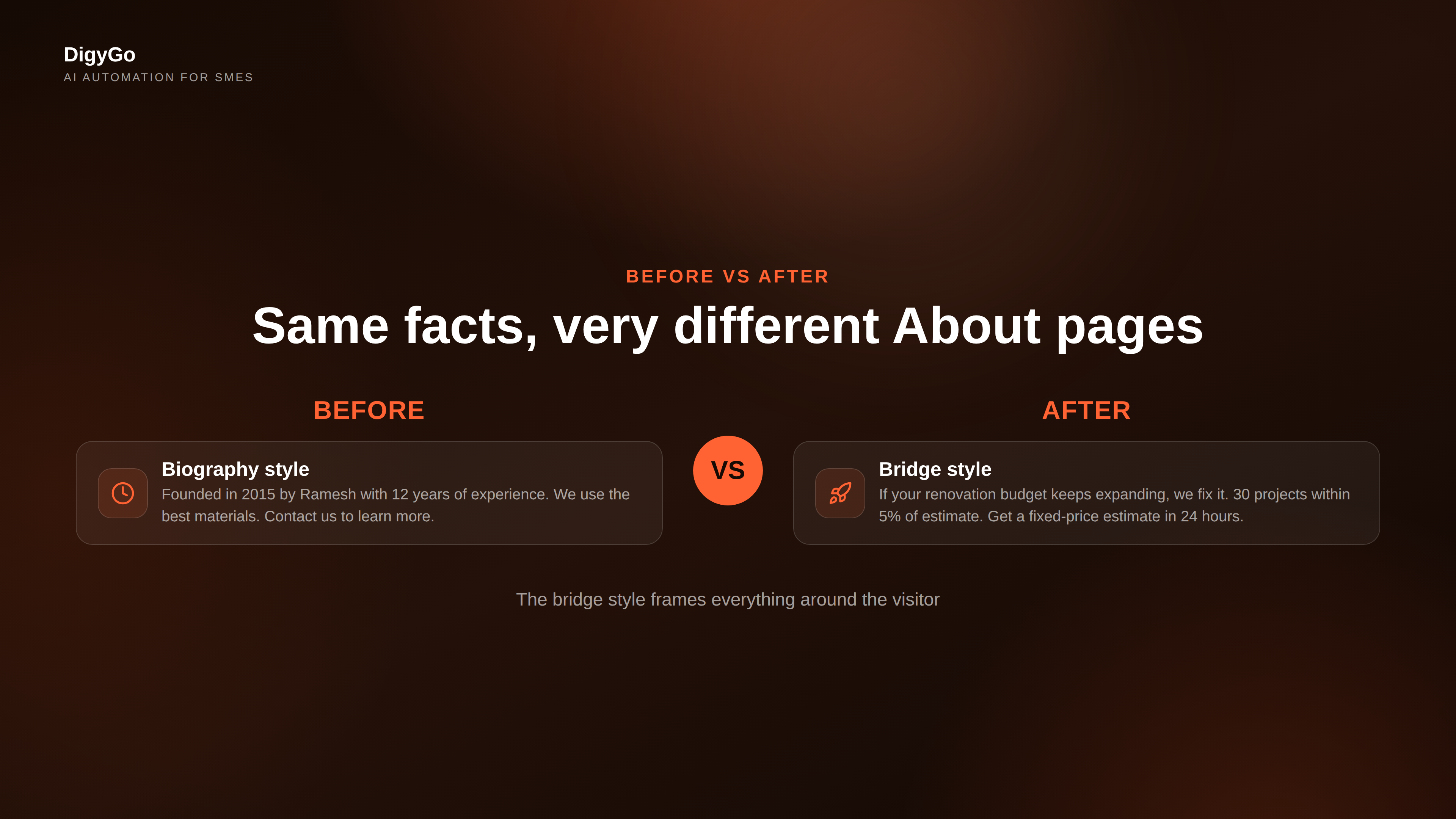
Before and After: The Same Business, Two About Pages
Here is what the shift looks like with real words.
| Before (biography style) | After (bridge style) | |
|---|---|---|
| Hook | "ABC Services was founded in 2015 by Ramesh, who has over 12 years of industry experience." | "If your renovation budget keeps expanding, you are not alone. Most homeowners tell us the same frustration — and we fix it." |
| Proof | "We use the best materials and latest techniques." | "Our last 30 projects came in within 5% of the original estimate. Here is what our clients say." |
| CTA | "Contact us today to learn more." | "Tell us about your project. We will send a fixed-price estimate within 24 hours — no obligation." |
The second version does not share a single new fact about the business. It simply frames every fact around what the visitor cares about. That shift alone changes how the page performs.
When to Refresh Your About Page
An About page is not a once-and-done asset. It needs updating whenever your business changes meaningfully:
- Added a service. If you now serve a different customer profile or solve a new problem, the About page should reflect it.
- New proof available. A fresh testimonial, a better number, or a case study. Replace old proof with stronger proof.
- Every 6 months minimum. Even if nothing changed, review the page. Stale dates and outdated team photos tell visitors you are not paying attention.
A quick refresh takes 30 minutes. It costs nothing. And it keeps your primary trust-building page working at full strength.
Frequently Asked Questions
Should my About page include my personal story?
Only if the story connects directly to the problem you solve. "I started this business because I saw how hard it was for homeowners to find reliable electricians" — that works. "I grew up in a small town and always dreamed of being an entrepreneur" — that does not help the visitor decide.
How long should an SME About page be?
Aim for 400–700 words. That is enough to cover the five sections above without losing the visitor's attention. If you have more to say, move it to a dedicated "Our Story" or "How It Works" page and link to it.
Should I put my team photos on the About page?
Yes, if the team is small enough to show genuine faces. A photo of 3–5 real team members builds trust faster than any copy. If you have 30+ people, show a subset that represents the people clients will actually interact with.
Does the About page affect SEO?
Yes. A well-written About page naturally uses relevant keywords (service, location, problem, solution) and tends to rank well because visitors spend time reading it — which sends positive signals to search engines. It is often the second-most-visited page on an SME website after the homepage.
What to Do This Week
- Open your current About page. Read it as if you are a first-time visitor. What question does it answer?
- Rewrite the first three sentences to name the visitor's problem, not your history.
- Add one specific number or testimonial as proof within the first five sentences.
- Replace your generic "Contact us" with a specific, low-friction next step.
- Schedule a 30-minute refresh every 6 months on your calendar.
That is it. One page. Five edits. And a better enquiry rate without spending a rupee on ads.