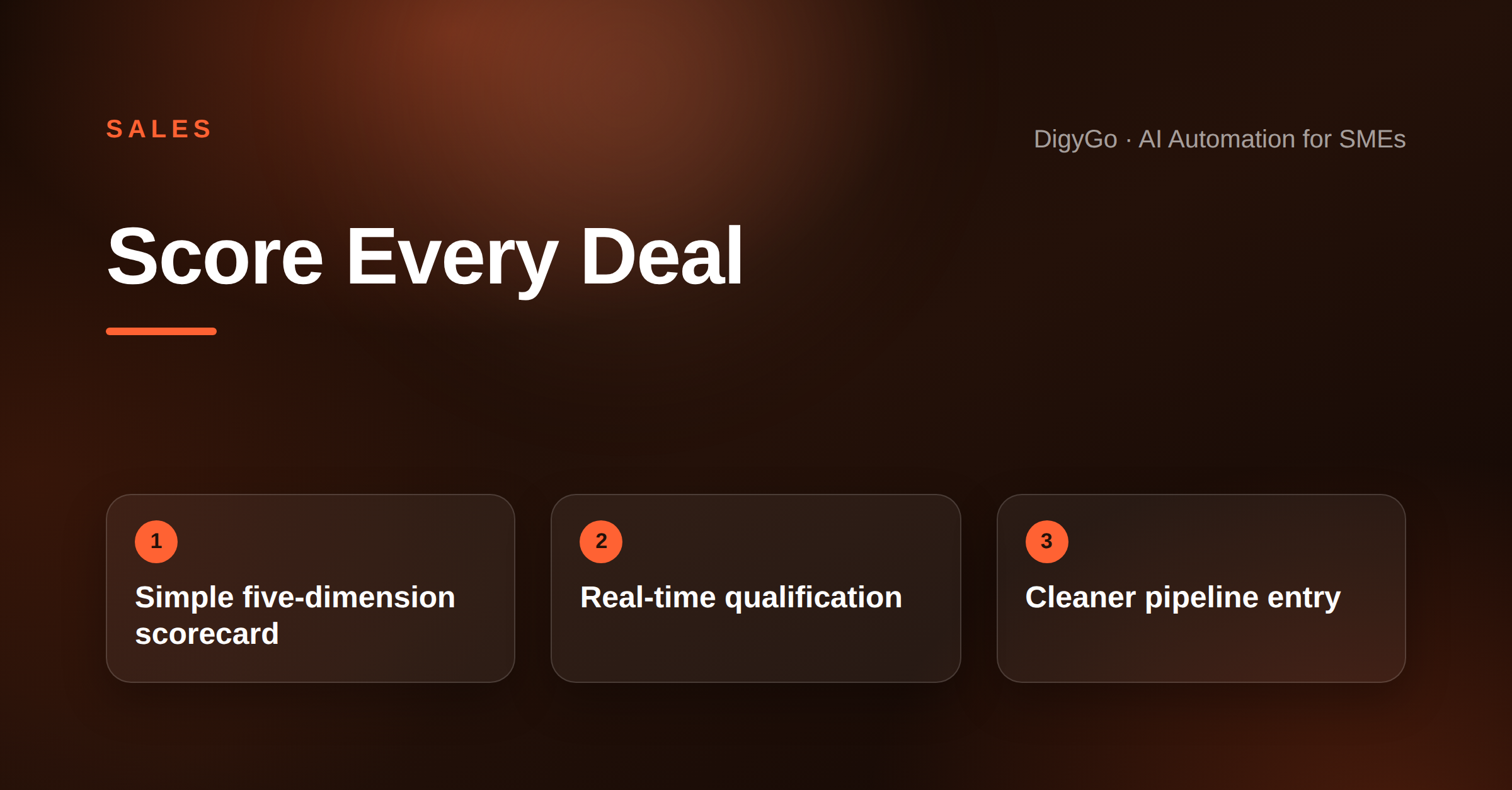
Most SME sales teams chase every opportunity that shows up. A simple discovery scorecard helps you qualify during the first conversation so you spend time on deals that fit, handle objections earlier, and protect your team's capacity for the right opportunities.
A practical sales playbook for SMEs on using a simple five-dimension discovery scorecard to qualify opportunities live, protect team time, and keep the pipeline clean before proposals are sent.
- Why a structured scorecard beats gut-feel qualification
- The five discovery dimensions that predict deal fit
- How to score without making the conversation feel like an exam
- Three pipeline rules that keep the funnel clean without micromanaging reps
Every hour on the wrong deal is an hour stolen from the right one
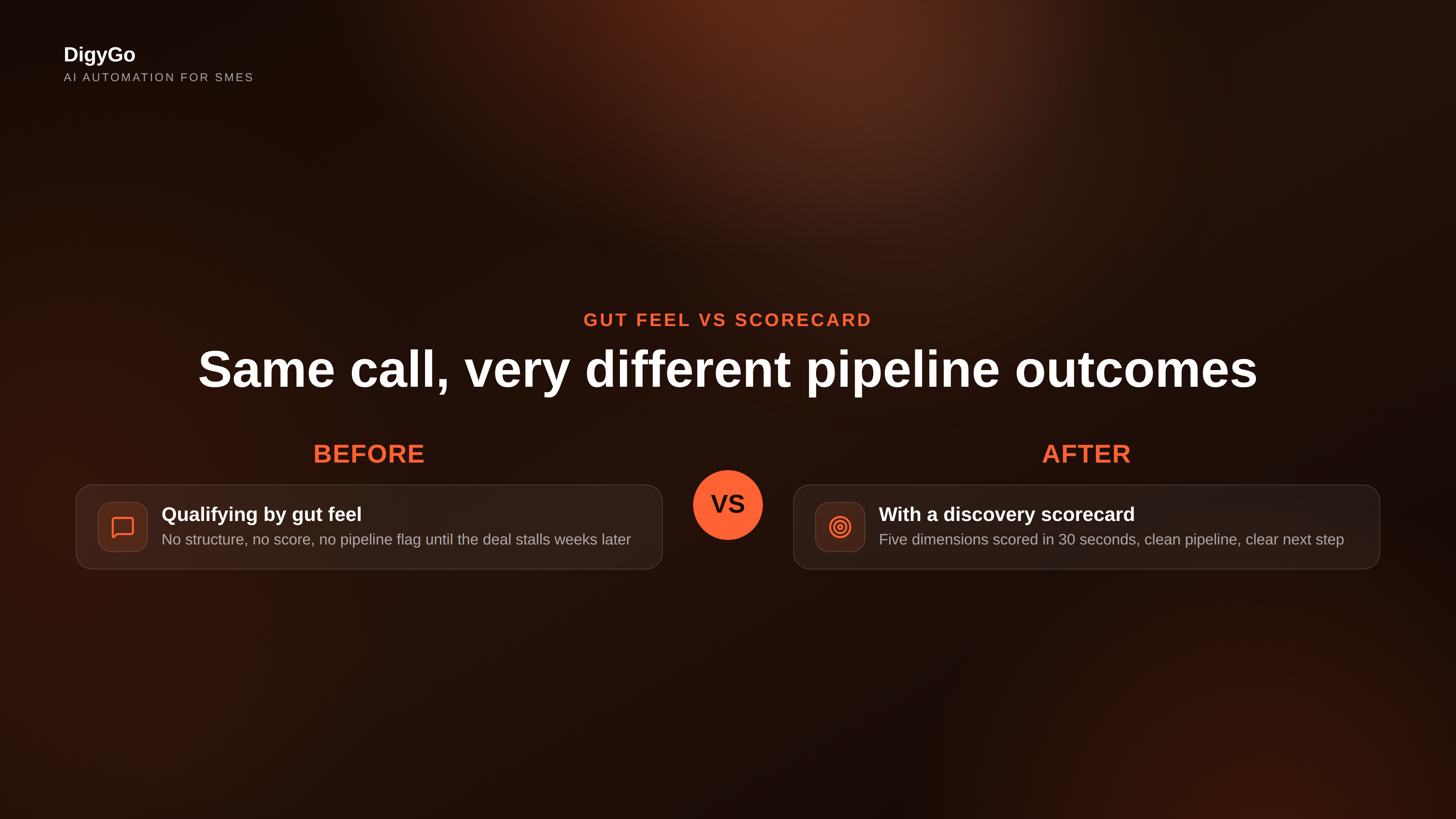
SME sales teams work with thin margins and small teams. When every rep is carrying ten deals, the difference between a good quarter and a bad one is not about closing harder. It is about which opportunities were allowed into the pipeline in the first place.
Without a structured qualification method, two problems surface repeatedly:
- Deals drift. The prospect seems interested, but no real decision timeline surfaces. The opportunity sits in the pipeline for weeks, draining follow-up energy that should be spent on better-fit prospects.
- Price objections become the norm. When you discover budget constraints late in the process, the only move left is discounting. The deal closes at a lower margin, or it stalls because the fit was never right.
Gut-feel qualification works for experienced reps who have made hundreds of calls. Most SME teams do not have that luxury. A structured scorecard levels the field, helps newer team members qualify confidently, and makes every discovery call more productive.
The five dimensions that separate a real deal from a time sink
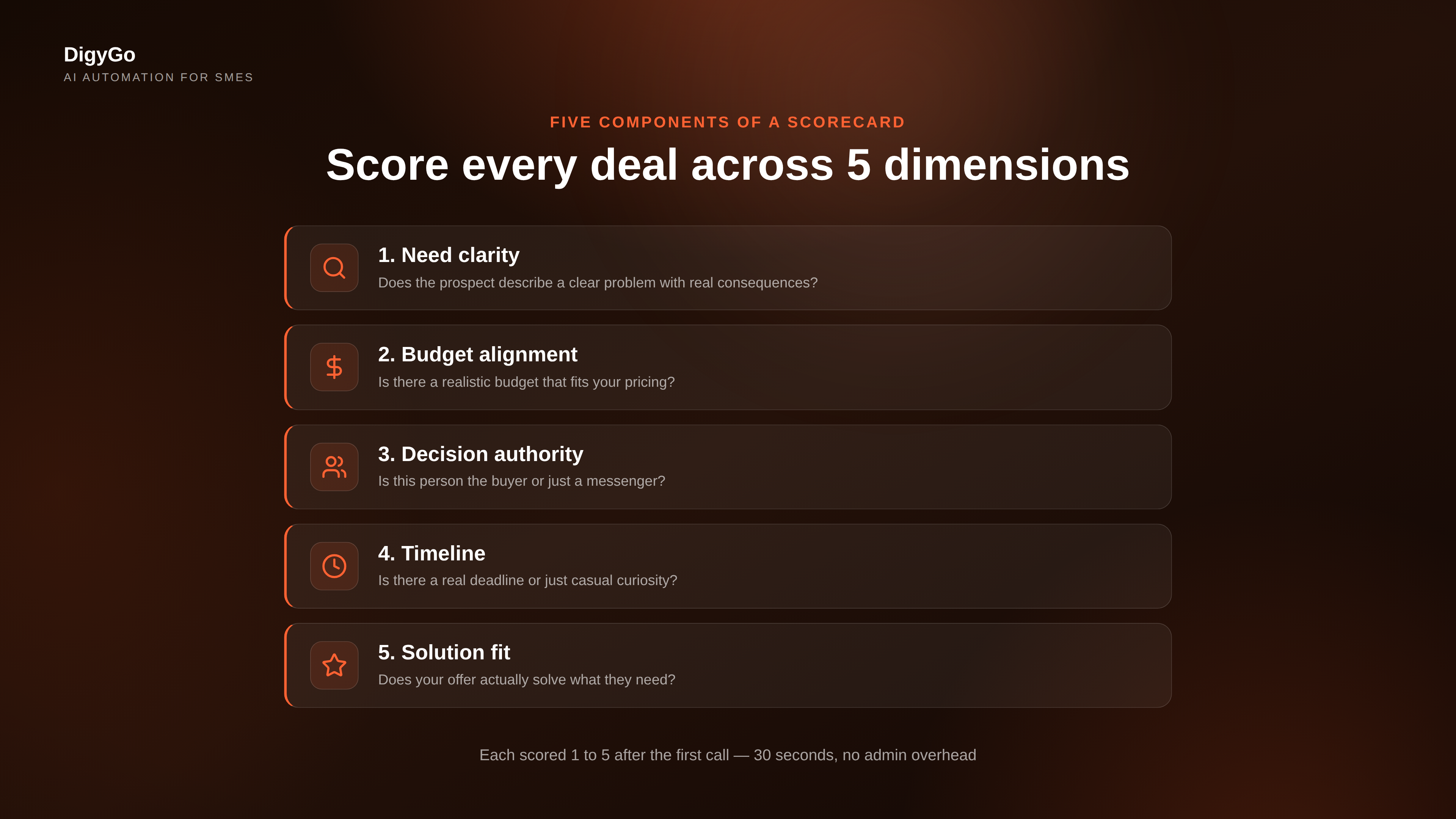
You need a simple scoring system your team can use live during a call, not a spreadsheet they fill in afterward. These five dimensions cover the essentials without adding complexity:
1. Need clarity — does the prospect understand their own problem?
A deal with high need clarity means the prospect can describe what is broken, why it matters, and what a fix would look like. A low-score prospect says "we want to explore options" without specifics. Score 1 (vague) to 5 (clear need with consequences).
2. Budget alignment — is there room in the budget for your offer?
You do not need an exact number on the first call. You need to know whether a realistic budget exists or whether every discussion will be about finding the cheapest option. Score 1 (no budget discussion possible) to 5 (budget range confirmed, fits your pricing).
3. Decision authority — is this person the buyer or the messenger?
SME buyers are often the founder or director. Multi-threaded deals are rare in this segment. If the contact cannot make or strongly influence the buying decision, the deal will stall later. Score 1 (no authority, messenger only) to 5 (decision-maker on the call).
4. Timeline — is there a real trigger, or just curiosity?
Deals that close have a genuine deadline: a project start date, a seasonal need, an expiring contract. Curiosity calls rarely convert without extended follow-up. Score 1 (no timeline, "just looking") to 5 (clear trigger, decision within 30 days).
5. Solution fit — does your offer actually solve what they need?
The honest self-check. If your service is a poor fit, the deal will either close with heavy customization (margin killer) or stall after the proposal. Score 1 (weak fit, would need heavy rework) to 5 (strong fit, standard delivery works).
How to score without making the call feel like a survey
The scorecard works best when the rep never announces they are scoring. Weave the questions naturally into the discovery conversation:
- Need clarity: "What does a good outcome look like for you? What happens if it does not get solved?"
- Budget: "Have you looked at roughly what a solution like this would cost? Are we in the right ballpark?"
- Authority: "Who else would need to be part of the decision to move forward?"
- Timeline: "Is there a specific date or event driving this? What happens if you decide to wait?"
- Fit: "Based on what you have shared, I think we can help. Here is where I see a strong match and here is where you would need a different approach."
After the call, the rep spends 30 seconds assigning a score to each dimension. A total of 20 to 25 out of 25 is a strong opportunity. Below 15 needs a serious qualifying conversation before any proposal work begins. Between 15 and 19 is worth pursuing but needs a clear next step that clarifies the low-score dimensions.
Three simple pipeline rules for scorecard-driven qualification
A scorecard without action rules is just a form. Pair it with these three rules to keep the pipeline clean:
Rule 1: No proposal before 15
If the total score is below 15, do not send a quote, proposal, or pricing breakdown. Schedule a second discovery call focused on the weak dimensions instead. Proposal energy on an unqualified deal is almost always wasted energy.
Rule 2: Flag below-3 dimensions in the CRM
Every dimension that scores below 3 should show up as a risk flag in your deal record. When you review the weekly pipeline, these flags tell you which deals need attention and which are likely to stall if nothing changes.
Rule 3: Score every first call for two weeks, then calibrate
If your team is new to structured qualification, pilot the scorecard for the first 15 to 20 discovery calls. At the end of two weeks, review the data: which dimensions were most commonly low? Was the team scoring consistently? Adjust the thresholds based on real feedback, then make the scorecard a permanent part of your call workflow.
Frequently asked questions
Does a scorecard add more time to discovery calls?
No. The scoring happens after the call and takes about thirty seconds. The real time savings come from avoiding long follow-up cycles on bad-fit deals.
Can I use the scorecard for existing pipeline deals?
Yes. Score each active deal and apply the pipeline rules. You will likely find a few that should have been disqualified weeks ago. Clearing them from the pipeline frees up capacity for better opportunities.
Does the scorecard work for service businesses and product businesses?
Yes, with one adjustment. For product businesses, add a sixth dimension around implementation effort if the product needs significant setup. For service businesses, the five dimensions above cover most cases.
How do I prevent reps from inflating scores?
Review scored calls periodically with the team. When a deal that scored 20 later stalls, examine which dimension was overconfident. The scorecard improves with honest calibration, not perfection.
What if a low-scoring deal eventually becomes a customer?
It happens. Some deals start weak on paper and convert through relationship or timing. The scorecard is not a disqualification tool; it is a prioritization tool. Low-scoring deals can still be pursued, but they need a longer qualification path and a smaller time allocation upfront.
Start with one scorecard, not a system
You do not need a CRM overhaul or a complicated qualification framework to start. Print the five dimensions, put them on a shared doc, and score the next five discovery calls your team runs. The answers will tell you more about your pipeline health than any dashboard.
If you want a simpler way to capture, score, and route every new enquiry before it reaches your discovery call so your team sees qualification data before they even pick up the phone, talk to us about how DigyGo handles lead triage and qualification automation.