
Most SME sales teams do not know why they lost the last three deals. They guess, move on, and lose the next one the same way. A five-minute post-loss review fixes that.
A practical sales playbook for SME founders on using a five-question post-loss review to surface patterns, fix repeated objections, and improve close rates without adding complexity.
- Why most SMEs skip post-loss reviews and how much that silence costs
- A five-question template that surfaces the real reason a deal died
- How to run a 15-minute loss review with your team every week
- What to track so the same objection does not keep killing deals
The Cost of Not Knowing
The average SME sales person loses four or five deals a month. They hear "we went with someone else" or "it is not the right time" and they move on to the next lead. The problem with moving on is that the same objections, the same qualification gaps, and the same follow-up failures keep repeating.
A single lost deal contains exactly the information you need to close the next one faster. But if you never extract it, every loss stays isolated. You never know whether the issue was price, timing, trust, or fit. And the team keeps guessing.
A post-loss review does not need to be long. It does not need a form. It needs five honest answers and ten minutes of attention. When that becomes a weekly rhythm, the team stops repeating mistakes and starts recognising patterns before they hit.
The Five-Question Loss Review
After every lost deal, the person who ran it answers five questions. Do this within 48 hours while the conversation is still fresh. Write the answers down in a shared doc or a simple spreadsheet so the patterns become visible.
- Did we fully understand what the buyer wanted to achieve? Most deals die because the seller rushed past discovery into pitching. If the buyer's outcome was fuzzy, the loss started before the proposal was sent.
- Did the buyer have the authority to decide? Deals stall when the person you spoke with needs approval from a partner, a board, or a spouse. If you did not know who else was involved, that gap killed the deal.
- Did the buyer see enough proof that we could deliver? Some buyers need a case study with a similar business, a reference call, or a sample. If they asked for proof after the proposal, you did not put enough in earlier.
- What was the stated reason, and what do you think the real reason was? The polite "went with someone else" is rarely the full truth. Ask the buyer one honest follow-up question after they decline: "What was the one thing that tipped it?" Their real answer is the one to track.
- What would you do differently next time with a similar buyer? This is not blame. It is a single action — ask sooner about budget, share a testimonial earlier, set a clearer timeline — that the seller would take if they had the same conversation again.
Five answers. Ten minutes. One shared place to record them.
How Much a Lost Deal Can Teach You
The Weekly Pattern Review
A single loss review tells you about one deal. A stack of them tells you about your sales process. That is why the weekly pattern review matters more than any individual debrief.
Once a week, spend 15 minutes looking at the loss reviews from the past seven days. Do not read every detail. Look for the question that keeps getting the same answer.
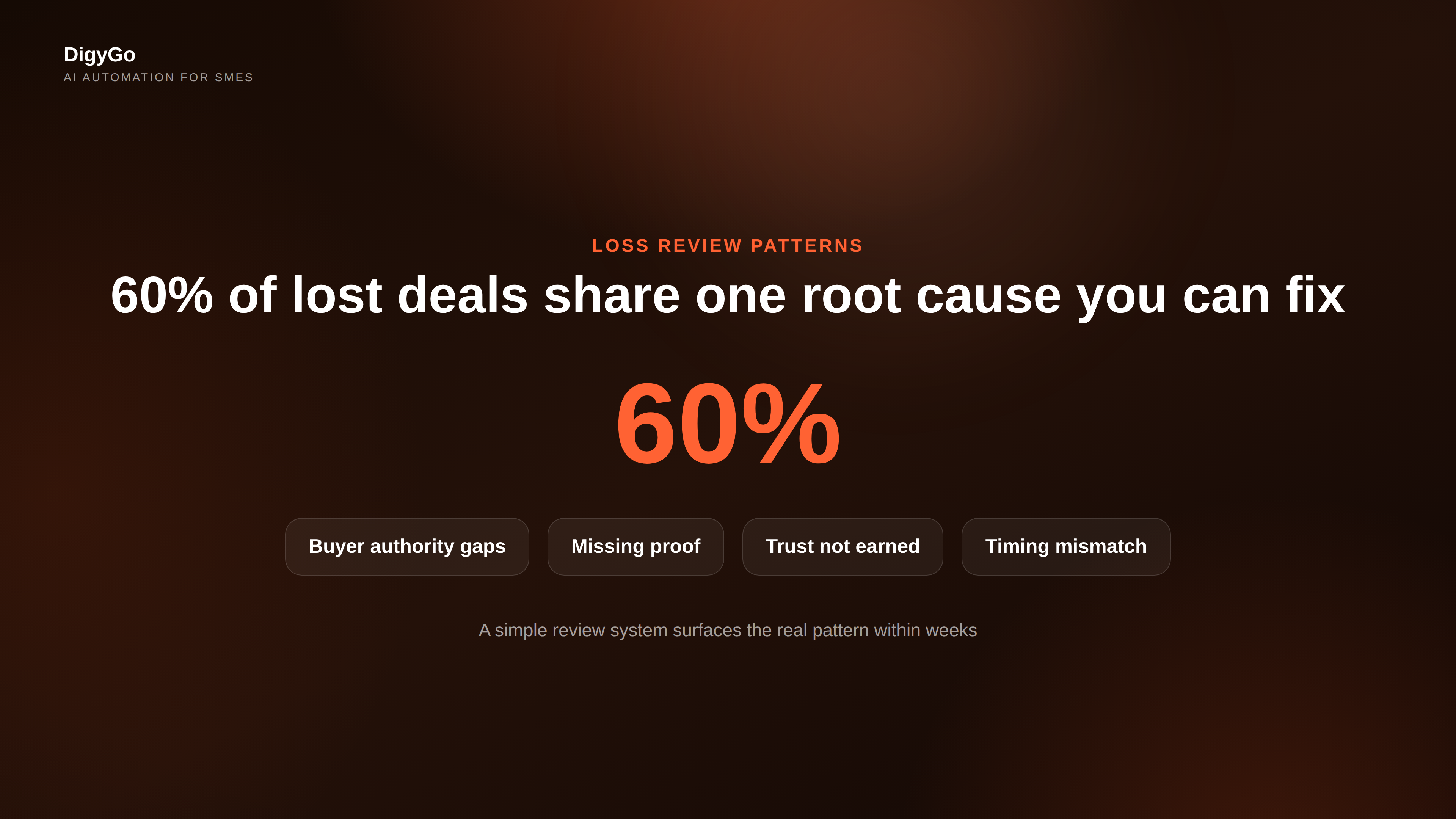
If three sellers all said "the buyer did not have authority" then you have a qualification gap. If four deals had "the buyer wanted more proof" then you are not putting enough case studies and testimonials into your discovery conversations. If the stated reason was always price but the real reason was "did not trust us to deliver on time" then the problem is operational, not about pricing.
Track these patterns in a simple table:
| Pattern | How many deals | One action to fix it | Owner |
|---|---|---|---|
| Buyer lacked authority | 4 | Ask "Who else will decide?" in first call | To be assigned |
| Not enough proof shared | 3 | Add one case study to every proposal | To be assigned |
| Real reason was trust | 2 | Offer reference calls before quoting | To be assigned |
Pick the top pattern. Assign one person to fix it. Check the next week whether the pattern appears again. That is the entire system.
How to Build the System in 30 Minutes
You do not need software, a CRM upgrade, or a consultant. Here is exactly what to do this week:
- Create one shared doc or spreadsheet with the five questions above as columns. Add a column for the buyer industry, the deal value range, and the seller name.
- Set a 48-hour rule. Every lost deal gets a review within two working days. The seller fills it in. No exceptions — if you wait a week the honesty drops and the detail fades.
- Block 15 minutes on Friday for the team to look at that week's reviews. Do not discuss every entry. Only discuss the patterns that show up three or more times.
- Choose one pattern to fix each week. Assign one person to try a different approach. Next Friday, check if the pattern shrank.
That is it. The whole system is a doc, a deadline, a short meeting, and one weekly fix.
Manual Reviews vs a Structured Loss System

Building a Culture of Honest Learning
The biggest obstacle to post-loss reviews is not time. It is the feeling that a loss review sounds like a blame session. If the team thinks "I have to explain why I screwed up", they will write vague answers and the system produces nothing useful.
Frame it differently. The deal did not close because of a system gap, a missing step, or a mismatch — not because the seller failed. The seller is the one who surfaces where the system let them down. That is a contribution, not a confession.
When the CEO or sales lead fills in their own loss reviews for deals they handled, the team sees that the practice applies to everyone. That is when the culture shifts from guessing to learning.
Frequently Asked Questions
What if the buyer does not tell me the real reason they declined?
Most buyers will give a polite answer that is not the full truth. Send one short follow-up a few days later: "I would love to learn one thing we could improve. What made the biggest difference in your decision?" A surprising number will answer honestly once the pressure of saying no has passed.
How do I handle a seller who resists filling in loss reviews?
Start with your own losses first. When the team sees you doing it, the resistance drops. If it persists, make loss reviews a required step before new leads are assigned — it becomes part of the workflow, not a judgement.
Is this useful for a one-person sales operation?
Absolutely. One-person teams need loss reviews more than anyone. You have no one else to spot the pattern for you. Five minutes after every lost deal saves you repeating the same mistake four or five times.
How long before the system starts improving close rates?
Most teams see a difference within four to six weeks. The first two weeks surface patterns that were invisible. The next two weeks produce one or two fixes. By week six the same mistakes start disappearing from the loss column.
Should I share loss review patterns with the whole company?
Share the patterns, not the individual entries. A summary like "three deals lost because of missing proof" is useful for marketing and delivery teams. The individual seller details stay within the sales team.
Want a template to start your own loss review system today? Talk to the DigyGo team and we will send you a ready-to-use spreadsheet.