Most SME growth slows down for a simple reason: the team stays busy, but nobody owns the rhythm that connects leads, delivery, retention, and follow-through. A weekly growth rhythm fixes that by making one short review the place where leaks are seen, owners are named, and the next actions are locked in.
A practical guide for SME founders on using one weekly growth rhythm to review lead flow, delivery, retention, and ownership so the business compounds instead of drifting.
What a weekly growth rhythm actually does
Think of it as a small operating habit, not another meeting. Every week, you review the same few metrics, ask the same few questions, and leave with clear ownership. That repeatability is what lets growth systems compound.
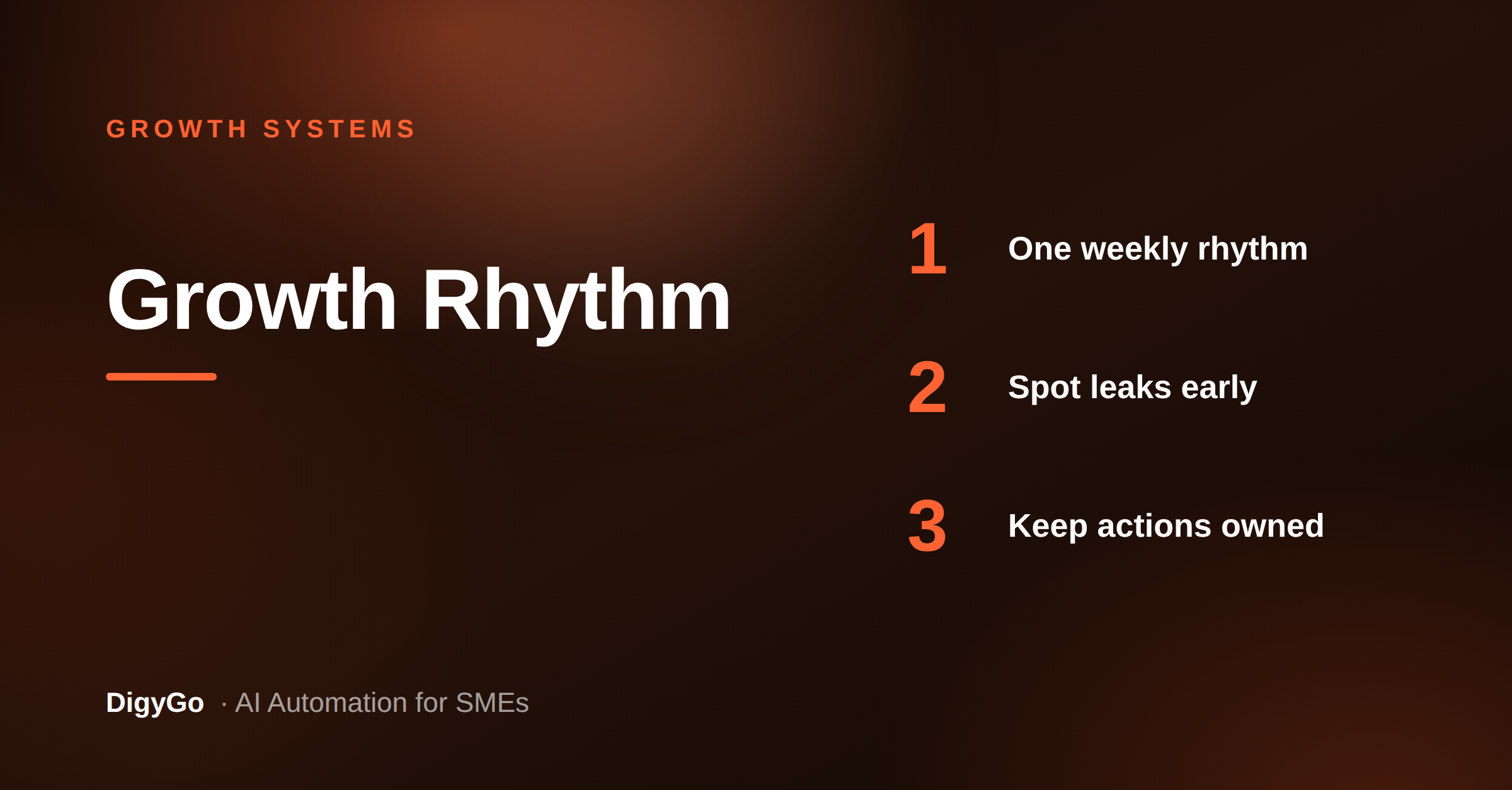
- Track the same signals every week.
- Assign one owner for every fix.
- Close the loop before the next review.

The 4 signals to review each week
Keep the list short enough that the team can act on it in one sitting. The goal is not reporting for its own sake. The goal is to expose the few points where growth is leaking.
- Lead flow: Are enquiries coming in at a steady pace, and from the right sources?
- Speed to response: Are new leads getting a first reply while interest is still high?
- Delivery progress: Are active jobs or campaigns moving without unnecessary delay?
- Retention risk: Are any customers, renewals, or repeat buyers showing signs of drift?
If a metric does not lead to an action, it does not belong in the meeting.
Why most growth reviews fail
Many teams talk about results but never turn those conversations into a system. The meeting becomes too broad, the notes disappear, and the same issues return next week. That is not a growth rhythm. That is a recurring discussion.
A useful rhythm has boundaries. It needs a fixed time, a fixed agenda, and a visible owner for every decision. Once the team knows the pattern, the conversation gets faster and the fixes get smaller — which is exactly what compounds over time.
Manual drift versus a managed rhythm
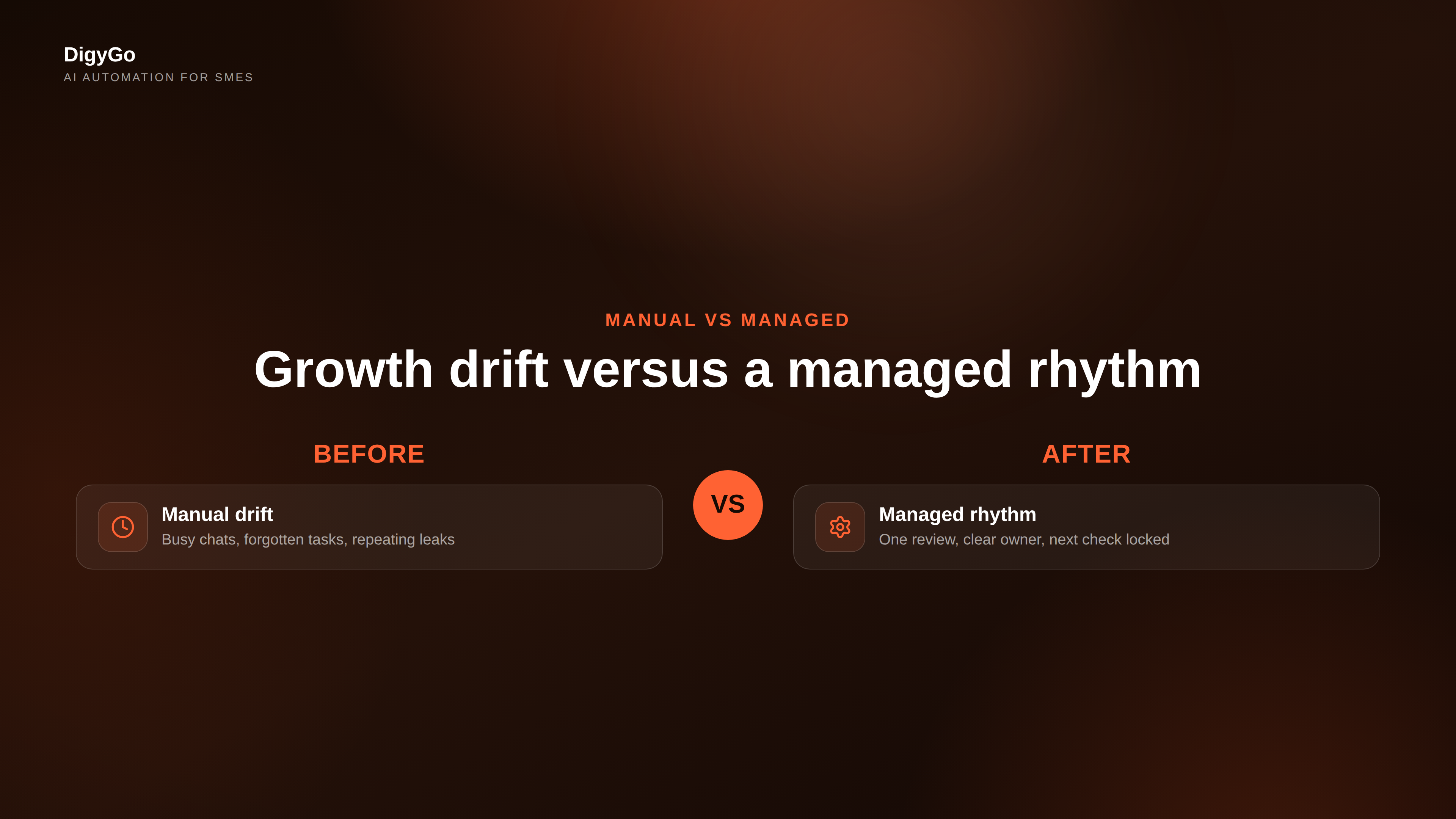
The difference is simple. Without a rhythm, growth work gets handled whenever someone remembers. With a rhythm, work is reviewed, assigned, and checked again before it slips.
- Manual drift: updates live in chats, tasks get forgotten, and nobody sees the full picture.
- Managed rhythm: one review keeps the team aligned on what matters now.
How to run the meeting in 20 minutes
Use the same order every week so the meeting stays sharp:
- Review the four signals.
- Call out the biggest leak.
- Assign one owner and one deadline.
- Confirm what will be checked next week.
This is enough for most SMEs. The point is not to solve everything in the room. The point is to keep the system moving.
What compounding looks like in practice
Over a few weeks, the gains are usually small but visible: response times improve, fewer leads slip away, handoffs become cleaner, and recurring issues stop hiding in plain sight. Over a few months, those small fixes create a business that feels more predictable.
That predictability matters because growth becomes easier to repeat. Teams know what to review, owners know what to fix, and leaders spend less time firefighting.
FAQ
How often should we run a growth rhythm?
Weekly is the best default for most SMEs because it is frequent enough to catch problems early without becoming noisy.
Who should attend?
Keep it tight: the person who owns revenue, the person who owns operations, and anyone who must act on the decisions.
What if we have too many numbers?
Cut the list until the meeting feels almost too simple. A growth rhythm works best when it highlights action, not clutter.
Need help designing a weekly rhythm that actually sticks across leads, follow-up, and delivery? Talk to DigyGo about building it properly.