Most SME growth teams do not fail because they lack ideas. They fail because the same ideas get tested again and again without a clean record of what worked, what did not, and what should happen next.
SMEs do not need more random experimentation. They need a growth experiment ledger that records tests, results, and next actions so teams stop repeating failed ideas.
A growth experiment ledger fixes that problem. It gives your team one place to record tests, results, learnings, and next actions so growth stops depending on memory, guesswork, or whoever happened to be in the room last week.
Why repeat tests quietly drain growth
When experiments are not tracked properly, the business keeps paying for the same lesson twice. A new offer gets tried, a channel gets tweaked, or a follow-up sequence gets changed, but the reason behind the result is lost.
- Memory fades. Teams forget why a test was started and what problem it was meant to solve.
- Ideas get recycled. The same campaign or offer comes back because nobody can see the earlier outcome.
- Decisions get slower. Without a record, every review becomes a debate instead of a decision.
What a growth experiment ledger should actually capture
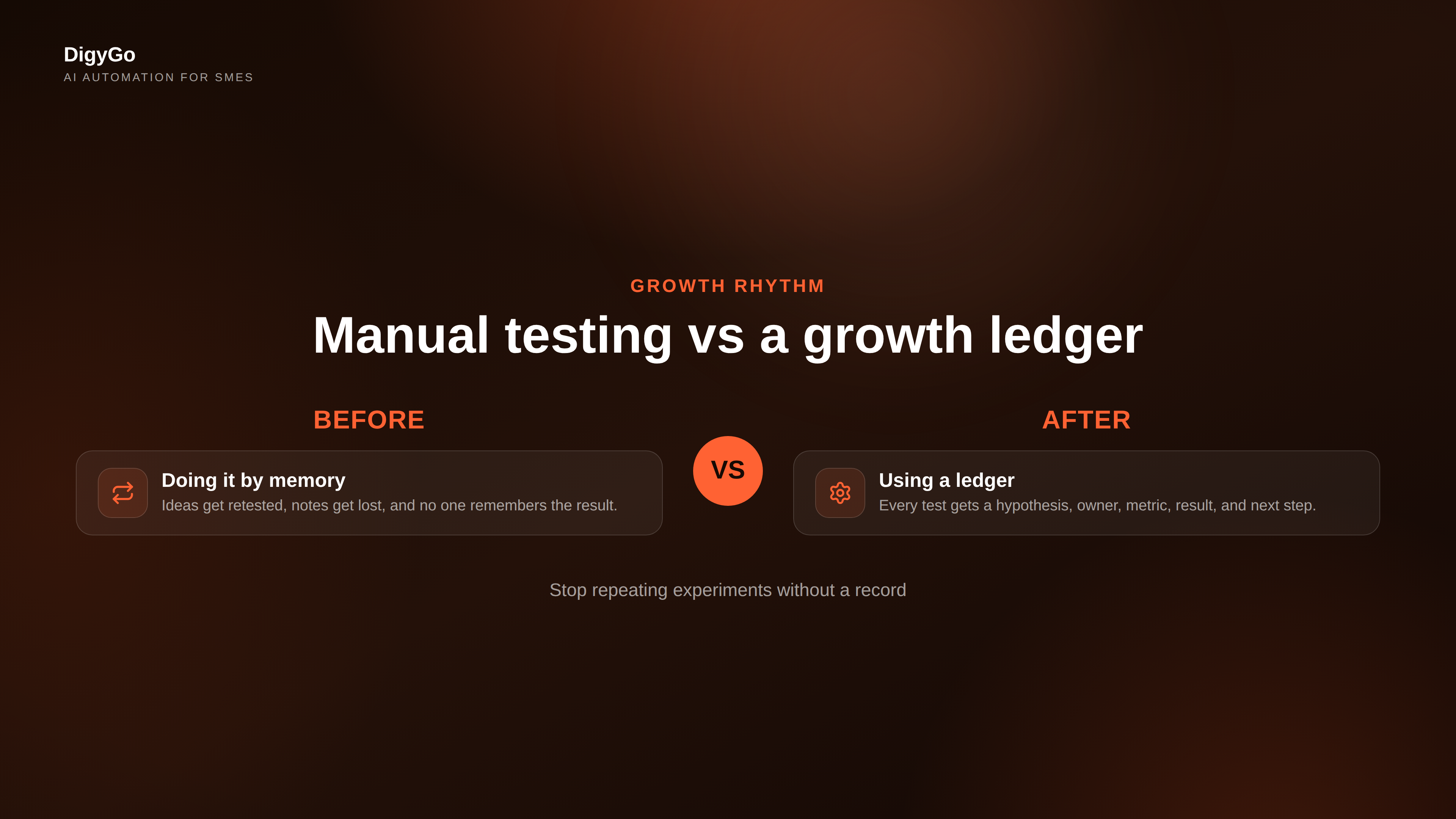
This is not a giant project document. It is a simple operating system for growth. The ledger should tell the team what was tested, why it was tested, how success was measured, and what action follows the result.
| Ledger field | What to write | Why it helps |
|---|---|---|
| Hypothesis | The change you expect to make | Keeps the test focused |
| Owner | Who is responsible for the test | Prevents invisible work |
| Metric | The one number you will watch | Avoids argument later |
| Result | What actually happened | Stops the same test being repeated blindly |
| Next step | Kill, keep, or refine | Turns learning into action |
A growth system becomes valuable when every experiment leaves behind a decision, not just a screenshot.
How the ledger changes weekly growth reviews
With a ledger in place, weekly growth reviews become much sharper. Instead of asking the team to remember every test from scratch, you can scan the record and look for patterns across offers, channels, audience segments, and follow-up timing.

The review gets faster because the facts are visible
The best part is not just organisation. It is speed. A team that can see the history of its tests can decide faster where to invest the next round of effort. That reduces hesitation and keeps growth work moving.
- Review the test log. Look at the last few experiments and their outcomes.
- Group the patterns. Find repeated wins, repeated failures, and unclear signals.
- Choose the next move. Stop weak tests, improve promising ones, and schedule the next experiment.
Where SMEs usually go wrong
Most small teams do not need more experimentation. They need better discipline around experimentation. Without a ledger, growth work turns into a series of disconnected attempts that never build on each other.
- Testing too many variables at once
- Using vague success criteria
- Letting experiments die without a decision
- Forgetting to assign an owner for the next action
Make the ledger part of the operating rhythm
The ledger works best when it is part of a repeatable rhythm. Every test should be logged when it starts, updated when it ends, and reviewed in the same weekly meeting that handles growth, retention, and operations.
That consistency is what turns isolated experiments into a compounding system. Instead of hoping the next idea works, your team starts building a reusable record of what actually moves the numbers.
Want help building a cleaner growth system for your SME? Talk to DigyGo.