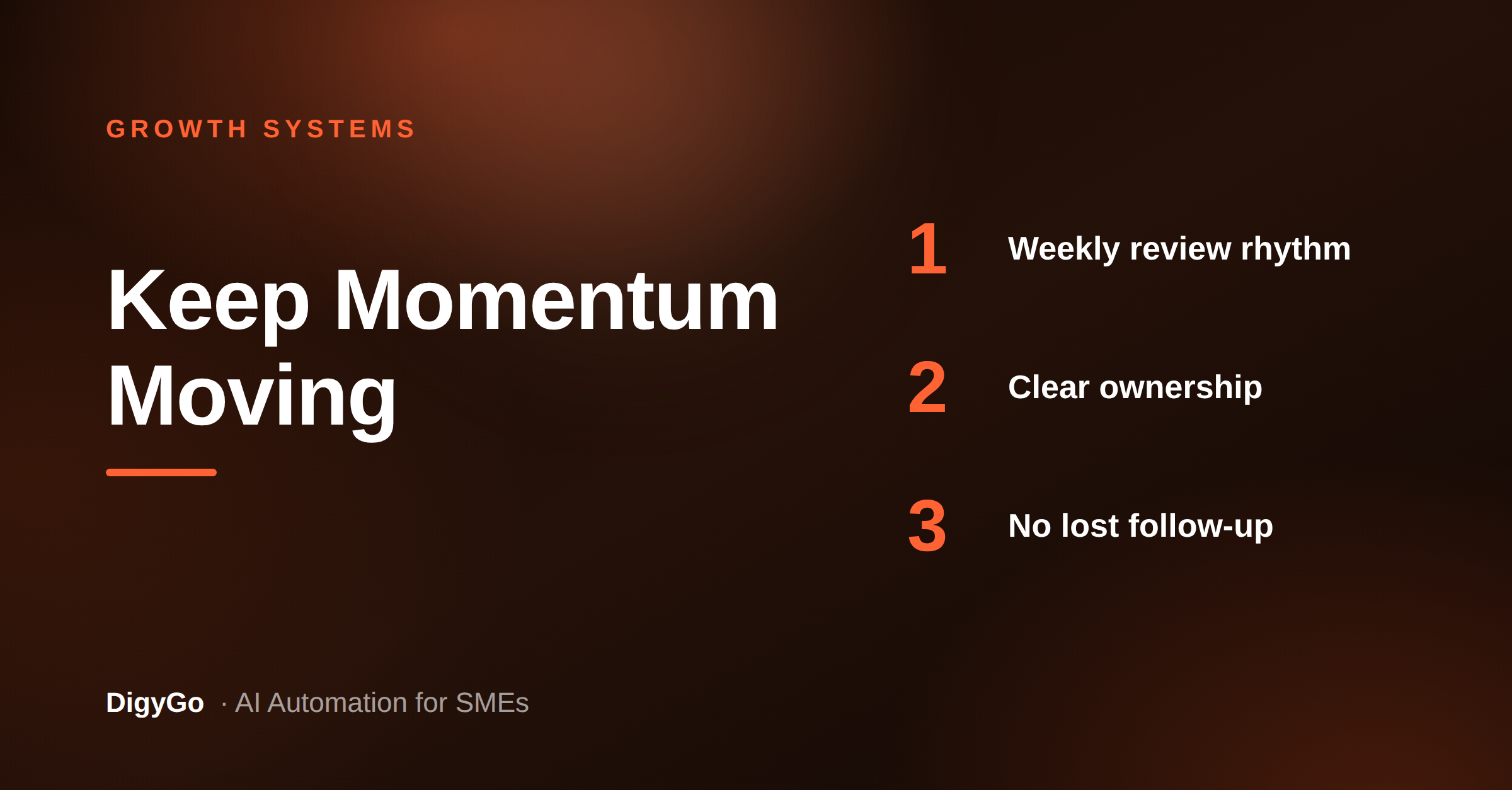
Most SMEs do not stall because the team lacks effort. They stall because growth work has no rhythm: one good week, one busy week, then silence. A simple growth cadence fixes that by turning reviews, handoffs, and follow-up into a weekly operating habit.
A practical growth cadence helps SMEs turn weekly reviews, ownership, and follow-up into a repeatable system that keeps momentum from fading between wins.
| What slips | What cadence fixes |
|---|---|
| Tasks get remembered too late | Weekly review keeps action visible |
| Wins fade into noise | Momentum becomes a named system |
| Owners drift | Each action gets a date and person |
| Follow-up goes missing | Next step is captured before the meeting ends |
Why momentum disappears after a good week
Growth usually starts with energy: a campaign works, referrals rise, or a new process saves time. The problem is that most teams treat the win as proof they are “on track” instead of asking what made it work. Without a cadence, the lesson disappears and the next week starts from zero.
That is why a growth cadence matters. It creates a fixed time to review what moved, what stalled, and what needs an owner. The goal is not more meetings. The goal is fewer blind spots.
What a good cadence actually contains
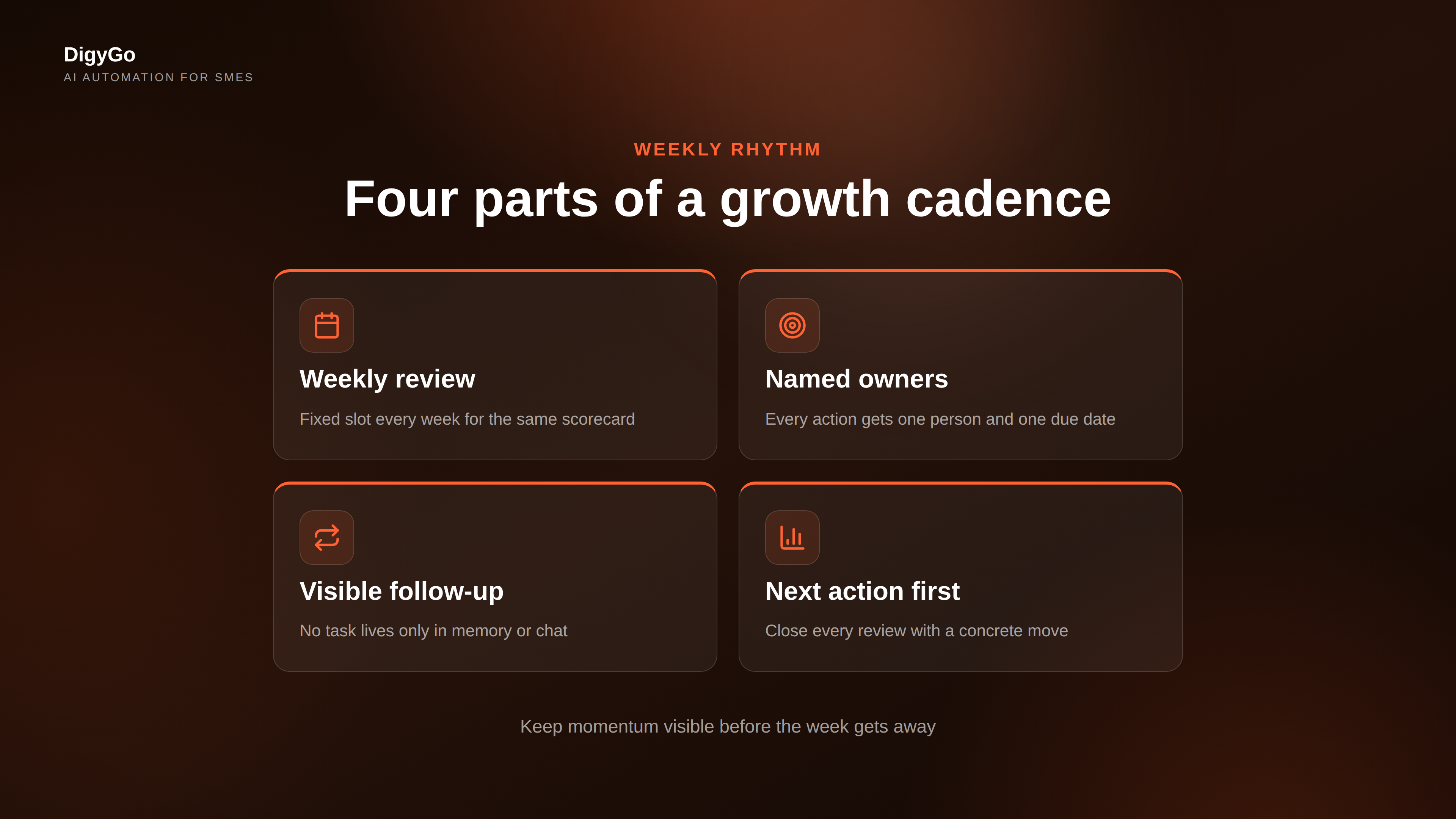
A useful cadence has to be simple enough to run every week and strict enough to prevent drift. For most SMEs, the structure is easy:
- One fixed review slot for the same day and time each week.
- One scorecard with a few numbers that matter.
- One owner per action so nothing sits in the group chat.
- One next-step rule that every win, loss, and blocker ends with action.
When these four parts exist, the team does not waste energy deciding what to do next. The cadence does that work for them.
How to run the weekly growth meeting
Keep the meeting short and practical. First, review the numbers that tell you whether momentum is building or leaking. Then ask three questions: What improved? What broke? What needs to happen before next week?
- Start with one headline metric.
- Look at one leading indicator and one lagging indicator.
- List the bottleneck in plain language.
- Assign each action to a person and a due date.
- Record the next follow-up before the meeting closes.
If the meeting ends without ownership, it is not a cadence. It is a conversation.
Split the work: keep one side on learning and one side on action
The most effective growth teams separate review from execution. One side of the week is for learning: what the numbers say, where the funnel leaked, and what pattern emerged. The other side is for action: the fix, the owner, and the check-in date.
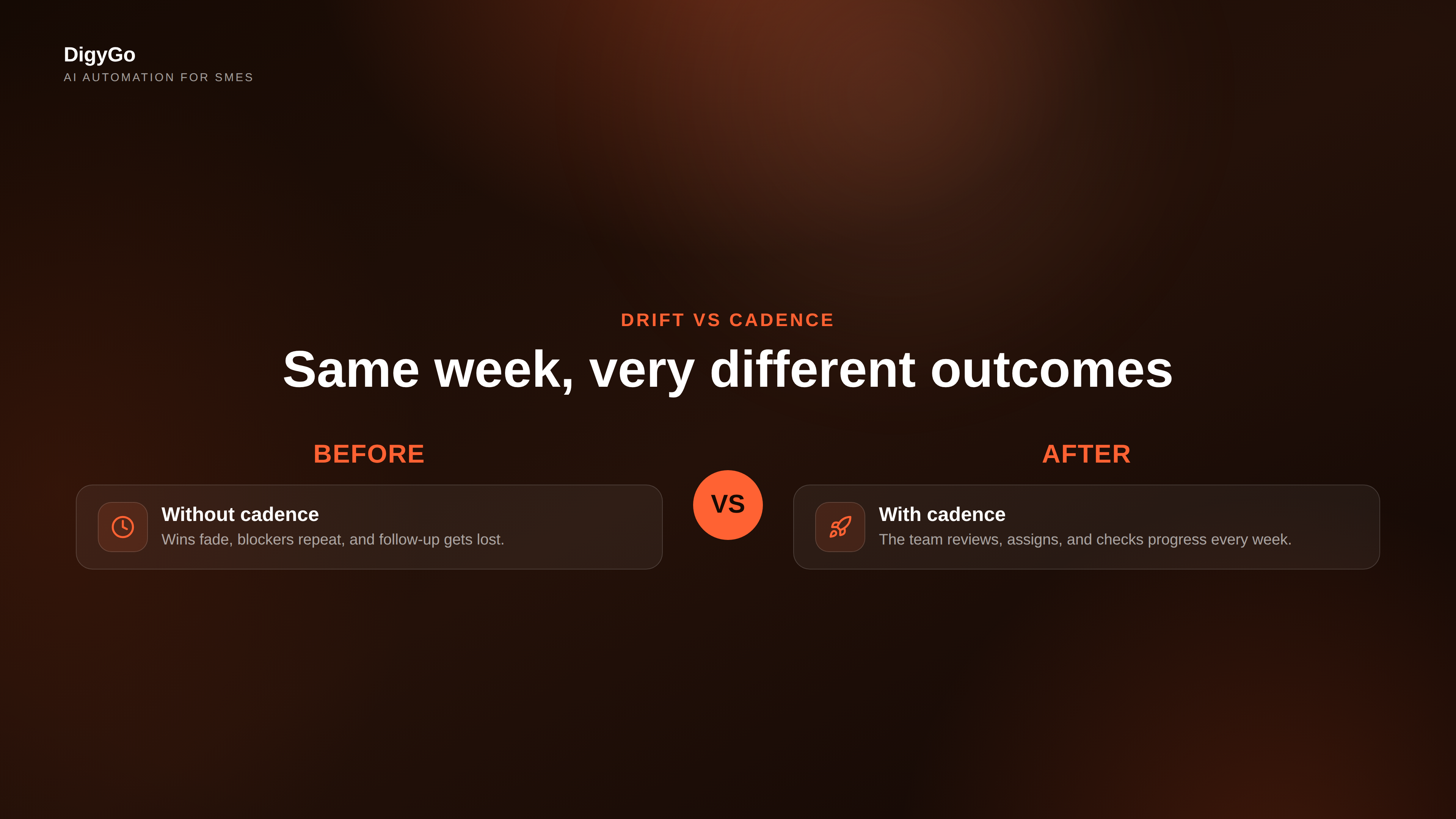
A drifting team keeps revisiting the same issue because nobody closed the loop. A team with cadence writes the decision down once, acts on it, and checks progress the following week.
Signs your cadence is working
You will notice the shift quickly. Meetings get shorter because people arrive prepared. Follow-up gets faster because the next step is already assigned. And the team starts talking in patterns, not guesses.
The best sign is consistency. A good cadence keeps small wins from disappearing and small problems from turning into monthly surprises.
Common mistakes to avoid
- Too many metrics: if everything is important, nothing gets reviewed well.
- No owner: action without ownership is just advice.
- Irregular timing: a cadence only works when it repeats.
- Meeting without notes: memory is not a system.
FAQ
How long should a growth cadence meeting be?
For most SMEs, 20 to 30 minutes is enough if the scorecard is tight and the owner list is clear.
Who should attend?
Only the people who can review numbers, remove blockers, or own the next action. Keep it small.
What is the simplest version to start with?
Start with one weekly review, three metrics, and a written action list. You can add more structure later.