Most SME sales pipelines are not pipelines. They are parking lots. Deals sit at the same stage for weeks because no one asks the hard question: does this one belong here?
A practical sales playbook for SME founders on using deal stage gates to qualify pipeline entries, kill unpromising deals early, and improve close rates without adding complexity.
- Stage gates force a real decision at each step: proceed, nurture, or kill.
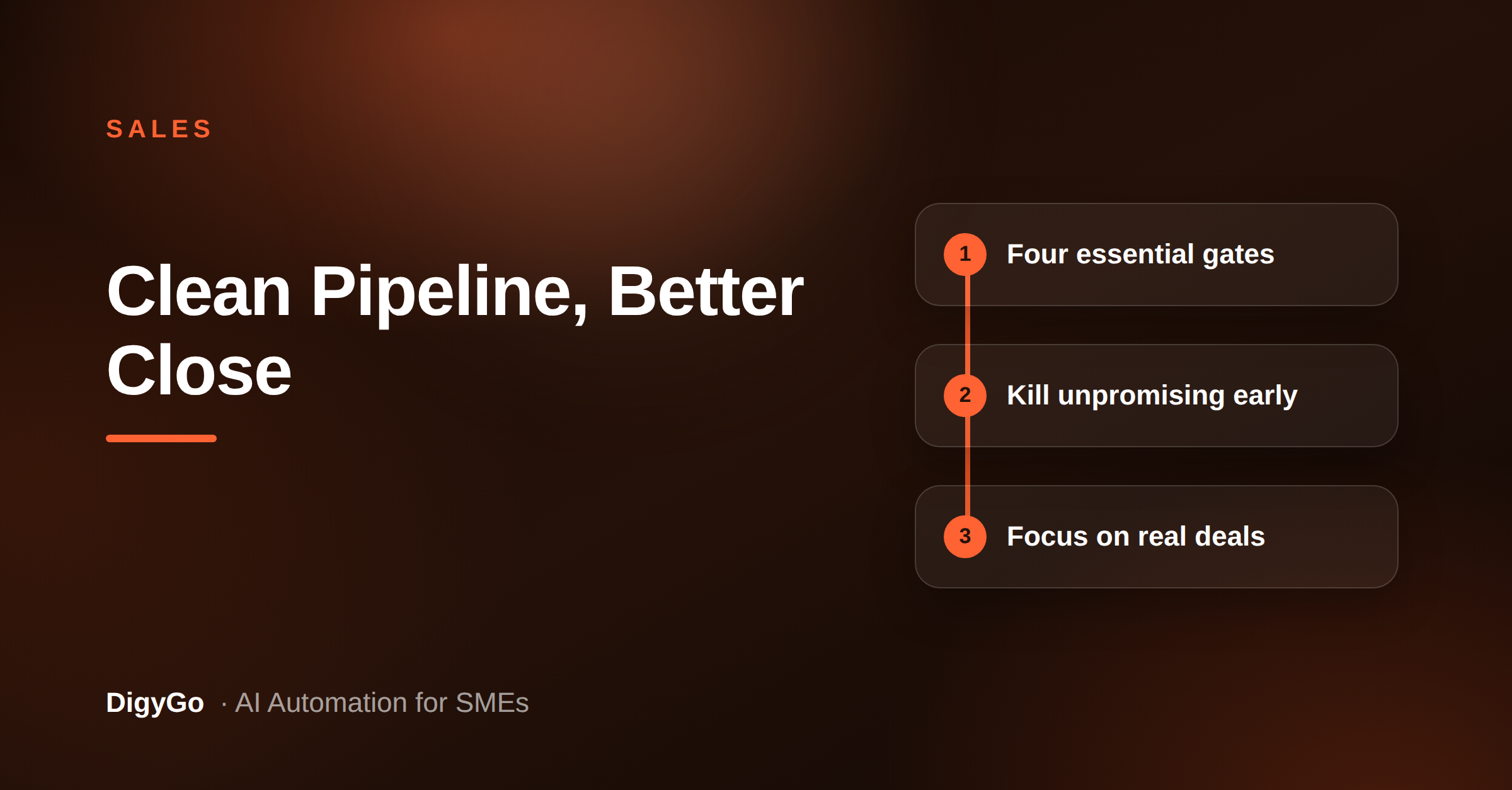
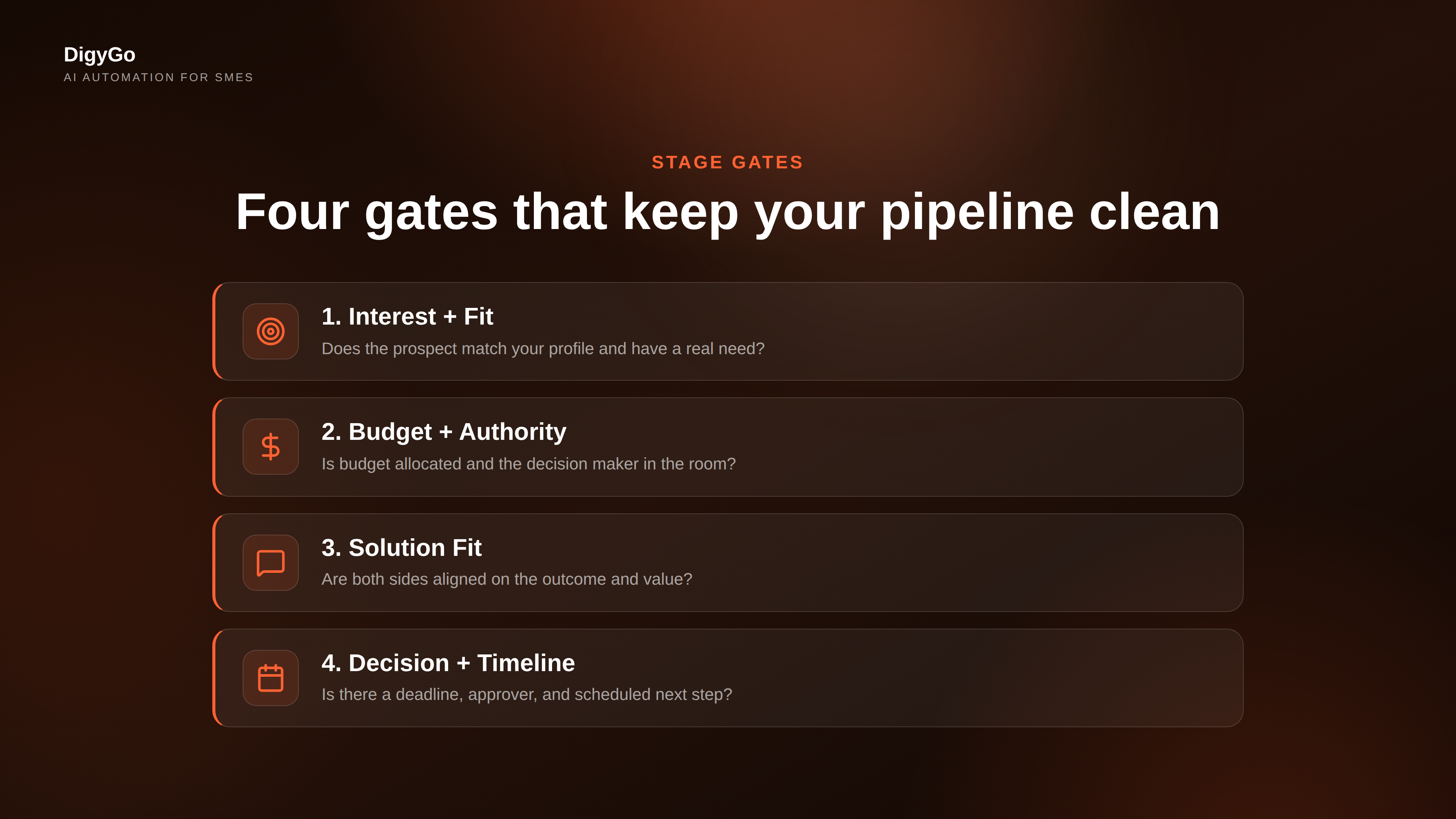
- Four essential gates for SMEs: fit, budget, solution, and timeline.
- A clean pipeline improves close rates by making your team focus on deals that can actually close.
- Kill unpromising deals early to protect team time and sales energy.
The Problem With a Bloated Pipeline
When you look at your CRM today, how many deals are sitting in "negotiation" from three months ago? How many never moved past the first call? If your pipeline is full of stalled entries, your close rate looks worse than it should and your team spends energy chasing dead ends instead of investing in the good ones.
Pipeline bloat is common in SMEs because there is no structured moment to decide whether a deal qualifies for the next step. Every lead that shows a flicker of interest stays in the pipeline forever, and the team keeps following up long after the buyer has quietly walked away.
The fix is not a bigger pipeline. It is a cleaner one. Stage gates give you a repeatable way to keep only the right deals moving forward.
What Is a Stage Gate?
A stage gate is a review point at the end of each pipeline stage where the team answers one question: does this deal earn the right to move forward? The answer must be proceed, nurture (move to a separate follow-up track), or kill (remove from active pipeline).
No deal moves forward just because time passed. It moves forward because it met a clear, agreed criteria at the gate.
This is different from a weekly pipeline meeting where you review everything. A stage gate happens at the deal level, triggered when the rep believes the stage is complete. The gate decides whether that belief is correct before the deal advances.
The Four Essential Stage Gates for SMEs
Not every SME needs a complex five-stage process. Start with these four gates. They cover the full path from first contact to closed deal without adding unnecessary overhead.
Gate 1: Interest + Fit
Criteria: The prospect matches your target profile and has a real need.
Before any discovery call time is invested, confirm that the lead fits the type of customer you serve well. Ask: Do they operate in your service area? Do they have the kind of problem your offer solves? Is this a real active need or just price shopping?
Leads that fail Gate 1 should be nurtured or released, not put into the active pipeline.
Gate 2: Budget + Authority
Criteria: The prospect has budget allocated and the person you are speaking to can approve a decision.
This gate is where most SME deals stall without anyone realising why. You have a great conversation. The prospect loves the offer. But there is no budget owner in the room and the timeline is vague. That is not a real deal yet.
At Gate 2, get clarity on budget range and decision process before building a proposal. If the budget is too tight or the decision maker is not involved, the deal stays in nurture until those gaps close.
Gate 3: Solution Fit
Criteria: The solution is a strong match for the need and the prospect agrees on the desired outcome.
After sharing your proposal or quote, the gate checks whether both sides are aligned on what success looks like. The prospect should be able to describe the outcome they expect in their own words. If they cannot, the fit is not yet clear enough to move toward close.
This is also the gate where you test for hidden objections. If the prospect seems hesitant or non-committal after seeing the proposal, Gate 3 is the right place to surface that before more time is spent.
Gate 4: Decision + Timeline
Criteria: The prospect has a decision deadline, the approver is confirmed, and next steps are scheduled.
Gate 4 qualifies the path to close. Does the prospect know when they will decide? Is the approver available? Are the next steps on both sides clearly scheduled? If the answer to any of these is "not yet," the deal should not sit in "verbal commitment" forever. Move it to nurture with a follow-up timeline, or flag it as stuck and assign a specific action to unblock it.
How to Run a Stage Gate Review Without Adding Meeting Bloat
Stage gates do not require a new weekly meeting. Integrate them into your existing pipeline review:
- During weekly pipeline review: pick two or three deals that are about to move stages. Review each one against the gate criteria. If it does not meet the bar, keep it in the current stage or move it to nurture.
- In the CRM: add a simple status field per stage: qualified, pending review, or stalled. This makes gate decisions visible without extra process.
- As a deal ages without moving: trigger a gate review automatically. If a deal sits at Gate 2 for more than two weeks, the rep reviews it against the criteria and decides next action.
The team does not need to gate every deal every week. Focus the gate review on deals that are about to move or have stalled. That keeps the process lean.
Why Killing Deals Early Protects Your Close Rate
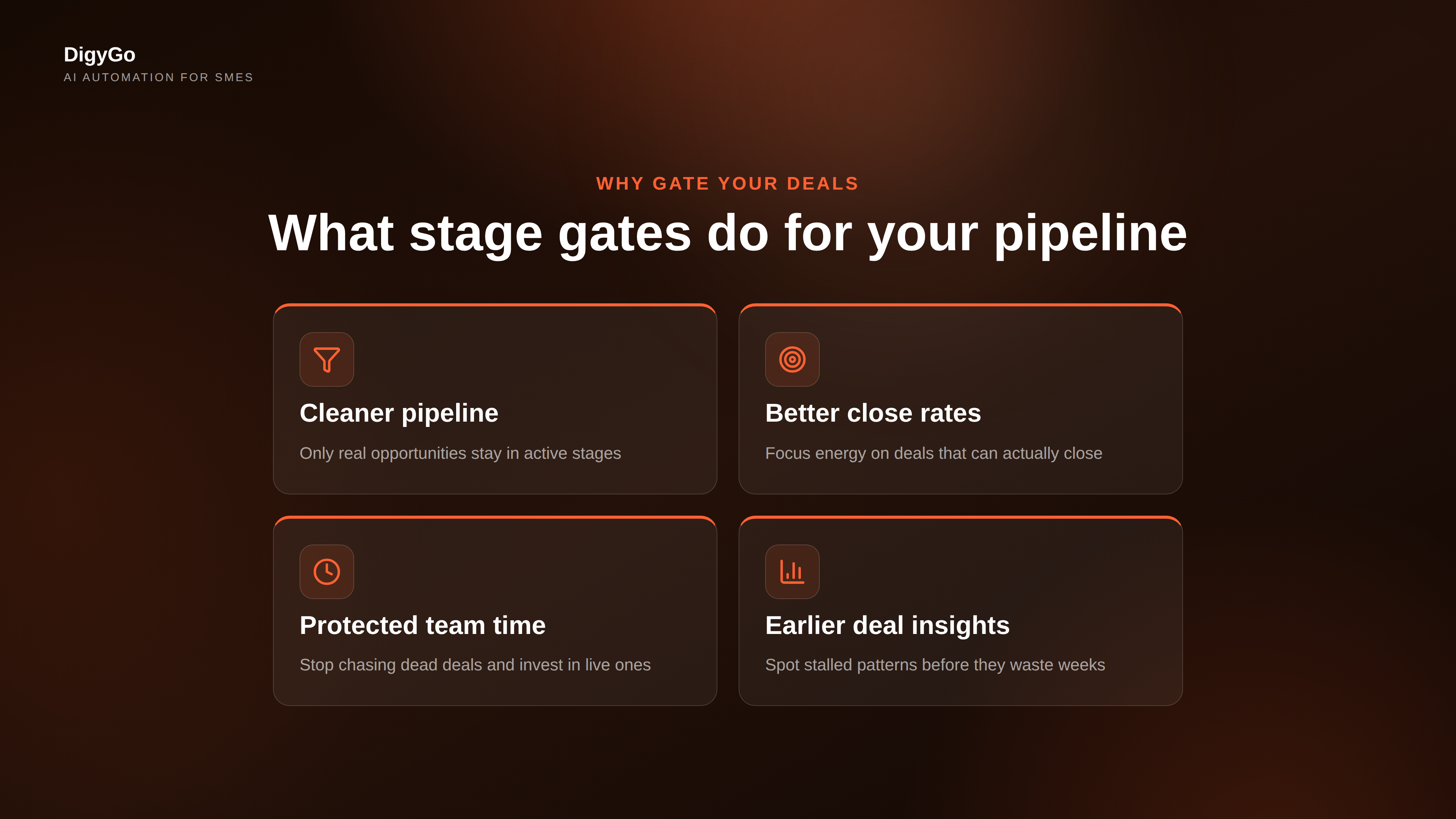
It sounds counterintuitive: removing deals from the pipeline improves your close rate. But a pipeline full of deals that will never close distorts your forecast, wastes follow-up time, and drains team morale. Every hour spent chasing a dead deal is an hour not spent closing a live one.
When you gate early and kill deals that do not fit, three things happen:
- Your pipeline becomes a reliable snapshot of real opportunities, not wishful thinking.
- Your team focuses energy on deals that are actually winnable.
- Your forecast accuracy improves, which helps with resourcing, cash planning, and confidence.
Killing a deal early is not a failure. It is a good decision made with the information available. Keeping a dead deal alive out of optimism is what hurts your numbers.
FAQ
How many stage gates should an SME have?
Four is a good starting point: Interest + Fit, Budget + Authority, Solution Fit, and Decision + Timeline. Add or remove based on your typical deal complexity. If your sales cycle is short (a few days), three gates may be enough. If deals involve multiple stakeholders, add a fifth gate for stakeholder alignment.
Does a stage gate slow down the sales process?
No. A good gate speeds things up because it prevents the team from investing time in deals that are not ready. The time saved on dead deals more than compensates for the few minutes it takes to gate each live deal.
What is the difference between a stage gate and a weekly pipeline review?
A weekly pipeline review looks at all deals broadly. A stage gate is a specific checkpoint for one deal at one transition point. The gate answers "is this deal ready to move?" while the review answers "where is the pipeline this week?"
What do I do with deals that fail a gate?
Move them to a nurture track with a clear next action and a re-engagement timeline. Do not leave them in the active pipeline. Label them as "nurture" and review them monthly instead of weekly so they do not clutter your active forecast but are not lost either.
Can I automate stage gates?
Yes, partially. You can set up your CRM to flag deals that have been in one stage past a threshold (for example, 14 days in Gate 2). But the decision itself still needs a human judgment call. Use automation to prompt the review, not to make the decision.
Start With One Gate
You do not need to install all four gates at once. Pick the stage where your pipeline leaks the most. If deals often stall after the first call, start with Gate 2 (Budget + Authority). If they stall after sending a quote, start with Gate 3 (Solution Fit).
Run that one gate for two weeks, see how the team uses it, and add the next gate when the first one feels natural. The goal is not a perfect system on day one. It is a cleaner pipeline by the end of the month.
If your sales pipeline is collecting dust instead of closing deals, talk to us about how automation can help stage gates work without adding admin time.