Most SME founders spend months building a lead generation system — ads, content, referrals — only to lose new clients in the first 60 days because there is no onboarding system on the other side. The result is a leaky bucket: hard-won customers drift away before they experience the value of the service, and the growth system never compounds. A structured customer onboarding process is not a nice-to-have admin task. It is one of the highest-leverage growth operations an SME can build, and it directly protects recurring revenue.
A practical guide for SME founders on building a customer onboarding system that protects retention, drives referrals, and lets growth systems compound from day one instead of leaking new clients before they see real value.
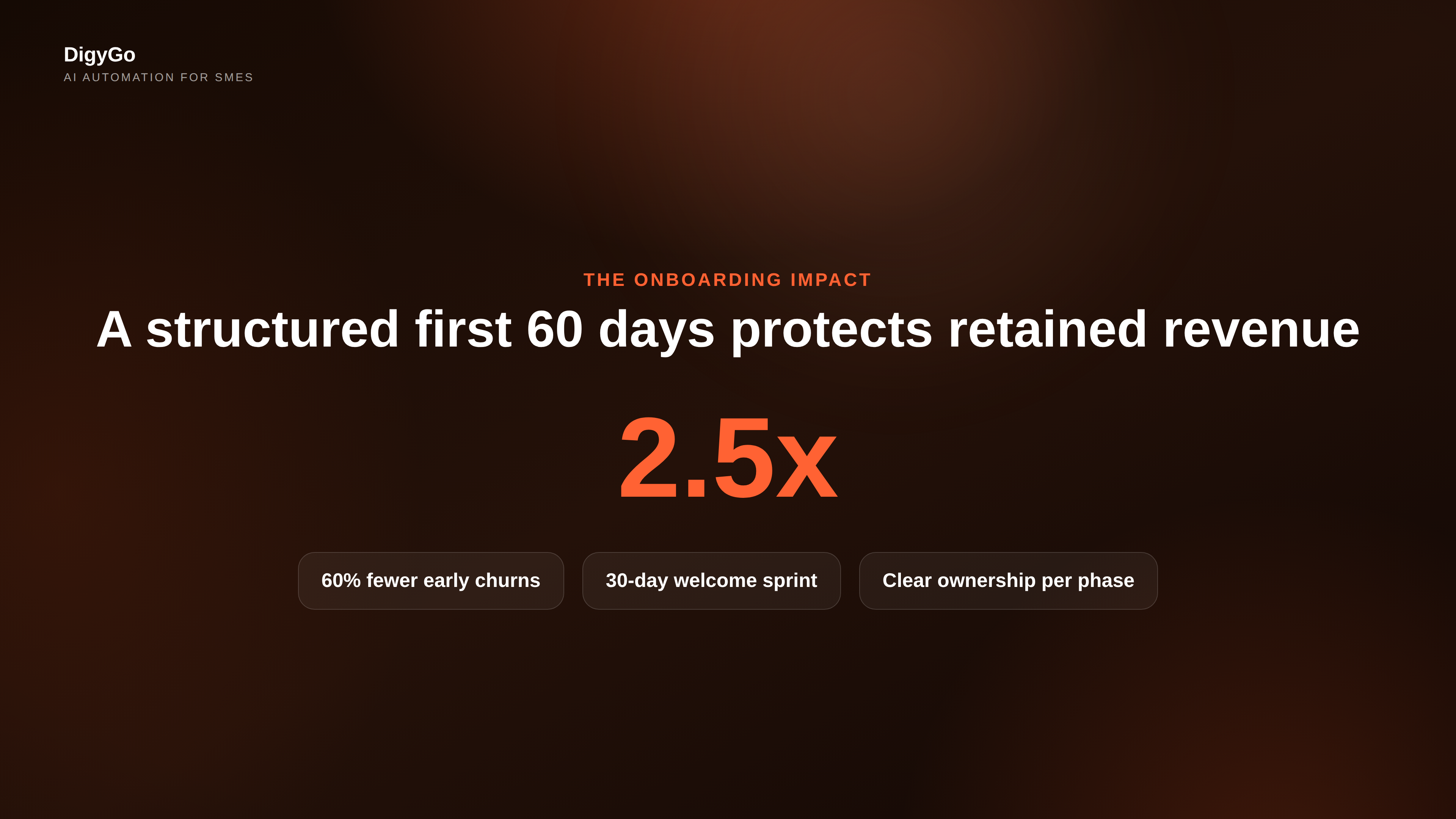
- A systematic onboarding process reduces early churn by giving every new client a clear, predictable first 30 days
- Structured check-ins during the first 60 days turn passive customers into active promoters who renew and refer
- Documented onboarding steps make your system repeatable across team members without the founder explaining every handoff
The Onboarding Gap That Leaks Retention
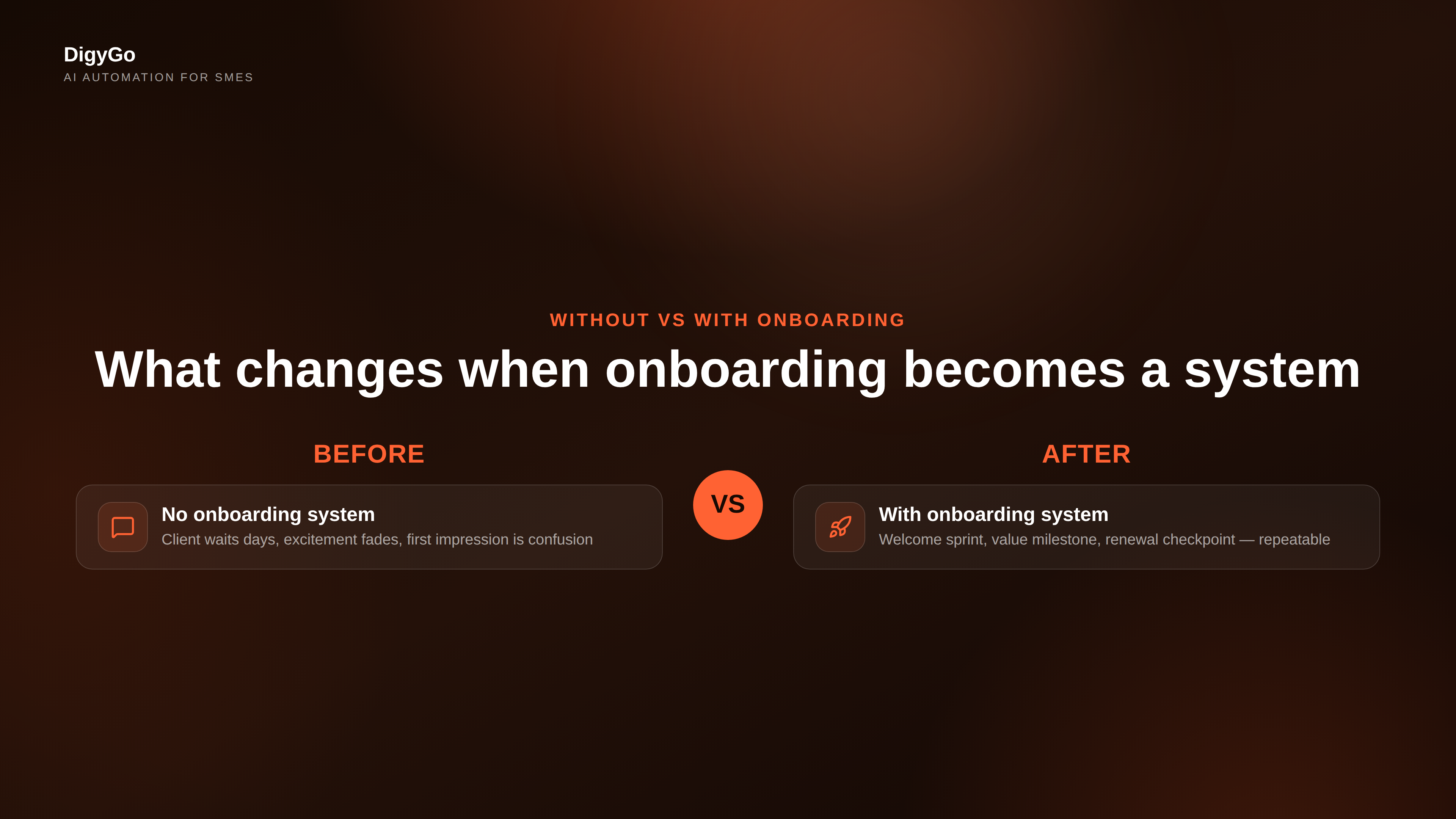
When a new client signs up or says yes to a proposal, the energy is high. The team is excited, the customer is optimistic, and everyone assumes the relationship will work out. But without an onboarding system, that initial goodwill erodes fast. The customer does not know what happens next. They wait for a welcome email, a call, or a login link. Days pass. The excitement fades. And by the time the first real interaction happens, the customer has already formed an opinion: this feels chaotic.
For an SME, every new client that churns in the first 60 days represents not just lost revenue but lost acquisition cost. You paid for the lead, you paid for the sales conversation, and you paid for the onboarding effort — and none of it compounded because the system was missing. A growth system without an onboarding process is like a funnel without a bottom: you fill it at the top but everything drains out the bottom.
What a Good Onboarding System Looks Like
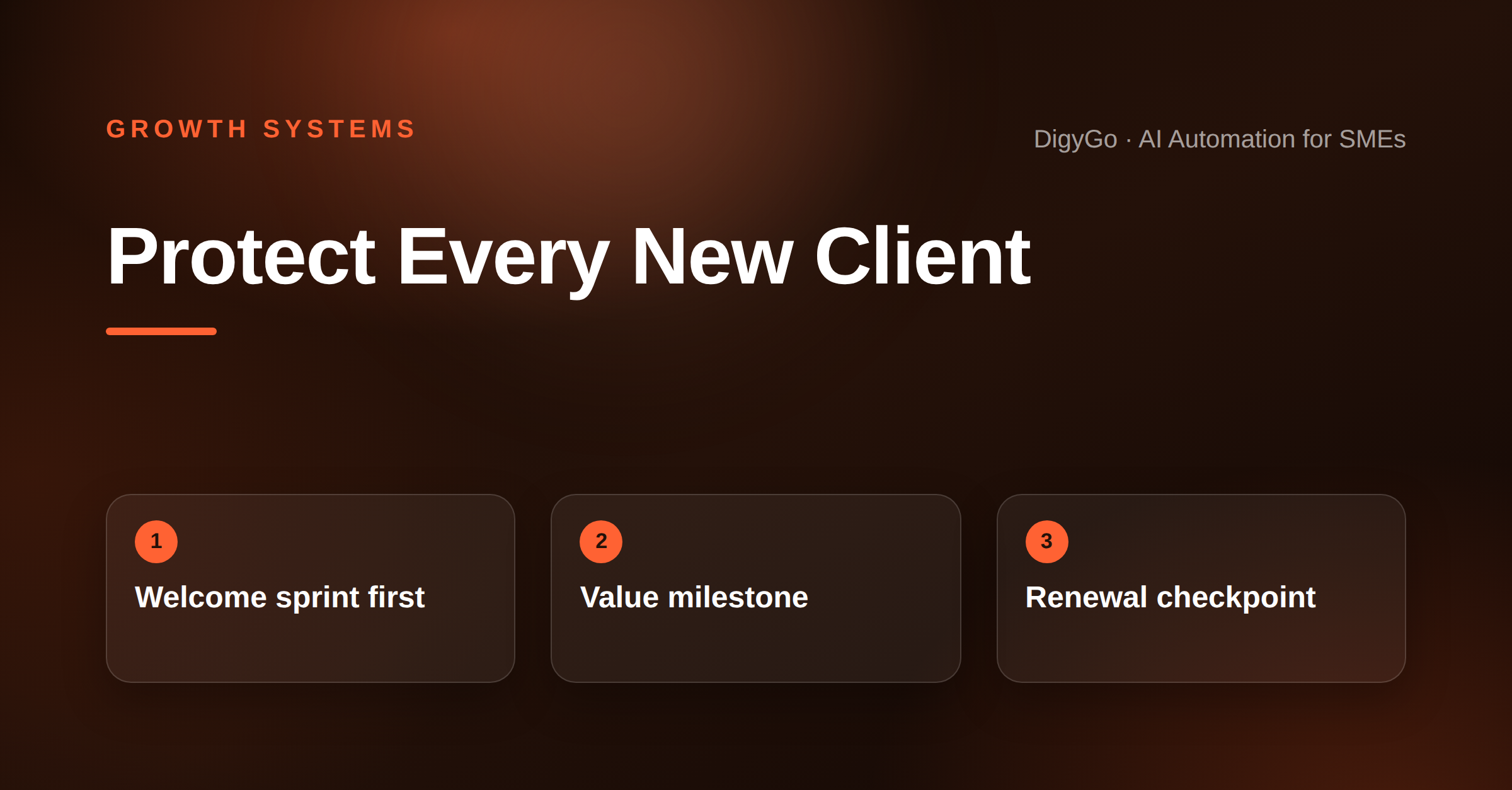
A strong customer onboarding system has three phases, each with a clear owner, a defined output, and a timeline. These phases are not complicated — they are repeatable steps that any team member can execute without guesswork.
Phase 1: The Welcome Sprint (Days 1–5)
The first five days set the tone for the entire relationship. Every new client should receive a welcome message with their account details, a brief call or video to confirm scope and expectations, and a clear document outlining what happens in the first 30 days. The goal is not to deliver the full service yet — it is to prove that the SME runs a professional, organised operation. A simple checklist with three actions (welcome, confirm scope, share timeline) ensures this phase completes every time, regardless of who handles it.
Phase 2: The Value Milestone (Days 15–30)
By day 15, the customer should have experienced a clear value milestone — a moment where they see the service working. This could be a first deliverable, a completed setup, or a result from the work. If the customer reaches day 30 without a positive value milestone, their likelihood of renewing drops significantly. An onboarding system schedules this milestone explicitly: it maps the work, assigns ownership, and sends a progress check-in before the milestone date, not after.
Phase 3: The Renewal Checkpoint (Days 45–60)
The final phase of onboarding transitions the customer from "new" to "active." A check-in call around day 45 reviews the value delivered so far, gathers feedback, and identifies any dissatisfaction early. By day 60, the system should have produced a clear go/no-go signal for renewal. This is not a sales call — it is a relationship review. The information gathered here feeds directly into your retention data, referral pipeline, and service improvement process.
Onboarding as a Growth Lever
When onboarding works as a system, it stops being a cost centre and starts being a growth lever. Here is how it compounds:
- Retention compounds revenue. A customer who reaches their value milestone renews at a higher rate. Renewed customers buy more over time — upsells, add-ons, and expanded scopes are far easier with a retained client than a new one.
- Happy onboarded clients refer. The best time to ask for a referral is right after the customer has seen a clear value milestone — not six months later. An onboarding system builds a referral trigger into the process naturally.
- Feedback improves the service. Every onboarding check-in produces data: what confused the customer, what delighted them, what was missing. This feedback loop improves the product or service, which in turn makes future onboarding smoother — a compound cycle.
- The founder steps back. With a documented onboarding system, a new team member can onboard a client without the founder explaining every step. This is how growth systems scale without the founder becoming the bottleneck.
Making the Onboarding System Repeatable
The difference between a one-time effort and a repeatable system is documentation and ownership. Write down each onboarding phase as a simple checklist. Assign one owner per phase — not a committee. Set a timeline with clear deadlines for each action. And schedule a short weekly review during the first 60 days to catch any drift before it causes a churn event.
For SMEs using automation tools, some of the welcome touches can be triggered automatically — a welcome email, a calendar invite for the scope call, a reminder for the day-15 check-in. But the core of the system is human: a real conversation, a genuine check-in, and a visible commitment to the customer's outcome. Automation supports the rhythm; it does not replace the relationship.
Frequently Asked Questions
How long should an SME onboarding process last?
For most service-based SMEs, 45–60 days is the right window. It is long enough to deliver real value and short enough to keep momentum. After 60 days, the customer should transition from "onboarding" to "active account" with a different review cadence.
What happens if a client resists the onboarding steps?
Resistance is usually a signal that the customer does not understand why the step matters. Explain the purpose: "This call helps us tailor the service to your needs" or "This checklist ensures nothing slips through the cracks." If resistance continues, it may be a fit issue — better to discover it at day 15 than at renewal time.
Can onboarding really reduce churn for a one-time service?
Yes. Even for one-time services, a structured onboarding process improves the experience, increases the likelihood of a testimonial or referral, and makes it more likely the customer returns for future needs. The principle applies to any business where the customer's first impression shapes their long-term perception.
Who should own the onboarding system in a small team?
One person — ideally the person closest to delivery. In an SME, this is often the project manager or lead service person. The salesperson who closed the deal should hand off to this owner clearly, with a brief context note. The founder oversees the system but does not run every step.
What is the most common mistake in SME customer onboarding?
Treating it as a one-time event instead of a phased system. A single welcome email is not onboarding. The system needs multiple touchpoints, clear value milestones, and a defined transition to active status. Without phases, there is no structure, and without structure, the customer experience depends entirely on which team member happens to handle it.
The businesses that compound growth fastest are not the ones with the most leads or the biggest marketing budgets. They are the ones that keep the customers they already have. A simple, repeatable customer onboarding system is the operation that protects every rupee you spend on acquisition. If you do not have one yet, start with the welcome sprint this week.