Most SMEs treat a lead as lost the moment the prospect does not reply to the first message. But in reality, most prospects are simply not ready to buy when they first reach out — they are gathering information, comparing options, or waiting for the right time. An automated lead nurturing system changes that. It keeps your brand in front of the prospect with useful, timed touches until they are ready to have a real conversation — without adding manual work to your team's plate.
A practical guide for SMEs on building an automated lead nurturing system that captures every enquiry, qualifies without a call, sends timed touches, and hands off warm prospects ready to buy.
Why most SME leads go cold before they are ready
The typical SME enquiry flow is simple: a prospect sends a message, the team replies, and if the prospect does not respond immediately, the thread gets buried and forgotten. The follow-up never happens because there is no system to remind anyone — and by the time someone remembers to check, the prospect has moved on to a competitor who answered faster or followed up better.
This is not a sales problem. It is a system problem. The prospect was interested — they just needed more time, more information, or more trust before saying yes. A lead nurturing system fills that gap by delivering the right message at the right interval, keeping the conversation alive without needing anyone to remember to ping the prospect manually.
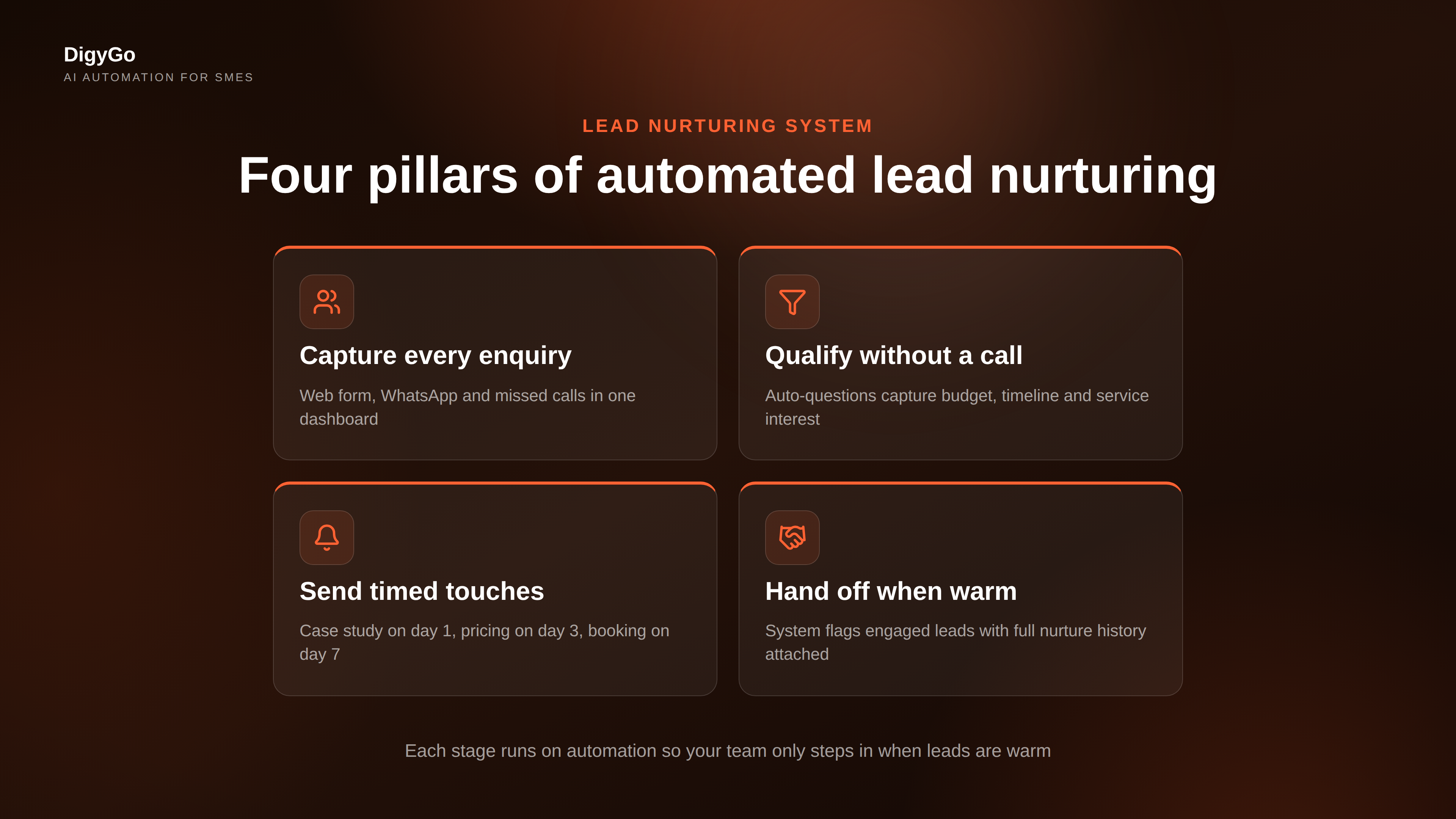
The four pillars of automated lead nurturing
A nurturing system does not need to be complicated. It rests on four clear stages, each handled by automation so your team only steps in when the prospect is genuinely warm.
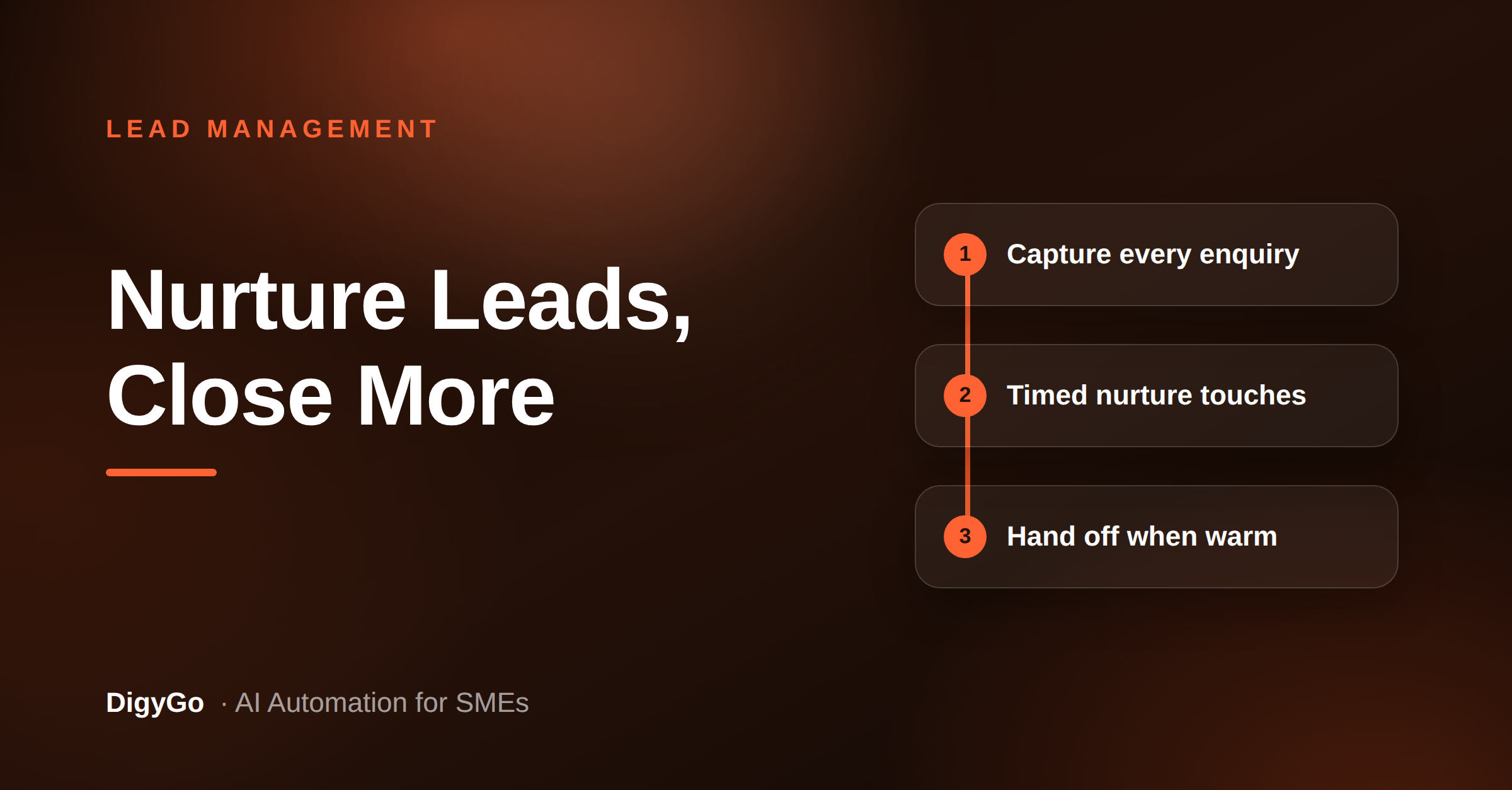
1. Capture every enquiry in one place
Leads arrive from many places — website forms, WhatsApp messages, Instagram DMs, missed calls. If each channel lives in a different inbox, nurturing is impossible from the start. The first pillar is a unified capture system that funnels every enquiry into a single dashboard, regardless of source.
2. Qualify without a call
Before you nurture, you need to know what the prospect actually wants. An automated qualification step — a quick set of questions sent by chat or form — captures budget, timeline, and service interest. This lets you segment prospects into different nurture tracks based on their answers, not guesses.
3. Send timed, relevant touches
This is the core of nurturing. Based on the qualification data, the system sends a sequence of messages — maybe a case study on day one, a pricing overview on day three, and a booking link on day seven. Each message is useful, not pushy. The prospect is never pressured; they are simply given more reasons to choose your business.
4. Hand off when the prospect is warm
The nurturing sequence runs until the prospect clicks a booking link, replies with a specific interest question, or reaches a certain engagement score. At that point, the system flags them as warm and hands them directly to your sales or service team — who now have the full context of the nurturing history, not a cold lead from weeks ago.
What good nurturing looks like in practice
Consider a home-service SME that gets enquiries via WhatsApp. A prospect messages asking about pricing for a two-bedroom paint job. The automated system:
- Replies instantly with a thank-you and a quick qualification question about the square footage and preferred timeline.
- Sends a price range once the specs are clear, plus a link to a portfolio of recent paint work.
- Follows up on day three with a short testimonial from a similar project and a "still comparing?" message.
- Sends a booking link on day seven if the prospect has not responded, with a simple "ready to lock in a free estimate?"
If the prospect clicks the booking link, the system hands the conversation to the estimator with the full lead history attached. If the prospect never clicks, the system pauses the sequence and flags the lead as long-term — no wasted time, no ghosted thread.
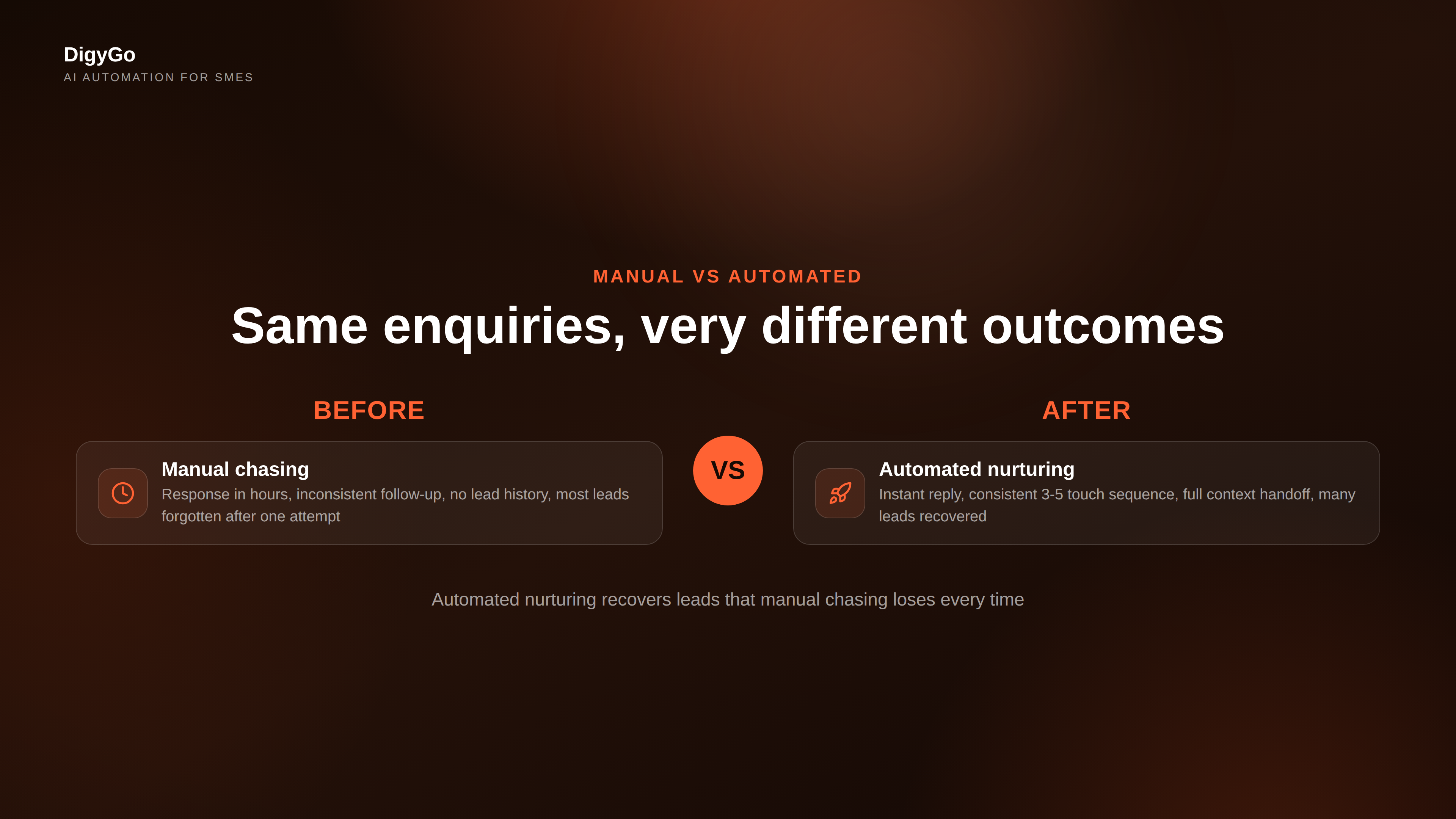
Manual chasing vs automated nurturing
To see why automated nurturing makes such a difference, compare the two approaches side by side.
| Manual chasing | Automated nurturing | |
|---|---|---|
| Response time | Hours or days — depends on who is free | Seconds — triggered immediately |
| Follow-up consistency | Inconsistent — depends on memory | Deterministic — every lead gets the same sequence |
| Qualification | Often skipped to "save time" | Built into the flow — happens before nurture starts |
| Message relevance | Generic — same message for every lead | Segmented — content matches qualification answers |
| Warm handoff | No history — handoff is just a contact number | Full lead history — the sales team knows context |
| Leads recovered | Few — forgotten after one attempt | Many — 3-5 touches before a lead is truly cold |
How to build your first nurturing sequence
Start small. Even a single three-step sequence will outperform the random follow-ups most SMEs rely on today.
- Pick one lead source — choose the channel that brings the most enquiries (WhatsApp, website form, or Instagram).
- Write three messages — a thank-you + qualification question (touch 1), a case study or price overview (touch 2, day 3), a booking link (touch 3, day 7).
- Set the trigger — each message goes out automatically unless the prospect replies or books before the scheduled time.
- Define "warm" — what action tells the system the prospect is ready? A booked slot? A specific question? A clicked link? That action stops the sequence and alerts your team.
That is the entire system. You do not need a complex CRM or a dedicated automation engineer. A simple tool like DigyGo can handle the capture, qualification, message timing, and handoff from a single dashboard.
Common nurturing mistakes SMEs make
Even a good nurturing system can underperform if it falls into these traps:
- Too many touches, too fast. Sending a message every day feels like spam. Space them by 2–3 days at minimum.
- No segmentation. Sending the same content to a budget-conscious prospect and a premium buyer reduces relevance for both.
- No off-ramp. If a prospect replies asking a specific question, the automation should pause and hand off — not keep barking the same sequence.
- Starting from scratch every month. The same messages should work every cycle. Save your first sequence as a template and reuse it.
Why this matters for Tamil Nadu SMEs
In Tamil Nadu's SME landscape, most businesses operate with small teams where the same person who answers the phone also manages operations, sales, and delivery. There is no dedicated follow-up role. Automated lead nurturing closes that gap by running in the background — keeping prospects warm without pulling your existing team away from the work that keeps the business running today.
When every enquiry is captured, qualified, and nurtured through a timed sequence, your team only talks to prospects who have already shown genuine interest. That means fewer wasted calls, shorter sales cycles, and a higher percentage of incoming leads turning into real conversations — and then into paying customers.
FAQ
How many touches should a nurture sequence have?
Three to five touches is a good starting point for most SMEs. Any more risks feeling pushy; any fewer risks the prospect forgetting about you. Adjust based on how fast your typical sales cycle closes.
Is lead nurturing only for email?
Not at all. For Tamil Nadu SMEs, WhatsApp is often the most effective nurture channel because prospects already use it daily. The same sequence logic works on WhatsApp, SMS, email, or any messaging platform your prospects prefer.
How do I know if a nurtured lead is warm?
Set a specific action as the signal — clicking a booking link, replying with a budget question, or spending time on your pricing page. Once that signal fires, the system stops the sequence and notifies your team.
Do I need a CRM to run lead nurturing?
A CRM helps, but you can start with a simple automation tool that captures enquiries from multiple channels and sends timed messages. Tools like DigyGo combine capture, nurturing, and handoff in one dashboard so you do not need to stitch together separate systems.
Start nurturing your leads automatically — try DigyGo's automation platform and stop cold leads from slipping through the cracks.