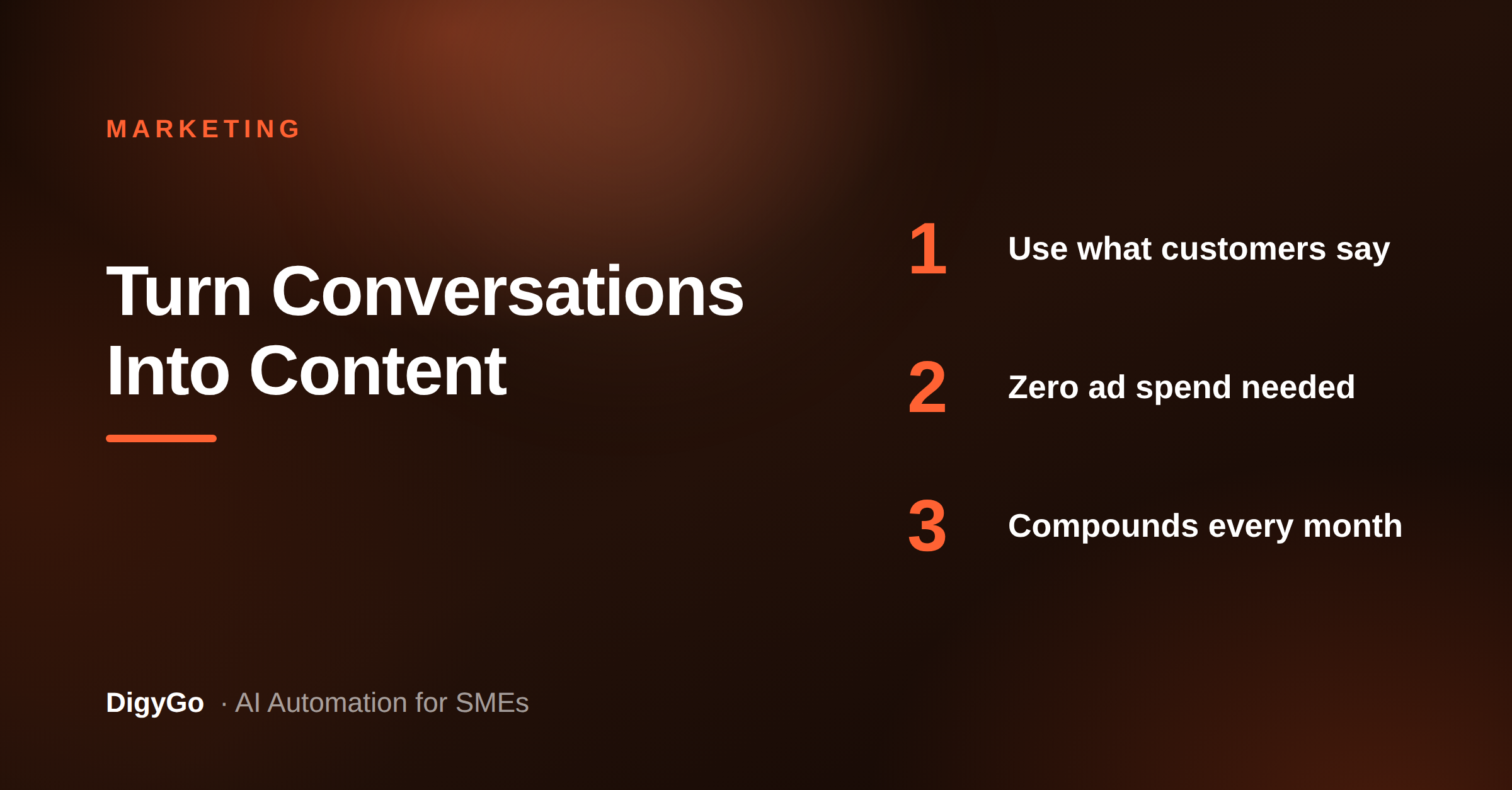
Every SME founder talks to customers every day. Those conversations — the objections, the questions, the moments of relief when a problem gets solved — are the best marketing material most businesses never use. Here is how to turn them into a repeatable content engine.
A practical guide for SME founders on turning real customer conversations into testimonials, FAQ entries, and proof points that attract better enquiries — without adding ad spend or new tools to the weekly routine.
Most SME marketing starts the hard way: staring at a blank page, trying to invent something clever to post. The blank page is the wrong place to start. The right place is the conversation you had this morning.
A plumbing contractor who spent ten minutes on the phone explaining why they charge more than the competitor just heard the exact concerns every price-conscious prospect has. A salon owner who got a WhatsApp message saying "I love how you did my hair last time — when can I come back?" just received a testimonial they can use in every ad this month. A web designer who sent a follow-up message and got "we went with someone cheaper, but the quality wasn't there" just discovered a proof point that belongs on their service page.
The material is already there. The missing piece is a system to capture it, repurpose it, and distribute it. Here is how to build that system without adding a single new task to your week.
Why customer conversations beat manufactured content
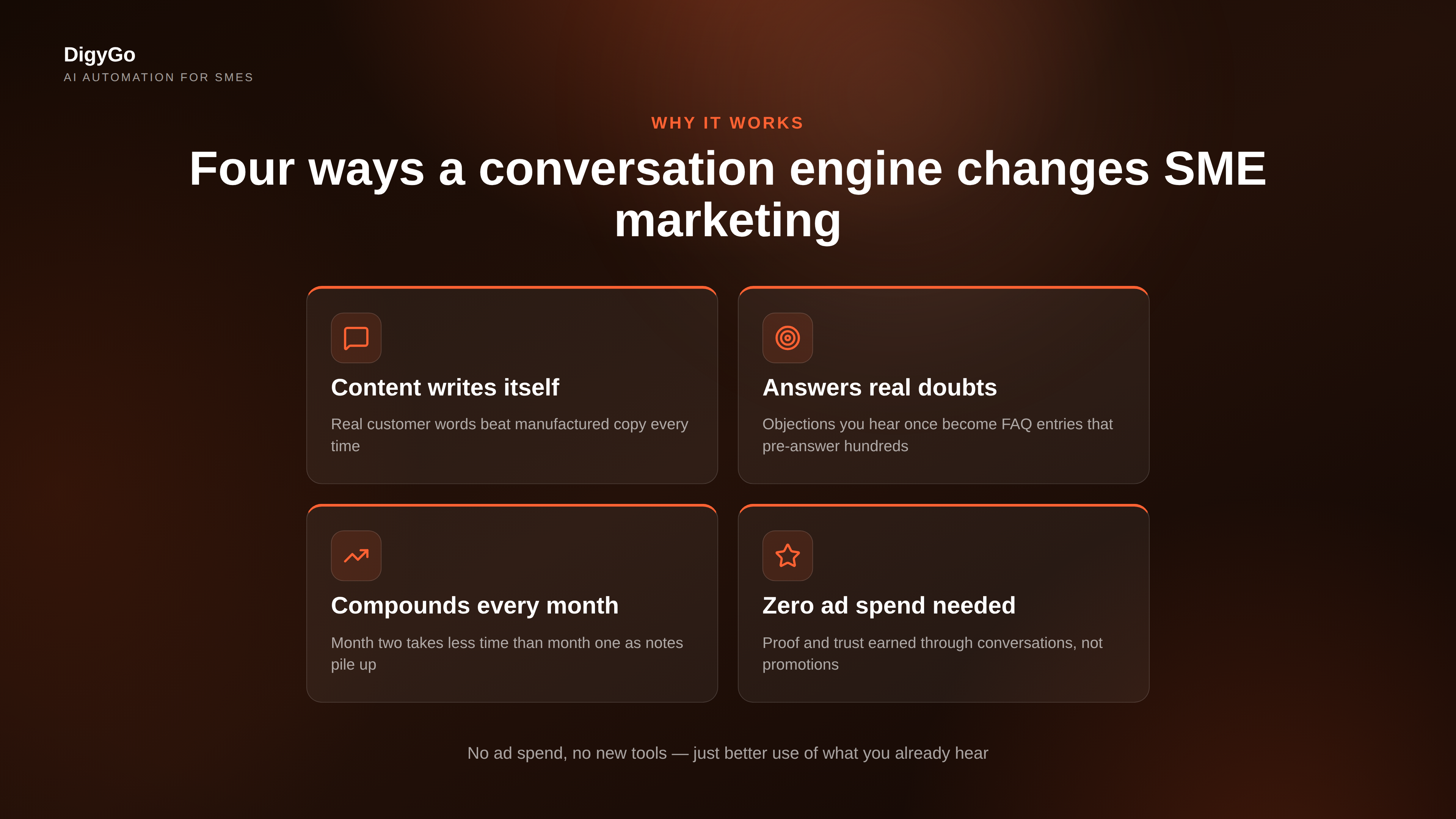
Content that converts does not sound like marketing. It sounds like a real person answering a real question. That is exactly what every customer conversation is. When you take a genuine exchange and turn it into a post, testimonial, FAQ entry, or social update, it works better than anything you would write from scratch for two reasons:
- It is specific. Generic claims like "we provide quality service" land nowhere. A direct quote from a customer who said "I called three other electricians before you — you were the only one who showed up when you said you would" lands hard.
- It answers real doubts. The objection a prospect raised on the phone this morning is the same objection ten other prospects had this month. When you turn that objection into a blog post or an FAQ, every future prospect sees the answer before they can articulate the doubt.
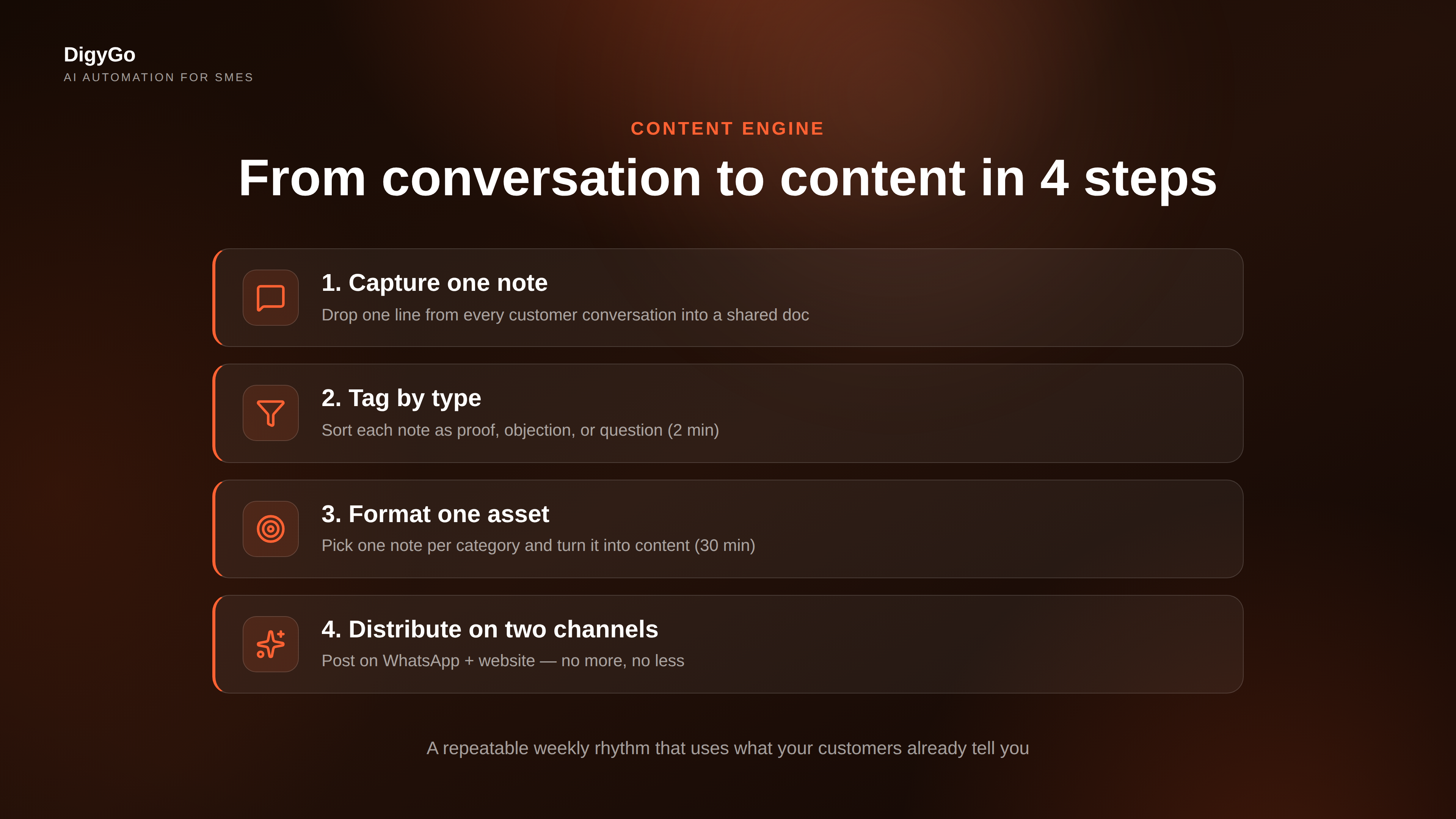
Step 1: Capture one thing from every conversation
The hardest step is not writing the content — it is remembering what was said. Without a capture system, the good material evaporates by lunchtime. The fix is simple: put one place where raw notes go, and make it accessible from anywhere.
For most SMEs, that place is a WhatsApp chat with yourself, a shared note on the team phone, or a single Google Doc titled "Content Raw Material." The format does not matter. What matters is a rule: every team member who talks to a customer drops one sentence into that place after the call ends.
That one sentence can be:
- A direct quote from the customer ("You were the only one who called back")
- A question they asked ("How long does this take? Is it safe?")
- A concern they raised ("The last guy charged me double what he quoted")
- A result they described ("We saved four hours this week because of your system")
If your team logs three customer conversations a day, that is fifteen raw notes a week. That is more than enough marketing material for a month.
Step 2: Tag each note by type
Once you have a pile of raw notes, the next step is sorting them into the three asset types. This takes two minutes at the end of the week. Open your notes and add one tag to each:
- Proof — something that shows the business delivered. "Client said their energy bill dropped 22% after our audit." This becomes a testimonial, a case study snippet, or a social proof block.
- Objection — something a prospect worried about before buying. "They were scared a long-term contract would lock them in." This becomes a blog post, an FAQ entry, or a service-page paragraph that addresses the fear directly.
- Question — something they needed explained. "How do I know this will work for my type of shop?" This becomes a how-to post, a comparison table, or a short explainer video script.
After one week of tagging, you will see patterns. The same objection surfaces from different prospects. The same question gets asked three times. Those patterns tell you exactly what your marketing should say. You are no longer guessing what resonates — you are writing down what people have already told you matters.
Step 3: Format one piece of content from each tag category per week
Once a week, pick one note from each category and turn it into a piece of content. Spend no more than 30 minutes on this. Here is how to format each type fast:
| Tag type | Best format | Time to produce | Where it goes |
|---|---|---|---|
| Proof | 1-sentence testimonial + photo | 5 min | Service page, social post, ad |
| Objection | FAQ entry or short blog post | 15 min | Website FAQs, blog, WhatsApp broadcast |
| Question | How-to post or short video | 10 min | Social, blog, GBP update |
The key constraint is time. A 30-minute weekly content session will not produce polished, designed assets. It does not have to. Raw, specific, real content beats polished, generic content every time for SME buyers. A WhatsApp-forwarded testimonial screenshot with a two-line caption will generate more enquiries than a professionally designed ad that says nothing real.
Step 4: Distribute across your channels
The content you produced in step three should appear on exactly two channels — no more, no less. Spreading thin across five platforms means nothing gets enough repetition to work. Pick the two channels where your specific SME already gets enquiries (for most Tamil Nadu SMEs, that is WhatsApp and the website), and post there consistently.
On WhatsApp: forward the testimonial or FAQ to your broadcast list with a one-line note. On the website: add the FAQ entry to the relevant service page or the testimonial to an existing proof block. That is it. Two places, one piece of content, five minutes to distribute.
What this looks like after 4 weeks
After one month of this system, a typical SME would have:
- 4 proof points added to the website or used in ads
- 4 objections turned into FAQ entries or blog posts that pre-answer buyer doubts before the first call
- 4 question-based posts shared on WhatsApp or social media that demonstrate expertise without selling
- A growing repository of raw notes that makes every future content session faster
The compounding effect is real. Month two takes less time than month one because the notes pile is already there. Month three starts generating enquiries from content that was created weeks earlier. The engine does not get louder — it gets more specific, and specificity is what converts.
FAQ
What if my team does not write things down?
Start with one person — yourself. Capture one note a day from your own conversations. After two weeks, show the team what you have built and ask them to contribute. Most people need to see the output before they believe in the process.
What if we do not get many customer conversations?
Use the conversations you do have. If you only talk to five customers a week, capture one line from each. That is still five raw notes, which is enough for four to five pieces of content a month. The scarcity makes each note more valuable, not less.
Can we automate this capture?
Yes, once the manual habit is established. Tools that transcribe WhatsApp voice notes, log call summaries, or pull feedback from Google reviews can feed directly into your raw-material doc. But start manual. The habit matters more than the tool.
How do I credit customers without asking permission?
For testimonials and quotes, always ask. A simple "Do you mind if I share what you just said on our page?" gets a yes 90% of the time. For anonymised objections and questions ("A customer recently asked me..."), no permission is needed — the content is advice, not endorsement.
What if the same objection keeps coming up?
That is a signal, not a problem. If the same objection surfaces every week, it deserves a dedicated FAQ entry, a service-page section, and a WhatsApp broadcast. Address it everywhere, and watch how many fewer discovery calls spend the first five minutes on the same concern.
Start with one note tomorrow
You do not need a content calendar, a social media manager, or ad budget to build a marketing engine that works. You need one place to capture what your customers are already telling you, and thirty minutes a week to turn those notes into content that answers real doubts and proves real results.
Tomorrow morning, after your first customer conversation, write one sentence into a note. That is the engine starting.
If your SME is ready to stop guessing what works and start using real customer signals to drive more enquiries, talk to the DigyGo team. We help Tamil Nadu businesses turn everyday operations into repeatable growth systems.