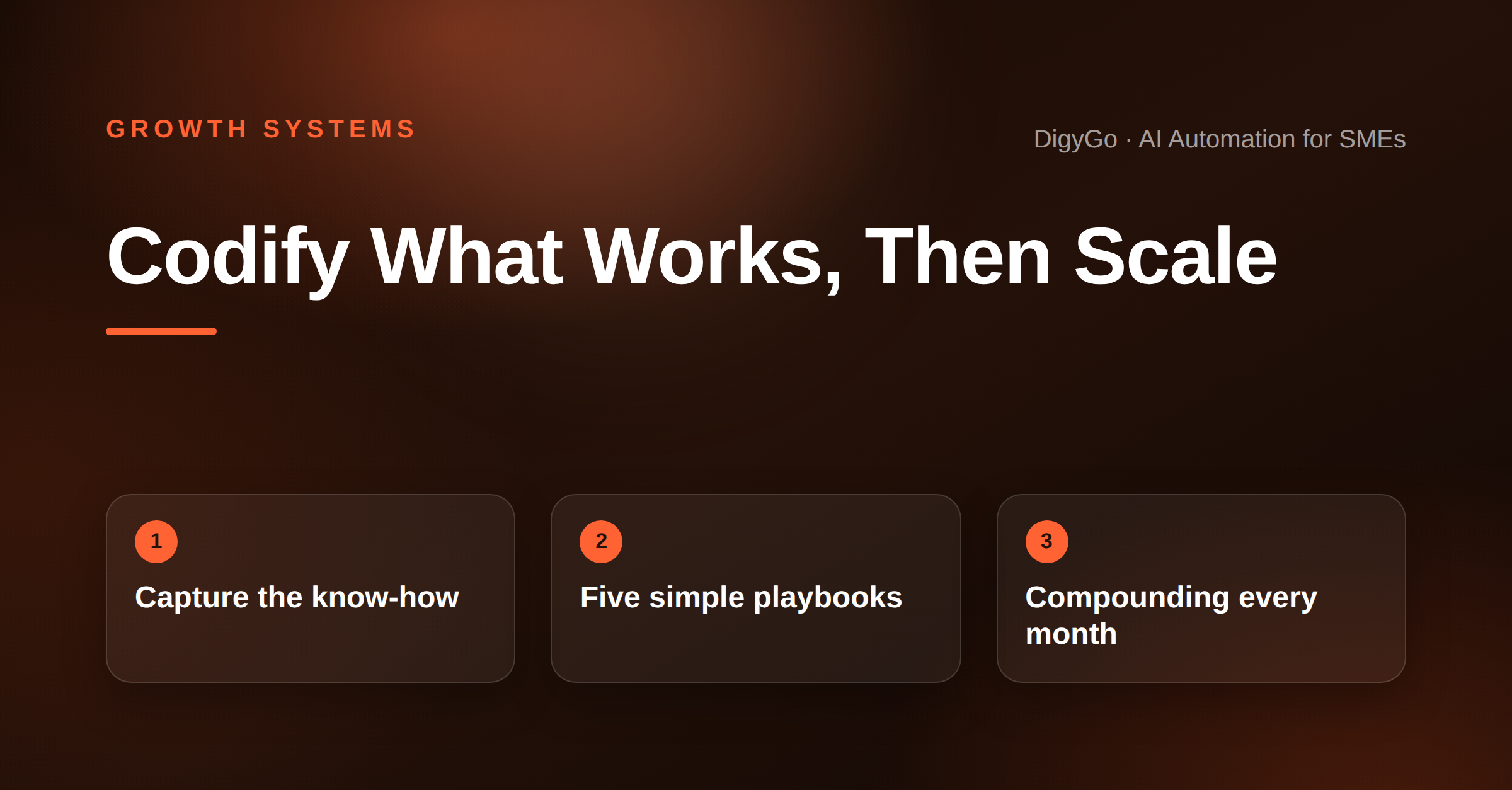
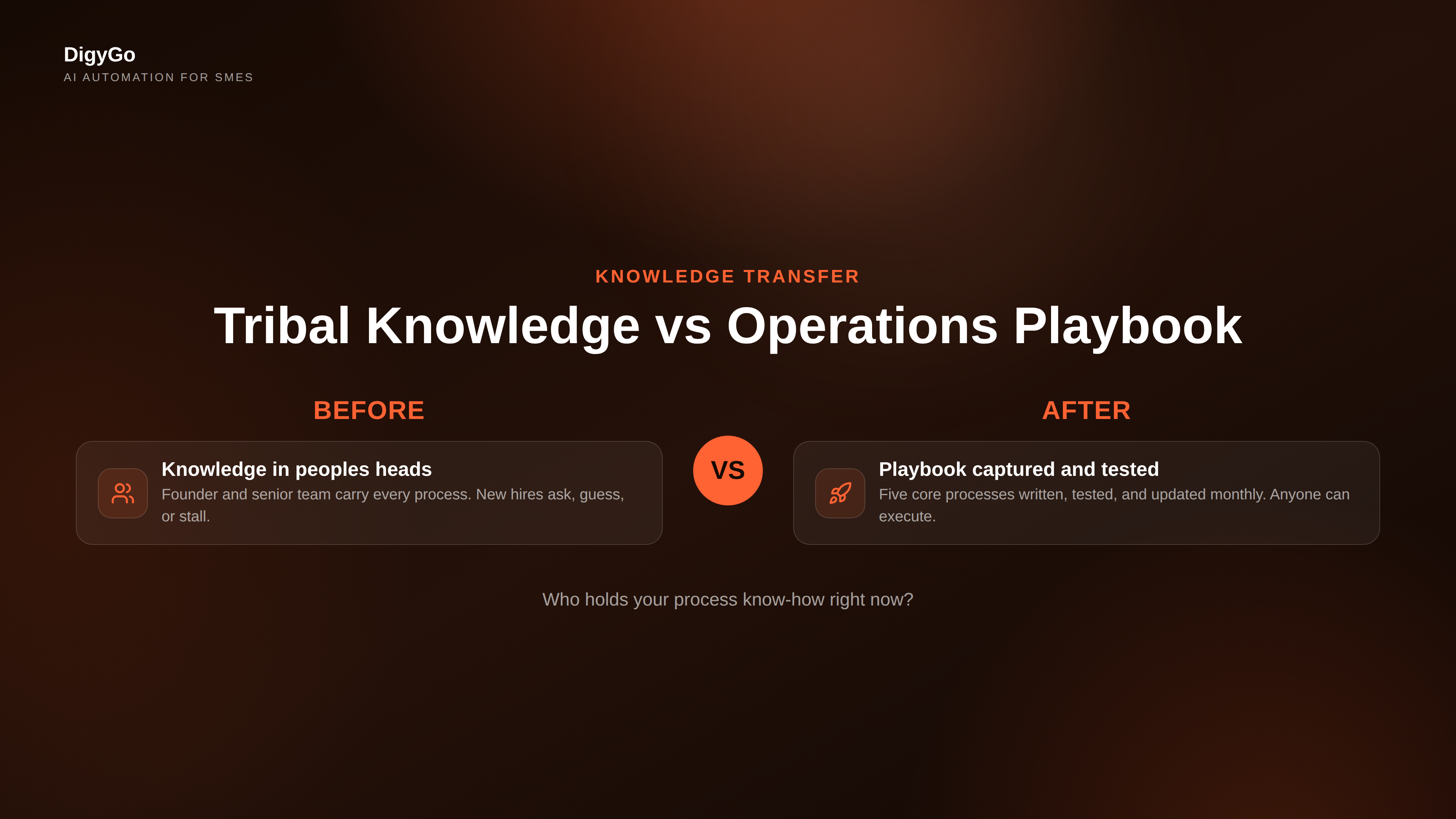
Growth stalls in most SMEs not because the work stops, but because the know-how lives in one person's head. An operations playbook captures the repeatable part of your business, so every process runs the same way, new people can execute quickly, and growth compounds instead of depending on whoever is available that week.
A practical Growth Systems guide for SME founders on building an operations playbook that captures tribal knowledge, standardises five core processes, and creates repeatable systems that compound growth without depending on any single person.
- An operations playbook turns tribal knowledge into a repeatable system anyone can run.
- You only need five core playbooks: leads, quoting, delivery, follow-up, and retention.
- Test each playbook with a new team member before you trust it.
- Review the playbook monthly so it keeps improving instead of gathering dust.
Why Most SME Growth Depends on One Person
Walk into most small businesses and the pattern repeats. The founder knows how quotes are priced, the senior technician knows how jobs are delivered, and the one experienced salesperson knows how follow-up actually happens. Everyone else operates on guesswork, asking questions each time and slowing the whole flow down.
That arrangement works fine at ten enquiries a month. It breaks at thirty. When volume grows, every decision funnels back to the same two or three people, they become the bottleneck, quality gets inconsistent, and customers feel it. The business grows revenue but not capacity, and the founder ends up more exhausted than when it was smaller.
This is exactly why repeatable systems matter more than new tactics. A growth system is not a clever campaign or a new tool. It is a documented, owned, repeatable way of doing the work that makes more revenue possible without more heroics.
What an Operations Playbook Actually Is
An operations playbook is a short, written version of how your business does its core jobs. It is not a 40-page manual and it is not a dusty policy document. It is one page per process, written in plain language, that tells any team member exactly what to do, in what order, and what a finished result looks like.
The difference between a playbook and a typical SOP is that a playbook gets tested and used. You write it, run it with a real job, fix the parts that fail, and only then hand it to someone else. It is a living tool, not an archive.
The Five Playbooks That Cover Most of Your Business
You do not need a playbook for everything. Start with the five jobs that touch every customer and every rupee of revenue. Once these are documented, the rest of the business becomes easier to add on top.
- Lead response: how enquiries are acknowledged, qualified, and routed, with the exact response window.
- Quoting: how quotes are priced, what questions are asked first, and how the quote is sent and followed up.
- Delivery: how a job moves from confirmed to completed, including checkpoints and who checks quality.
- Follow-up: how customers are contacted after delivery, when, and what the next offer is.
- Retention: how repeat customers are spotted, contacted, and kept in the pipeline.
Write these five and you have captured the full customer journey. Every other process, from admin to accounting, can wait until these are solid.
How to Build Your First Playbook in Five Steps
Building a playbook does not require a big project or a consultant. It requires watching one real run of the job and writing down what actually happens. Here is the sequence that works.
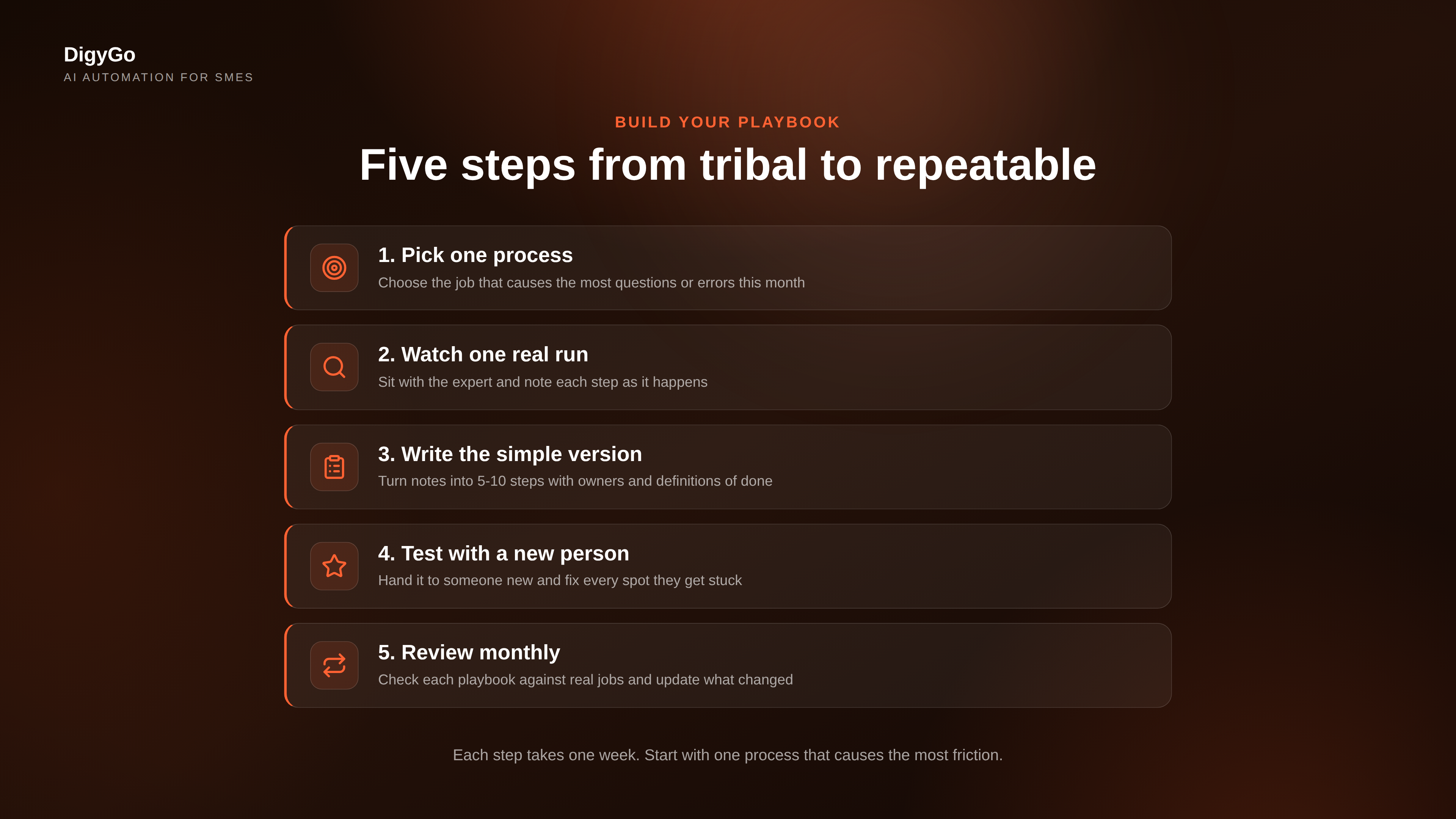
- Pick one repeatable job. Choose the process that causes the most questions or the most errors this month.
- Watch one real run. Sit with the person who does it best and note each step as it happens. Do not interrupt; just capture the sequence.
- Write the simple version. Turn the notes into 5 to 10 clear steps with one owner per step and a definition of done.
- Test it with a new person. Hand the playbook to someone who has never done the job. Wherever they stop and ask, that step is missing detail. Fix it.
- Review it monthly. Once a month, check each playbook against real jobs and update what changed.
The testing step is the one most SMEs skip, and it is the one that separates a playbook from a wish. If a new person can complete the job using only the document, the system works. If they cannot, you have found exactly where the knowledge was still tribal.
How a Playbook Compounds Growth
Once your five playbooks are working, three things change at once. First, the founder and senior team stop being the bottleneck, because anyone can run the process to the same standard. Second, new hires become productive in days instead of months, because the training is already written. Third, quality becomes consistent, which means fewer complaints, better reviews, and more repeat customers.
That is the compounding part. Every improvement you make to a playbook improves every future job that runs through it. Fix the quoting process once and every quote from now on benefits. Document the follow-up sequence once and every customer from now on gets the same reliable experience. Small, one-time fixes turn into permanent gains, which is exactly how growth systems compound.
This is also where automation fits naturally. A documented process is the cleanest starting point for AI and workflow tools, because you already know the steps, the owners, and the handoffs. The playbook becomes the blueprint, and the automation simply runs the blueprint on time, every time.
Pick the one process that wastes the most time this week. Watch one real run, write five steps, and test it with someone new. One playbook, done properly, is worth more than ten half-written plans.
Keeping the Playbook Alive
A playbook is only as good as its last update. Businesses change: new offers, new channels, new team members, new problems. If the document stops matching reality, people stop using it and the knowledge drifts back into heads.
Add a simple monthly ritual. In the same review where you check leads and revenue, spend ten minutes on playbooks. Ask three questions: which step caused the most confusion this month, which job produced the most errors, and what changed in how we work. Update the affected playbook immediately, while the context is fresh. That ten-minute habit keeps the system honest and compounding.
Frequently Asked Questions
How long should an operations playbook be?
One page per process, ideally. Five to ten steps, one owner per step, and a clear definition of done. If a playbook runs past a page, split the process into two playbooks.
What if we are too small for this?
Smaller is better. A two-person team still benefits from writing down how leads are handled and jobs delivered, because the moment you hire anyone, the knowledge needs to transfer anyway.
Do playbooks replace training or automation?
No. Playbooks make training faster and automation possible. They are the foundation; training and tools build on top of them.
Who should own the playbooks?
One person should own the monthly review, usually the founder or a project manager. Each individual playbook can have a different owner who knows that process best.
How is this different from a CRM or a tool?
A tool stores data and automates steps. A playbook captures the judgement and sequence that makes the process work. Most SMEs need the playbook first, because automating a messy process just automates the mess.
Ready to turn your tribal knowledge into a system that compounds? Talk to DigyGo about documenting and automating your growth processes.